
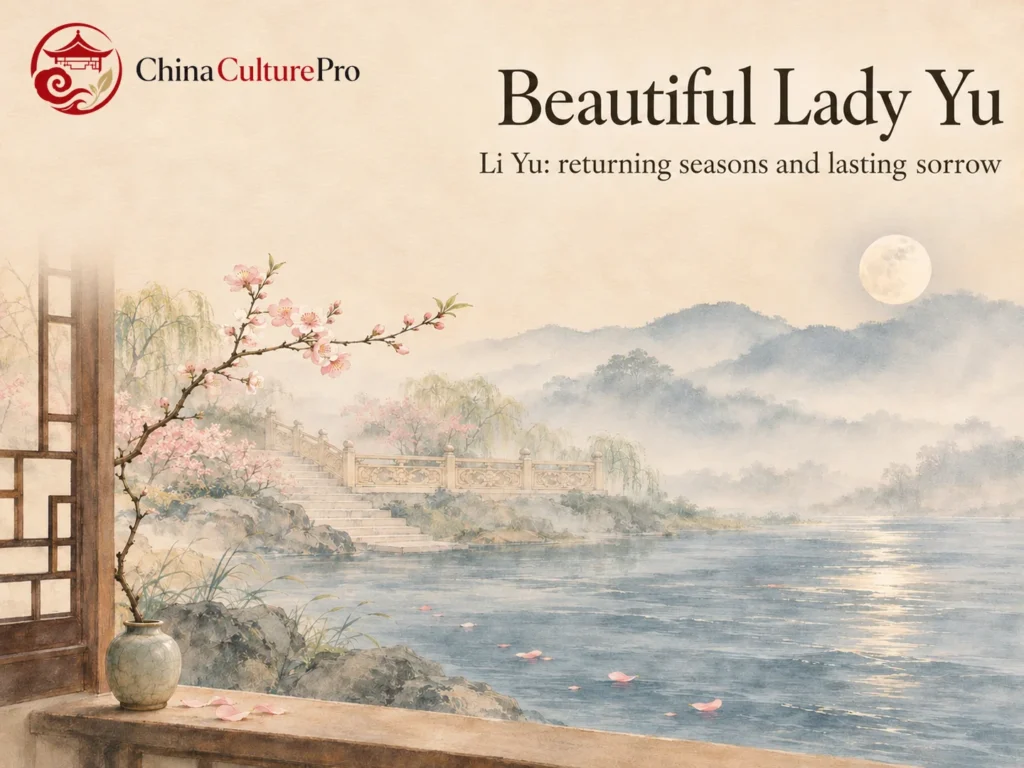

Quick Answer: What Is Li Yu’s Beautiful Lady Yu About?
Beautiful Lady Yu (虞美人, Yú Měi Rén) by Li Yu (李煜, Lǐ Yù) turns recurring flowers, moonlight and spring wind into reminders of a lost homeland. The closing comparison gives sorrow the scale and continuous movement of a river flowing east.
- Understand the title: It names a lyric pattern rather than the woman described in this particular text.
- Keep the palace at a distance: The speaker imagines its survival while remembering changed human lives.
- Read the ending as an answer: A question about the amount of sorrow receives an image of flowing water.
The familiar story that this lyric brought about the poet’s death belongs to a disputed historical tradition, not an established explanation supplied by the poem.

Beautiful things usually invite a wish that they would last. This lyric begins by asking when they will end. That reversal draws the reader into a life in which seasonal renewal brings pain because the past cannot return with it.
Read the Lyric and Understand Its Tune Title
This is a ci lyric (词, Cí), written to a tune pattern, or cipai (词牌, Cí Pái), called Beautiful Lady Yu. The pattern name does not require the text to tell a story about a woman of that name. [3]
Li Yu was the last ruler of Southern Tang (南唐, Nán Táng). After its fall in 975, he was taken to Kaifeng (开封, Kāi Fēng). That loss gives the lyric’s “former country” a historical center. [2]
Here is the complete text with an original, unrhymed English rendering. The lines vary in length, unlike a poem made entirely of five- or seven-character lines.
| Chinese text | Plain English rendering |
|---|---|
| 春花秋月何时了,往事知多少。 | When will spring’s flowers and autumn’s moon end? How many things belong to the past! [1] |
| 小楼昨夜又东风,故国不堪回首月明中。 | Last night the east wind returned to the little tower; in the moonlight, I cannot bear to look back toward my former country. [1] |
| 雕栏玉砌应犹在,只是朱颜改。 | The carved railings and jade-like steps must still remain; only the rosy faces have changed. [1] |
| 问君能有几多愁,恰似一江春水向东流。 | Ask how much sorrow there can be: it is like a whole river of spring water running east. [1] |
The ci poetry guide explains tune patterns more broadly. For the state’s setting, see the Five Dynasties and Ten Kingdoms guide.
Follow Returning Seasons into the Remembered Palace
The flowers and moon place beauty inside a cycle: spring arrives, autumn follows, and another year can begin. The speaker’s opening question makes that recurrence difficult to endure. What returns in nature summons what cannot be recovered in life. [1]
The word “again” sharpens that pressure when the east wind returns. A small present dwelling is set against the former country held in memory. The verse does not require the speaker to see its palace across the intervening distance. [1]
The palace line is a supposition: its railings and steps “must still” be there. The human contrast is broader than the aging of one unnamed beautiful woman. “Rosy faces” can include the people of the palace world or the speaker himself, whose circumstances have changed. [2]
Read the contrast as a relation between apparent endurance and human alteration. It does not certify the condition of a surviving building, and it does not tell us which individual face to picture. The uncertain distance is part of the grief: the speaker must imagine a world from which he has been removed.
Other Chinese moon poems give shared moonlight different emotional tasks. Here its brightness makes recollection harder to bear.
Read the River of Sorrow without Turning Legend into Fact
The last question asks about quantity, but the answer refuses a number. Spring water supplies breadth, fullness and movement. Sorrow becomes something the reader can imagine continuing beyond the end of the line. [1]
The river also changes the poem’s motion. Earlier seasonal images recur; the final current goes onward. The text brings cyclical time and irreversible loss together without resolving their tension into comfort.
A later story links the lyric with Li Yu’s poisoning. Historical research finds divergent accounts: the earliest surviving epitaph describes illness, while the poisoning narrative appears in later records. The claim that this particular lyric certainly caused his death goes beyond secure evidence. [4]
That distinction matters for reading. The poem’s intensity does not depend on turning it into a verified last statement. Its remembered country, imagined palace and river comparison already make the loss intelligible.
FAQs About Beautiful Lady Yu
Does Beautiful Lady Yu describe a woman called Yu?
Here the name identifies the lyric’s tune pattern. The text concerns memory, a former country and sorrow rather than narrating that woman’s life.
Whose faces have changed in the palace lines?
The phrase can include people of the remembered palace world or the speaker himself. The lyric does not identify one particular woman.
Was Li Yu certainly killed because of this lyric?
That causal story is not securely established. Historical accounts of his death differ, and the poisoning tradition appears later than the earliest account of illness.
Sources
[1] Li Yu, via Wikisource. Lyrics of the Two Rulers of Southern Tang: Beautiful Lady Yu
[2] Education Bureau, Hong Kong. Classical Poetry Reading Selection 44: Beautiful Lady Yu
[3] Ministry of Education, Taiwan. Revised Mandarin Chinese Dictionary: Yu Mei Ren
[4] Fang Cheng-hua, National Taiwan University. The Formation of a Tragic Story: The Death of Li Yu and Related Legends