


Quick Answer: What Is Autumn by Ba Jin About?
*Autumn* (秋, Qiū) is the third novel of Ba Jin’s (巴金, Bā Jīn) *Torrent Trilogy* (激流三部曲, Jīliú Sānbùqǔ), first published in 1940. It follows the Gao household as disputes over marriage, money and family authority lead its branches toward a split.[1][2][4]
- The setting: The Gaos are an extended family in Chengdu during the early Republican era.
- The conflict: Younger relatives try to decide their own futures while older relatives use family duty to justify decisions on their behalf.
- The reading order: *Family* and *Spring* establish the relationships that reach a breaking point in *Autumn*.
Watch who can choose where to live and whom to marry. The answers change by the end.[1][3]
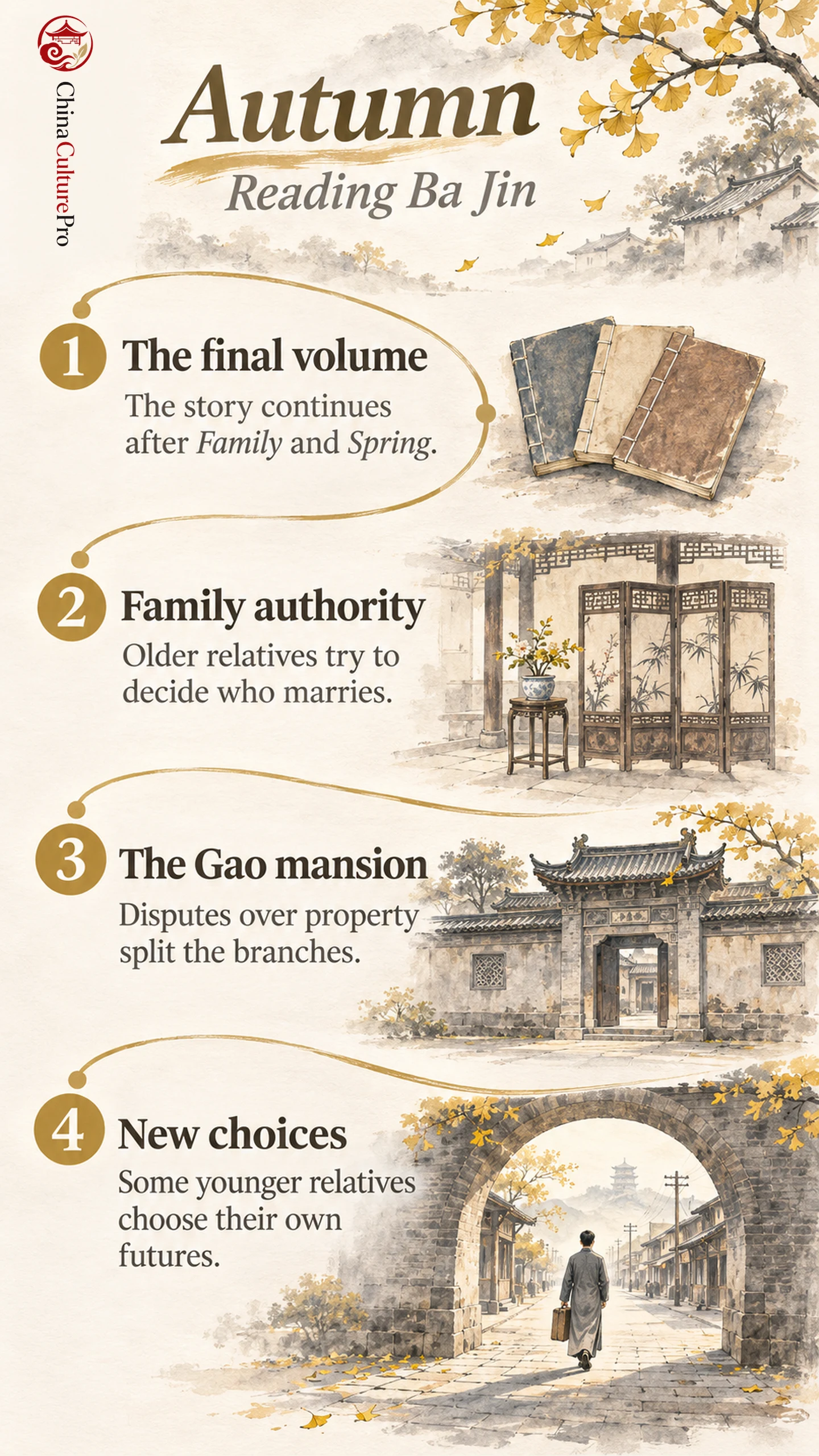
The Gao mansion can still look like the center of a powerful family after its residents have stopped agreeing on what they owe one another. *Autumn* follows the widening gap.
Where Autumn Fits in the Torrent Trilogy
Ba Jin began the sequence with Family, where Grandpa Gao’s authority shapes the lives of his grandsons and the women around them. Spring follows the consequences for a wider group of young relatives. *Autumn* is the continuation of that second book. It follows the consequences as the household loses its ability to make decisions for all its members.[1][2][4]
Gao Juexin (高觉新, Gāo Juéxīn) helps keep the three novels together. He understands some of the harms done to his generation. As the eldest son of the eldest branch, he also accepts obligations that help preserve the authority he has suffered under. When relatives ask him to step in, both parts of his position matter.[1][3]
The Characters to Follow in Autumn
The similar names can be hard to place at first. The table starts with each person’s relation to the main conflict.[1][3]
| Character | What to watch |
|---|---|
| Gao Juexin | The elder of the three brothers tries to preserve family ties while facing requests for help he cannot always fulfill. |
| Gao Juemin (高觉民, Gāo Juémín) | Juexin’s younger brother presses for more freedom, including in his relationship with Qin. |
| Zhou Mei (周枚, Zhōu Méi) | A young relative on the Zhou side is subject to his father’s authority over marriage. His fate tests what Juexin can do for someone else. |
| Gao Keming (高克明, Gāo Kèmíng) | An uncle who tries to maintain the household’s standing as its own branches pull it apart. |
Pay special attention to the two characters named Mei in romanization. The young man here is written 枚. The woman remembered from the first novel is written 梅. Their lives touch different parts of the family story.[1][3]
What Happens to the Gao Household?
Zhou Mei’s story shows how decisions reach beyond the Gao mansion. His father insists on the right to arrange his future. Juexin has reasons to protect him and far less power than an older relative who claims the last word. Affection and obligation pull in different directions, as they did when Juexin was younger.[3]
At the same time, disputes inside the Gao family turn toward money and control of the house. Some branches want to divide what they can obtain from the estate. Keming tries to keep the family together, but kinship has ceased to provide a sufficient reason for everyone to accept the same arrangement. The story brings disputes about property close to disputes about marriage. In each, the issue is which relatives can set terms for the others.[3]
What the Sale of the House Means
This section reveals the ending. The Gao mansion is sold and the family breaks up as a single household. Juemin and Qin have a wedding of their choosing and prepare for work elsewhere. Juexin marries Cuihuan, who has served in the household. The choices come out of different lives, and their significance depends on how little room these characters once had to make them.[3]
The seasonal title gives that ending a shape. Much that once gave the Gaos status passes out of their hands. Some people are now free to leave, while earlier losses remain. The title can hold both changes. Su Tong’s Raise the Red Lantern offers another way to read a household through who can occupy its rooms and who can leave.
The wedding ode Tao Yao imagines a bride joining a household that will flourish. Ba Jin’s ending gives that old association between marriage and household a different shape as the Gaos’ mansion is sold.
FAQs About Autumn by Ba Jin
Should I read Family and Spring before Autumn?
Yes, if you want the full story. *Autumn* begins with relationships formed in the earlier books. You can follow the breakdown of the household on its own, but the cost of Juexin’s loyalties is easier to see after the first two novels.[1][2]
Is Autumn set in 1940?
1940 is the year the novel first appeared. Its story continues the early Republican-era family narrative that begins in Chengdu in *Family*.[1][4]
Sources
[1] Academy of Chinese Studies. Ba Jin and the Torrent Trilogy
[2] CiNii Books. Autumn, People’s Literature Publishing House edition
[3] Douban Books. People’s Literature Publishing House edition of Autumn and synopsis
[4] Taylor & Francis Online. Ba Jin as Anarchist Critic of Marxism