

Quick Answer: What Is Six Records of a Floating Life About?
*Six Records of a Floating Life* (浮生六记, Fúshēng Liù Jì) is a Qing dynasty memoir by Shen Fu (沈复, Shěn Fù). It recalls his marriage to Chen Yun (陈芸, Chén Yún), their shared pleasures and hardships, and some of his travels. Four records survive as part of the standard text.[1][2][3]
- Marriage: Shen Fu remembers conversations, jokes and pastimes he shared with Yun.
- Hardship: Family conflict and a lack of money change where the couple can live.
- Structure: Each record has its own theme. Their stories overlap in time.[1][2]
Each record makes a different part of the same life visible.

A scene of arranging rocks and plants can tell you as much about the marriage as a scene about the family’s finances.
What the Four Surviving Records Cover
English chapter titles vary by translation. The Chinese titles let you find the same sections across editions.[2][3][4]
| Record | What it follows |
|---|---|
| Wedded Bliss (闺房记乐, Guīfáng Jì Lè) | Married life with Yun, including evenings of drinking, poetry and conversation. |
| The Little Pleasures of Life (闲情记趣, Xiánqíng Jì Qù) | Flowers, plants, incense and ways to make a small space worth looking at. |
| Sorrow (坎坷记愁, Kǎnkě Jì Chóu) | Family disputes, moves under financial pressure and Yun’s illness and death. |
| The Joys of Travel (浪游记快, Làngyóu Jì Kuài) | Journeys Shen Fu recalls through landscapes, roads and places he visited. |
The first and third records can leave very different impressions of the same years. Early intimacies matter to the way Shen Fu later remembers trouble, and his knowledge of the trouble shapes what he recalls from the happier times.[1][2]
How Chen Yun Shapes the Memoir
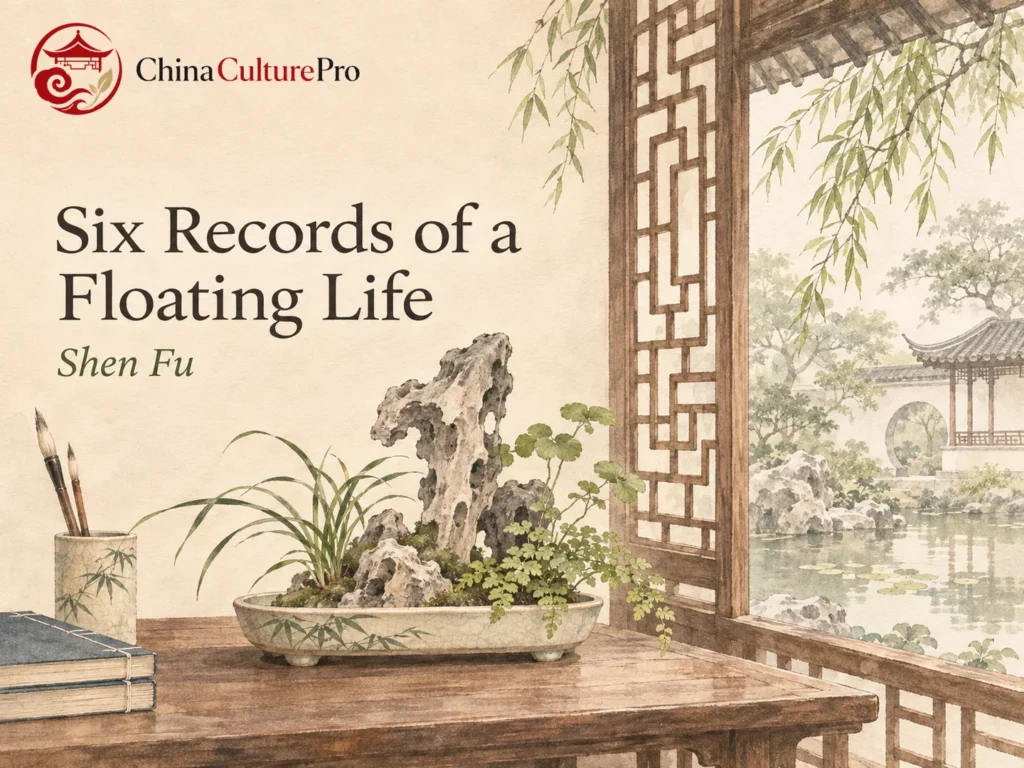
In the leisure record, Shen Fu and Yun discuss how to arrange rocks and plants in a shallow tray. They look at the finished scene together and imagine where a pavilion might stand, where they would fish and where a visitor might pause to look. A tray small enough to set under the eaves turns into a place they can picture moving through together.[5]
Yun has opinions and proposes details of her own. Shen Fu’s account gives you her through his memory, with choices about which conversations he wants a reader to hear. The tray also shows what he can still share with the reader after losing the person with whom he first shared it.[1][2][5]
In the first record, Yun sets out drinks and hopes the clouds will clear so they can see the moon. She and Shen Fu make up lines together. The laughter comes before the moon appears. Shen Fu tells the story from a time when the promise he and Yun saw in that night has acquired a more painful meaning.[8]
Why the Title Says Six
An early printed text preserves four records. The fifth is associated with a visit to the Ryukyu Kingdom, and the sixth with ways of living or cultivating health. The names remain part of the book’s history. The received text gives a full reading of the first four records.[1][3]
Later texts presented as both missing records were rejected as forgeries. A Ryukyu account found in a separate manuscript was later included in some editions as possible material for the fifth record. That development is distinct from recovering two complete chapters.[3]
Which English Translation to Read
Penguin Classics publishes Leonard Pratt and Chiang Su-hui’s *Six Records of a Floating Life*. Graham Sanders’s *Six Records of a Life Adrift* is a separate translation with an introduction and notes. Lin Yutang’s version appears as *Six Chapters of a Floating Life* in older catalogs. It began appearing in a periodical in 1935. A Chinese-English book edition followed in 1939.[4][6][7][9]
When you compare editions, start with the same record. The wedding chapter is a good place to hear how differently translators handle a change from conversation to recollection. For another book that brings journeys together with changing states of mind, read Gao Xingjian’s Soul Mountain, a modern novel with a much freer arrangement of narrative voices.
FAQs About Six Records of a Floating Life
Is Six Records of a Floating Life a novel?
It is an autobiographical work in classical Chinese. It includes domestic recollection, travel writing and observations on the pleasures of everyday life.[1][2]
When did Shen Fu write the memoir?
The work dates to the early nineteenth century. The Chinese publication history describes a later nineteenth-century printing of the four surviving records.[3][4]
Sources
[1] Graham Sanders. Six Records of a Life Adrift, a Qing memoir
[2] Southeast University Library. Six Records of a Floating Life and its contents
[3] Ping Guji. Six Records of a Floating Life, edition history and contents
[4] Penguin Classics. Six Records of a Floating Life, Pratt and Chiang translation
[5] Shen Fu. The Little Pleasures of Life, Chinese text
[6] Hackett Publishing. Six Records of a Life Adrift, Sanders translation
[7] CiNii Books. Six Chapters of a Floating Life, Lin Yutang translation
[8] Shen Fu. Wedded Bliss, Chinese text
[9] Nankai University Library. Periodical record of Lin Yutang’s 1935 translation