

Quick Answer: What Is The White-Haired Witch About?
The White-Haired Witch (白发魔女传, Báifà Mónǚ Zhuàn) is a martial-arts novel by Liang Yusheng (梁羽生, Liáng Yǔshēng), serialized in Hong Kong in 1957–58.[1] The swordswoman Lian Nichang (练霓裳, Liàn Nícháng) and the Wudang (武当, Wǔdāng) swordsman Zhuo Yihang (卓一航, Zhuó Yīháng) fall in love, but his school sees her as an outsider and opposes the relationship.
- Setting: The action unfolds during the late Ming, where court trouble and rival martial loyalties shape the lovers’ choices.[2]
- Title image: Lian discovers her hair has turned white after the confrontation at Wudang.[3]
- Screen versions: The 1993 film The Bride with White Hair and the 2014 The White Haired Witch of Lunar Kingdom are separate adaptations.[5][6]
This guide discusses the confrontation and the white hair in Chapter 26. It leaves the novel’s final resolution for the reader.

Liang gives Lian Nichang the ability to fight her way up a mountain. Getting a private conversation at the top is more difficult. The difference between those two things makes the Wudang episode a useful place to understand how the novel treats reputation and allegiance.
Why Lian Nichang and Zhuo Yihang Face a Choice
Lian is also known as Jade Rakshasa (玉罗刹, Yù Luóchà). To Master Baishi (白石道人, Báishí Dàorén), one of Wudang’s elders, the school’s standing depends in part on whom its leader marries. Chapter 26 opens with elders discussing whether Zhuo can lead the school while remaining attached to her.[3]
That conversation tells you what Lian is walking into. She comes asking to see Zhuo. The elders challenge her right to arrive armed, then deny her the reception she argues is due a visiting fighter.[3]
Their argument over the sword is also an argument over who can invoke the martial world’s rules. To Lian, a visitor should have a chance to make her request. For Wudang’s elders, the name they use for her is sufficient reason to refuse. Zhuo’s position makes a private decision a matter for other people to judge.
The court intrigues in earlier chapters place a second set of loyalties alongside those of the schools. For historical orientation, the Ming dynasty guide gives a broader view of the period. Within the novel, the court and Wudang are different settings in which a decision can put someone’s standing with allies at risk.[2]
What the White Hair Means in the Novel
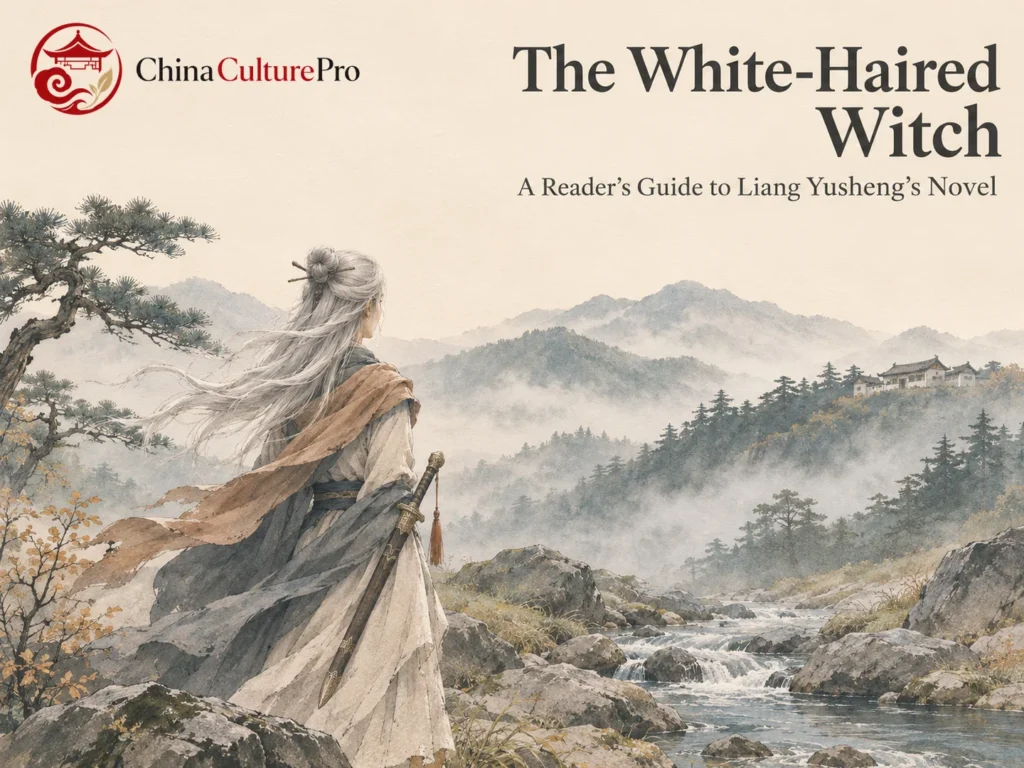
After the clash at Wudang, Lian wakes beside a mountain stream. In the water she sees a white-haired woman and struggles to recognize the face as her own. The change happens overnight within the story.[3]
Consider how little the discovery has in common with the fight that precedes it. On the mountain, opponents read her ability from the movement of her sword. Beside the stream, she has to read a change in herself. The image makes the cost of the confrontation visible before anyone else can tell her what it means.
Later in the same chapter, Lian’s white hair gives her friends a fright. They call out to her once they recognize her, but she leaves.[3]
The shift from the elders’ hostile words to the voices of friends separates the reputation carried by a nickname from the particular person who has to live with it.
Which Chinese Edition and Related Novels to Read
Search for 白发魔女传 or 白髮魔女傳 alongside 梁羽生. One cataloged Chinese edition was published in 1996 by Guangdong Tourism Publishing House and Huacheng Publishing House. It comprises two volumes, and the catalog lists ISBN 7805216452.[4]
The online Chinese contents index runs to Chapter 32.[2]
You can start here without another novel. Liang’s The Seven Swords of Mount Heaven (七剑下天山, Qī Jiàn Xià Tiānshān) takes place later in the story world, even though its newspaper serialization preceded the publication of The White-Haired Witch.[1][2]
Readers exploring other sides of Chinese wuxia can choose a comparison by interest. For another martial story set against the end of the Ming, try Jin Yong’s Sword Stained With Royal Blood. His Flying Fox of Snowy Mountain gives conflicting accounts a larger role in how a reputation takes shape.
For a sharper change in narrative style, Gu Long’s Sentimental Swordsman, Ruthless Sword offers another relationship between a fearsome reputation and private attachments. The Legend of Shushan Swordsmen offers more sustained supernatural swordplay for readers who came through the films’ fantasy elements.
How the Films Change the Story
Ronny Yu’s The Bride with White Hair (1993) stars Brigitte Lin and Leslie Cheung. It makes Lian the adopted daughter of a rival cult’s leader, giving the romance a different factional setup from the novel’s Wudang episode.[5]
Jacob Cheung’s The White Haired Witch of Lunar Kingdom (2014) stars Fan Bingbing and Huang Xiaoming. It builds a plot around the Jade Rakshasa being framed for a governor’s murder. An earlier Hong Kong adaptation from 1959 starred Law Yim-hing and Cheung Ying.[6][7]
If you saw one of the films first, look at what happens when Lian asks to see Zhuo in Chapter 26. Listen for who claims the right to refuse her request and what rule Lian cites in return.
FAQs About The White-Haired Witch
Is The White-Haired Witch a novel or a film?
Liang Yusheng’s work is a novel. The shared Chinese title and related English titles also identify several screen adaptations. Use the author for the novel and the director or year to identify a film.[2][5][6]
Do you need to read The Seven Swords of Mount Heaven first?
You can begin with The White-Haired Witch. It works as a self-contained entry and takes place earlier in the connected fictional chronology.[2]
Is the White-Haired Witch a supernatural creature in the novel?
Lian Nichang is a human swordswoman. Her name and overnight transformation have a legendary quality. Chapter 26 shows her discovering the change in a mountain stream’s reflection.[3]
Sources
[1] Ta Kung Pao. Remembering Liang Yusheng’s Newspaper Work
[2] Bailu Academy Library. The White-Haired Witch, Chinese Table of Contents
[3] Bailu Academy Library. The White-Haired Witch, Chapter 26
[4] CiNii Books. The White-Haired Witch, 1996 Chinese Edition
[5] Eureka Entertainment. The Bride With White Hair, 1993
[6] BFI London Film Festival. The White Haired Witch of Lunar Kingdom, 2014
[7] Hong Kong Film Archive. The White-Haired Witch, 1959