
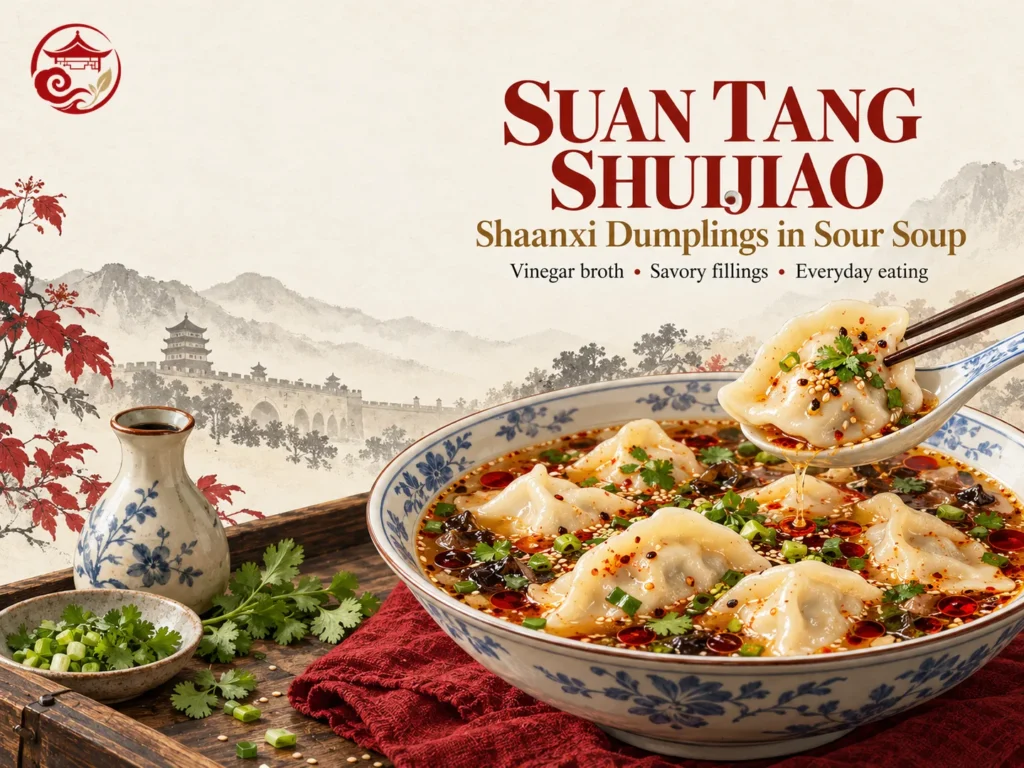

Quick Answer: What Is Suan Tang Shuijiao?
Suan Tang Shuijiao (酸汤水饺, suāntāng shuǐjiǎo) is a Shaanxi dish, especially associated with Xi’an, featuring boiled dumplings in vinegar-seasoned soup.[1][2]
- Dumplings: Sealed wheat wrappers hold a savory filling.
- Sour soup: Vinegar supplies the defining acidity; chili oil can add heat and aroma.
- Serving: The dumplings sit in soup poured into the bowl, with herbs and other seasonings varying by preparation.
The dish belongs to the wider Chinese dumpling family. Lamb versions have a place in local halal restaurant traditions, but the name alone specifies neither the filling nor the restaurant’s dietary standards.[2]
Boiled dumplings can arrive beside a vinegar dipping dish, but Shaanxi has another way to serve them: immersed in a bowl of sour, aromatic soup. This guide explains the broth, filling choices and ordering details that distinguish the dish from dumplings with soup sealed inside.
What Gives the Sour Soup Its Flavor?
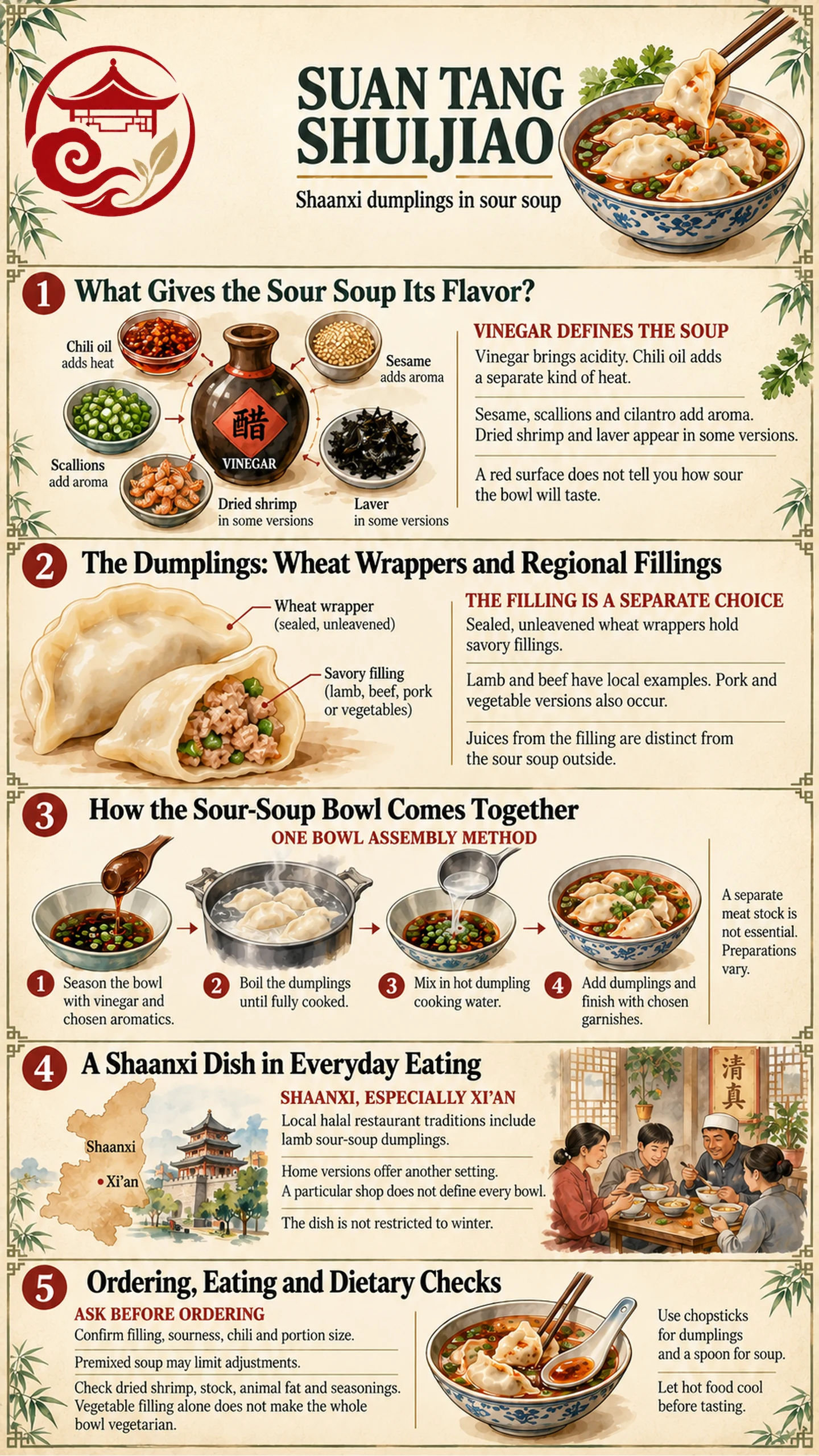
Vinegar gives the soup its sharp, fragrant character. Chinese black vinegar is one familiar choice, rather than a compulsory single variety. Some preparations use vinegar simmered with spices such as star anise and cassia, then strained before serving. Others build the bowl directly with vinegar and separate aromatics.[3][4]
Sourness and chili heat are separate qualities. A red surface often signals chili oil, but its appearance cannot tell you exactly how sour or spicy the bowl will taste. The following groups explain the ingredients you may encounter; they are not a mandatory shopping list.
| Ingredient or group | What it contributes | What varies |
|---|---|---|
| Vinegar | The soup’s defining acidity and vinegar aroma | Plain or spiced vinegar; strength and variety differ |
| Chili oil | Chili flavor, heat and reddish oil on the surface | Can be omitted when added separately; some bases are already mixed |
| Sesame seeds and sesame oil | Toasted seeds add small bites of texture; oil adds sesame aroma | Either or both may appear; they are different ingredients |
| Papery dried shrimp and laver | Savory seafood notes and, with laver, soft seaweed pieces | Optional additions in some home versions; dried shrimp is an animal ingredient |
| Scallions and cilantro | Fresh onion and herbal aromas | Choice, amount and timing differ between preparations |
Soy sauce, salt or other seasonings can round out the bowl. The combination reflects the cook’s version, including whether dried shrimp, laver or both are used.[4][5]
Here, the sour flavor is supplied by vinegar, rather than a fermented-vegetable soup base. Vinegar itself is a fermented product; the distinction is where the bowl gets its acidity.
The Dumplings: Wheat Wrappers and Regional Fillings
The dumplings are jiaozi (饺子, jiǎozi): filling enclosed in an unleavened wheat wrapper and boiled before serving. Their skins provide a firmer, chewier contrast to the liquid around them. A half-moon shape is familiar, but a particular number of pleats does not define this dish.
Lamb is documented in Xi’an’s halal restaurant tradition. Beef is another established choice: one Shaanxi family version pairs it with Chinese chives, while another home preparation uses carrot and onion. These are examples of different fillings, rather than a single formula every shop follows.[2][3][6]
The sour-soup format can also accommodate pork or vegetable dumplings. The soup does not reveal what is inside each wrapper, so the filling deserves its own menu check. The dumpling fillings guide explains the broader combinations.
Keep the filling’s moisture separate from the surrounding soup. A cooked meat filling may release juices within the wrapper, while the vinegar broth is assembled outside it. A juicy bite therefore does not mean the dumpling was made by enclosing a portion of sour soup. Prolonged soaking can also soften the wrapper, so its texture changes as the bowl sits.
How the Sour-Soup Bowl Comes Together
One demonstrated approach builds the soup in the serving bowl while the dumplings cook. The broad stages are straightforward:[4]
- Prepare the seasoning bowl: Put vinegar and the chosen seasonings, oil and aromatics into a serving bowl. Any spiced vinegar can be prepared beforehand.
- Cook the dumplings: Boil the filled dumplings until the wrapper and filling are fully cooked. Requirements depend on the dumplings; packaged products have their own instructions.
- Form the external soup: Add hot dumpling cooking water to the seasoning bowl and mix. This supplies the liquid without requiring a separate meat stock.
- Combine and finish: Transfer the cooked dumplings into the soup, adding any remaining herbs, sesame or other chosen garnishes before serving.
This is an assembly pattern, not a complete dumpling recipe. Other cooks combine the cooked dumplings and cooking liquid in a different order.[6] The relevant cooking methods are boiling the dumplings and mixing their external soup; neither requires sealing broth inside the wrappers.
A Shaanxi Dish in Everyday Eating
Suan Tang Shuijiao belongs to Shaanxi’s regional dumpling repertoire. Xi’an provides a concrete local setting: records of a longstanding halal restaurant tradition describe handmade lamb dumplings served in sour soup.[1][2] That is one strand of the dish’s local identity, rather than evidence that every bowl follows halal rules.
Home versions show another setting. A Shaanxi-style beef preparation can become a family meal, with the filling and seasoning adjusted by the cook.[3][6] Restaurant servings and household bowls need not look identical to share the same basic sour-soup idea.
It can serve as lunch, dinner or a late meal, and has no defining winter-only rule. A particular shop’s garnish, serving size or filling is best understood as that shop’s version, rather than a standard for the whole province.
Ordering, Eating and Dietary Checks
Check the dumplings and the soup separately before ordering. A vegetable filling does not resolve what is in the surrounding liquid, and a beef or lamb filling does not establish halal preparation.
- Filling: Ask which meat or vegetables are used, including any mixed ingredients. The dish name alone does not specify lamb, beef, pork or a meat-free filling.
- Sourness and heat: Request less chili or no chili oil if that is your preference, and discuss vinegar separately. A kitchen using a premixed base may have limited room to adjust either.
- Portion: Confirm whether the price refers to a number of dumplings, a serving or another measure. Do not assume that every shop’s bowl contains the same quantity.
- Dietary needs: Check dried shrimp, animal fat, stock and seasoning powders as well as the filling. Wheat wrappers, sesame, soy-based seasonings and shrimp are relevant ingredients to disclose when discussing allergies.
Use chopsticks for the dumplings and a spoon for the soup; let hot food cool before tasting. You can sip as much broth as you enjoy without having to finish the bowl.
For more detailed questions, see Chinese vegetarian food and the guide to Chinese food names.
FAQs About Suan Tang Shuijiao
Is Suan Tang Shuijiao the same as soup dumplings?
No. Its sour soup surrounds boiled dumplings in a bowl. In xiaolongbao (小笼包, xiǎolóngbāo), broth is enclosed inside the wrapper, commonly formed when aspic melts during steaming. The liquid’s location is the useful distinction.[7]
Is Suan Tang Shuijiao always spicy?
No. Vinegar defines the sourness; chili oil supplies a separate source of heat. Some preparations allow it to be left out. A restaurant with a premixed base may not be able to remove the chili after ordering.[4][6]
Does the soup need meat stock?
No. Hot dumpling cooking water can form the soup when combined with the bowl’s seasonings. Stock is a variation. Using water does not automatically make the dish vegetarian, because the filling and other additions still matter.[3][4]
Can Suan Tang Shuijiao be vegetarian?
Yes, with suitable dumplings and soup ingredients. Confirm that both are free of meat, seafood, animal fat and meat stock. If you need a vegan meal, also check eggs, dairy and the full seasoning ingredients.
Sources
[1] State Ethnic Affairs Commission. 〖道中华〗没有什么是一顿饺子解决不了的
[2] Xi’an Science and Technology Museum, 西安科普网. 〖非遗美食〗中华老字号白云章酸汤水饺制作技艺
[3] Wei Guo, Red House Spice. Beef dumpling soup (酸汤水饺)
[4] Sharon Nguyen, The Savory Chopstick. The Best Hot & Sour Dumpling Soup – Easy Recipe
[5] 下厨房. 酸汤水饺(在于汤料)
[6] 糖粒儿, 文学城. 〖酸汤水饺家庭版〗酸爽开胃,过瘾好吃,陕西人教你如何做酸汤(图文+视频)
[7] Judy, The Woks of Life. Soup Dumplings (Xiaolongbao – 小笼包)