
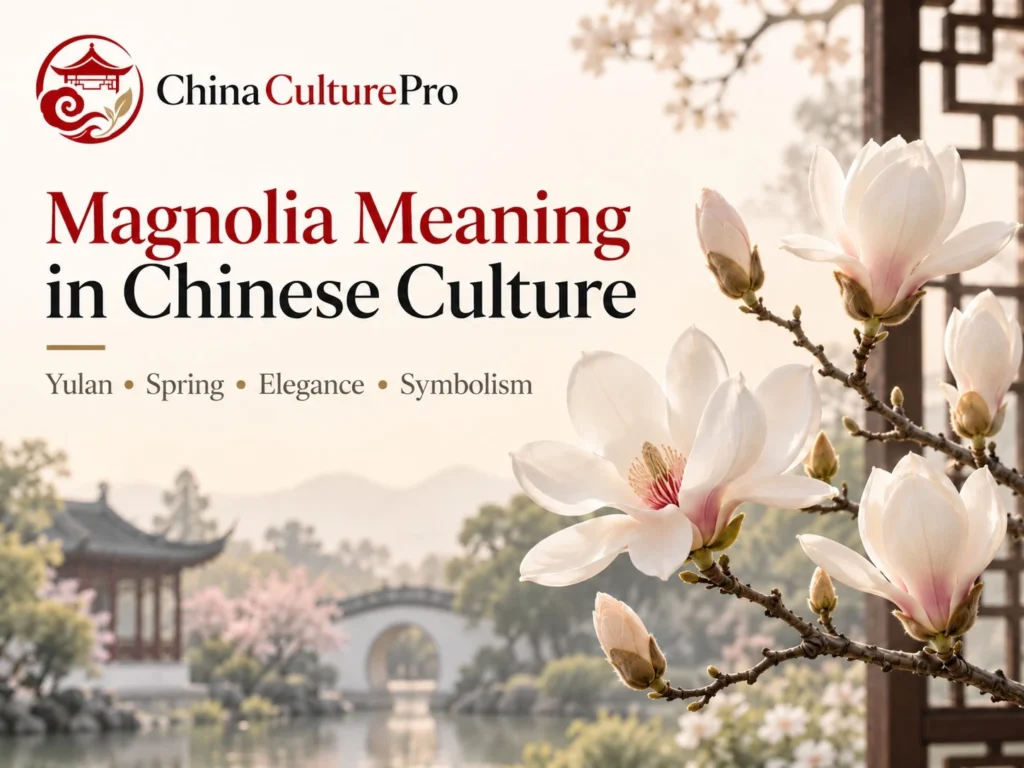

Quick Answer: What Does Magnolia Symbolize in Chinese Culture?
Yulan magnolia (玉兰, yùlán) has several context-dependent meanings in Chinese culture rather than one fixed symbolic definition.
- Early spring and renewal: Yulan usually flowers before its leaves open, making the bare branches covered in large blossoms a striking sign of spring’s return.
- Jade-like elegance and refinement: Its pale, substantial flowers and the name yulan encourage comparisons with jade and orchid-like fragrance, especially in poetry, gardens and flower-and-bird art.
- Cultivated and courtly taste: Magnolias planted in temples, palace grounds and private gardens can suggest an elegant setting, but they were never an exclusive imperial badge.
- Honor and prosperity in compound motifs: In Yutang Fugui (玉堂富贵, yùtáng fùguì), usually translated as “Jade Hall, Wealth and Honor,” magnolia contributes to a larger rebus. A lone flower does not express the complete wish.
- Modern Shanghai identity: White magnolia became Shanghai’s city flower in 1986, giving it a modern civic meaning separate from older art.
Magnolia does not automatically mean romantic love, female courage, longevity, wealth or protection. Those readings require a particular text, composition or modern creative context.
In English, “magnolia” can refer to a large botanical genus. In Chinese culture, however, the name does not point to one plant with one universal meaning. This guide focuses on Yulan magnolia (玉兰, yùlán) while distinguishing it from Mulan (木兰, mùlán), Xinyi (辛夷, xīnyí), white champaca and southern magnolia. The safest interpretation always depends on the species, season, medium, inscription and companion motifs.
What Is Chinese Magnolia? Yulan, Mulan and Xinyi Explained
Botanical “magnolia” covers many species, while Chinese common names developed through literature, materia medica and horticulture. Historical names therefore do not always map neatly onto one modern taxon. Flora of China also records taxonomic treatments that may use either Magnolia or the segregate genus Yulania for several familiar Chinese species.[1]
| Chinese name | Main modern identification | Common cultural setting | Interpretation limit |
|---|---|---|---|
| Yulan magnolia | Magnolia denudata | Early-spring gardens, flower-and-bird art and auspicious combinations | The principal plant discussed in this article |
| Purple magnolia or mulan | Magnolia liliiflora | Gardens, poetry and decorative art | A separate species, not merely a purple version of white yulan |
| Mulan (木兰, mùlán) | A historical plant name with variable use | Classical writing, plant names and the heroine’s name | An old occurrence cannot always be assigned to one modern species |
| Xinyi (辛夷, xīnyí) | A traditional name associated with magnolia flower buds; modern medicinal standards distinguish accepted source species | Classical texts and materia medica | Medicinal use does not create a healing symbol in decorative art |
| Southern magnolia, called guangyulan in China | Magnolia grandiflora | Modern parks and street planting | Native to North America and not the default plant in classical Chinese yulan imagery |
| White champaca, often called bailan | Magnolia × alba | Fragrant-flower culture in southern China and Southeast Asia | An evergreen tropical tree, not the deciduous white yulan |
The English label “Chinese magnolia” is itself imprecise. When a source means Magnolia denudata, “yulan magnolia” is clearer. When an old poem or painting gives only the word mulan, responsible interpretation should preserve some botanical uncertainty rather than forcing a modern species identification.
Why Magnolia Represents Early Spring and Renewal
The spring association begins with visible plant behavior. Yulan magnolia is deciduous, and its large white flowers normally open on branches that have not yet produced their new leaves. The result is an unusually clear seasonal signal: winter-bare wood appears to fill with upright blossoms. Botanical descriptions consistently identify this precocious flowering habit as one of the species’ defining visual features.[2]
In a garden, seasonal poem or painting, that habit can support meanings such as spring’s arrival, renewed growth, anticipation and fresh beginnings. The meaning is strongest when the work includes other early-spring clues or a seasonal inscription. It is not evidence that every magnolia represents perseverance, success or good luck. Magnolia species flower at different times, so an interpretation based on yulan’s early bloom should not be transferred mechanically to the entire genus.
For a broader comparison of how season and plant form affect meaning, see the guide to Chinese flower and plant symbolism.
Why Yulan Suggests Jade-Like Elegance and Refinement
The Meaning of the Name Yulan
The modern name yulan combines yu, “jade,” with lan, “orchid.” It does not mean that magnolia is botanically an orchid. Rather, the name invites an aesthetic comparison: the flowers can appear pale, smooth and substantial like carved jade, while their fragrance and dignified bearing recall the refined associations of orchids.
That word-picture helps explain why English summaries often reduce yulan to “purity” or “nobility.” Those words can be appropriate in a poem, a commemorative planting or a carefully interpreted artwork, but they should not be treated as permanent properties of the plant. “Jade-like,” “clean,” “elegant” and “refined” first describe appearance and taste. A moral judgment such as personal purity requires support from an inscription, literary context or documented curatorial interpretation.
Temple, Court and Garden Contexts
Yulan has a long history as a cultivated ornamental in China and became associated with temple precincts, palace grounds and elite gardens. Such settings can make it part of an atmosphere of cultivated taste, quiet fragrance and formal beauty. They do not make it a rank badge comparable to an insignia prescribed for a particular office.
This distinction matters when reading decorative art. A magnolia beside a terrace or ornamental rock may establish a sophisticated garden setting without praising the owner’s bloodline or official position. Court ownership also does not prove that every motif on an object carries an imperial meaning. The image, inscription and full decorative program remain more important than the object’s prestigious provenance.
Magnolia in the Yutang Fugui Motif
Yutang Fugui is a compound auspicious expression built through names, homophones and established floral associations. Yulan can supply yu, “jade,” while haitang, the Chinese name commonly used for flowering crabapple or begonia-like blossoms in art, contributes tang, which evokes “hall.” Peony then supplies its established association with fugui—wealth, rank and honor. The result wishes for an eminent household or a “jade hall” filled with wealth and distinction.
| Composition | How the wordplay works | Appropriate reading |
|---|---|---|
| Magnolia + haitang + peony | Yu from yulan; tang from haitang; peony as the “flower of wealth and honor” | The standard “Jade Hall, Wealth and Honor” wish |
| Magnolia + haitang + osmanthus | Yu and tang as above; gui in osmanthus echoes gui, “honored” or “noble” | A related honored-household rebus, subject to the title and inscription |
| Magnolia alone | Retains its floral beauty and possible jade-like association | Not the complete Yutang Fugui motif |
Compositions vary by period, region and medium. Some add lingzhi, birds, rocks or other flowers, and those additions can introduce further wishes. The principle is more important than a rigid ingredient list: identify what each component contributes, then read the ensemble. A Qing court carpet described as a Yutang Fugui design combines magnolia, haitang and peony with lingzhi and rocks, while other court objects use magnolia and haitang for related “jade hall” rebuses.[3]
Because peony carries the wealth-and-rank component, the site’s guide to peony meaning in Chinese culture provides the useful comparison. Removing the companion flowers changes the reading; a single magnolia should not be advertised as an automatic wealth or career charm.
Magnolia in Chinese Painting and Decorative Art
Chinese artists could use magnolia as a seasonal subject, a vehicle for brushwork or one part of an auspicious design. These functions overlap visually, so the medium and surrounding evidence matter.
An isolated flowering branch often belongs first to the tradition of observing and rendering plants. The Mustard Seed Garden Manual of Painting, originally published in the late seventeenth century and widely circulated later, includes magnolia among its model flower subjects.[4] Its presence in a painting manual shows that magnolia could be studied as a pictorial form; it does not make every magnolia study a coded blessing.
Magnolia with a garden rock, bird or terrace may create an early-spring scene or cultivated garden mood. A poem, title or collector’s inscription can then add a more personal meaning. Magnolia accompanied by haitang, peony, osmanthus or auspicious objects is more likely to participate in a rebus. Even then, the precise reading belongs to the whole composition.
A practical default is therefore conservative: if a museum record identifies magnolia but offers no symbolic interpretation, describe it as a floral, seasonal or decorative subject. Do not manufacture a claim of purity, wealth or feminine virtue simply because another artwork used the same plant differently. This contextual approach applies across Chinese flower symbols and other auspicious motifs.
Magnolia as Shanghai’s City Flower
White magnolia has a separate modern civic life. Shanghai selected it as the city flower in 1986; the municipal government marked the fortieth anniversary in 2026 and described magnolias as among the earliest flowers to bloom in spring.[5] Their early opening and upward-facing blossoms lend themselves to modern language about vitality, optimism and a city looking forward.
That civic meaning belongs to contemporary Shanghai emblems, awards, public landscapes and cultural presentation. It does not make magnolia China’s national flower, nor does it establish one nationwide meaning for every city. Most importantly, a modern Shanghai interpretation cannot be projected backward onto an anonymous Ming or Qing painting.
Is Magnolia Connected to the Heroine Mulan?
The shared word creates an attractive connection, but it is not an ancient flower-symbol rule. The Ballad of Mulan calls its heroine Mulan; the surviving early story does not turn a magnolia flower into her emblem or explain her courage through the plant. Even the origin of the name is debated. One scholarly interpretation connects it to a non-Han linguistic background rather than assuming it began as the Chinese flower name.[6]
The familiar surname Hua was attached in later retellings, and later literature, theatre and film continually reshaped the heroine. A contemporary artist may deliberately combine a magnolia with Mulan to express courage, independence or women’s strength. That can be meaningful modern symbolism, but it should be labeled as a creative association—not presented as the inherited meaning of yulan in all Chinese art.
How to Interpret a Magnolia Motif Correctly
- Identify the likely plant. Distinguish deciduous white yulan, purple magnolia, tropical white champaca and evergreen southern magnolia. If the image is stylized, keep the identification tentative.
- Classify the setting. Decide whether the work is a spring scene, garden view, flower study, court furnishing or auspicious decorative object.
- Check companion motifs. Haitang, peony and osmanthus can activate rebuses; rocks, birds and terraces may instead establish season or setting.
- Read the text and record. Give priority to the title, poem, inscription, date, maker, intended use and museum catalogue entry. These can outweigh generic motif dictionaries.
- Separate cultural layers. Do not merge classical Chinese art, modern Shanghai identity, Western flower language and a present-day tattoo or brand concept.
When none of these clues supports a more specific conclusion, the safest reading is “an elegant early-spring flower” or simply “a decorative magnolia.” A restrained interpretation is more accurate than assigning every attractive meaning found online.
Common Misreadings of Magnolia Symbolism
- All magnolias are Chinese yulan: Magnolia is a large genus. Southern magnolia and many garden hybrids have different origins and histories.
- White and purple magnolia are one flower with color-coded meanings: They can be different species. Traditional Chinese art has no reliable universal chart assigning luck or misfortune by magnolia color.
- Magnolia always means purity, nobility or feminine beauty: These are contextual aesthetic or modern floral readings, not mandatory definitions.
- Palace planting made magnolia an imperial emblem: A prestigious garden context indicates taste; it does not create an exclusive symbol of sovereignty.
- Magnolia alone means wealth or official success: Yutang Fugui requires a compound image or supporting text.
- The heroine Mulan made magnolia a traditional symbol of female courage: The early ballad establishes no such botanical emblem.
- Medicinal xinyi proves that magnolia art means healing: A pharmacological use and an artistic symbol are different categories.
- Planting or wearing magnolia changes fortune: Traditional wishes expressed through art do not establish supernatural effects.
For the wider method behind homophones, companion motifs and context-dependent readings, see Chinese symbols and meanings.
FAQs About Magnolia Meaning in Chinese Culture
What does magnolia symbolize in Chinese culture?
Yulan magnolia can mark early spring and suggest jade-like elegance. In gardens it may convey cultivated taste, while in a Yutang Fugui composition it helps form a wish for an eminent, prosperous household. White magnolia also has a separate modern identity as Shanghai’s city flower. None of these meanings applies automatically to every magnolia image.
What does “yulan” mean in Chinese?
Yulan literally combines the characters for “jade” and “orchid.” The name evokes pale, substantial flowers and refined fragrance, but the plant belongs to the magnolia family, not the orchid family. In precise botanical English, yulan magnolia usually means Magnolia denudata.
Does magnolia symbolize wealth or nobility?
Not by itself. Wealth and honor are most securely read when magnolia appears in a named rebus such as Yutang Fugui with haitang and peony, or when an inscription establishes that wish. A lone branch is more likely to represent floral beauty, spring or refined taste.
Is magnolia connected to Hua Mulan?
The later familiar name Hua Mulan contains the word mulan, which can denote magnolia in Chinese. The early ballad, however, does not use the flower as the heroine’s symbol, and the origin of her name remains debated. Female courage is therefore a valid modern creative reading, not a universal ancient flower meaning.
Do white and purple magnolias have different Chinese meanings?
There is no dependable traditional color code. White yulan and purple magnolia may be different species, and an artwork’s meaning depends more on its title, companions, date and use than on color alone. Modern florists or designers may create color meanings, but those should not be labeled as fixed classical tradition.
Sources
[1] Flora of China. Magnoliaceae Treatments and Chinese Species Nomenclature
[2] International Dendrology Society. Magnolia denudata: Yulan, the Grandfather of Magnolias
[3] Palace Museum. Gold-and-Silver-Thread Yutang Fugui Pile Carpet
[4] Los Angeles County Museum of Art. The Mustard Seed Garden Manual of Painting
[5] Shanghai Municipal Government. Best Spots to See Magnolia Blooms
[6] TIME. The Controversial Origins of the Story Behind Mulan