
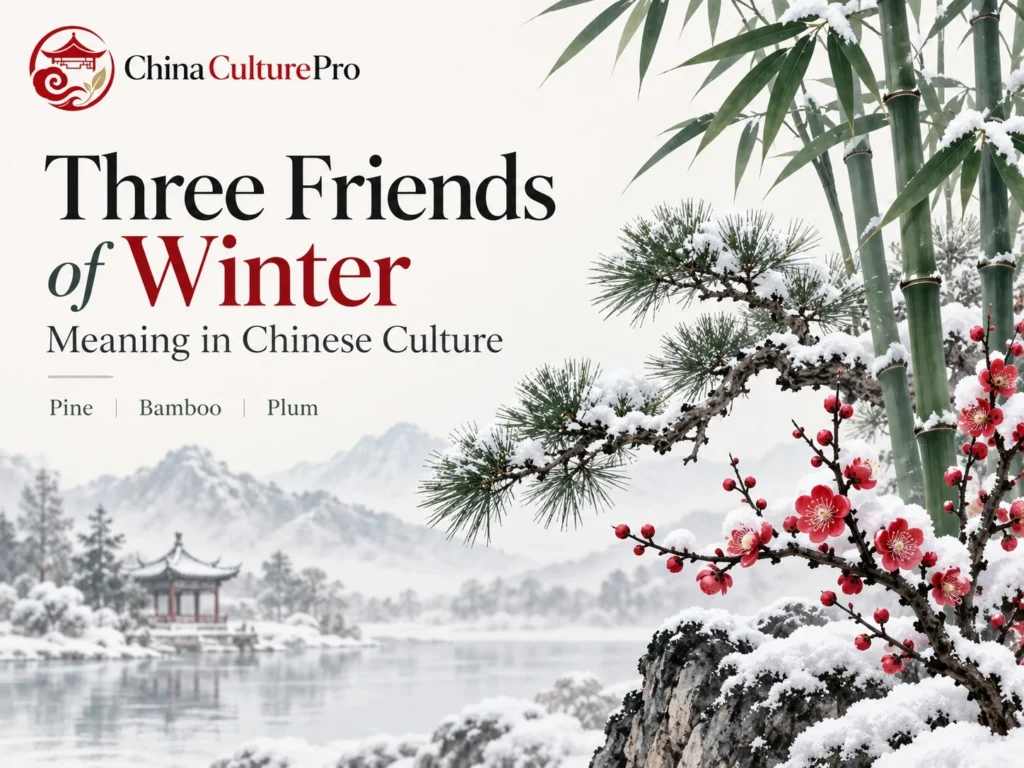

Quick Answer: What Do the Three Friends of Winter Mean?
The Three Friends of Winter (岁寒三友, suìhán sānyǒu) are pine, bamboo, and plum blossom. In Chinese art, the three plants form a fixed motif for moral character revealed by hardship: they remain green or flower when the winter landscape appears lifeless.
- Pine: Steadfastness, endurance, and constancy.
- Bamboo: Integrity, humility, and flexible strength.
- Plum blossom: Courage in adversity, renewal, and hope.
Together they chiefly represent perseverance and principled conduct, not automatic luck, wealth, or long life. Those additional readings depend on the object, inscription, occasion, and accompanying motifs.
Pine, bamboo, and plum blossom share a Chinese cultural life that is larger than the meanings of the three plants considered separately. Their winter behavior gave artists a visual language for constancy under pressure, while paintings, porcelain, lacquer, and later popular decoration carried that language into new settings. The key to reading the motif is to begin with the trio’s shared test—winter—and then check the medium and companion imagery before assigning secondary meanings.
Why Are Pine, Bamboo and Plum Called the Three Friends of Winter?
In the name “Three Friends of Winter,” winter is both a season and a metaphor for adversity. Pine remains evergreen, bamboo retains its upright segmented form and bends without easily breaking, and plum can flower before most spring plants. Their differences make a coherent sequence: pine endures, bamboo yields without surrendering, and plum announces renewal.
Chinese literati personified the plants as companions that share harsh conditions. That “friendship” primarily describes their affinity as moral images. It supports an ideal of the scholar-gentleman (君子, jūnzǐ), whose character becomes visible when circumstances are difficult. Museum interpretations repeatedly connect the complete trio with endurance, modesty, fortitude, purity, or lofty conduct.[3][5][6]
This collective meaning is more specific than saying that the design merely represents winter. It is also narrower than calling it a universal good-luck emblem. The central analogy is between surviving the cold and preserving one’s principles through hardship.
What Each of the Three Friends Represents
Each plant contributes a different aspect of resilient character. Its role in the trio should be separated from meanings it may carry when shown alone or with other symbols.
| Plant | Winter feature | Role within the trio | Interpretive limit |
|---|---|---|---|
| Pine | Evergreen needles and a weathered, enduring trunk | Constancy, firmness, and sustained moral resolve | Longevity is an important separate meaning of pine, but it is not automatically the subject of every Three Friends design. |
| Bamboo | Upright nodes, a hollow center, and the ability to bend | Integrity, humility, disciplined growth, and resilient flexibility | Its role concerns character rather than guaranteed advancement or prosperity. |
| Plum blossom | Flowers in late winter or at the threshold of spring | Courage, purity of purpose, renewal, and hope after hardship | It should not be confused with peach-blossom associations with romance. |
The combined design therefore expresses more than three independent definitions. Pine, bamboo, and plum create a progression of enduring, adapting, and beginning again. That shared structure is why a complete trio carries a stronger adversity-and-character meaning than any one plant by itself.
How the Three Friends of Winter Motif Developed
The Classical Idea of Character Revealed by Cold
The intellectual foundation predates the complete trio. In the “Zihan” chapter of the Analects, Confucius says, “Only when the year turns cold do we know that pine and cypress are the last to fade.”[1] The line made severe cold a test that reveals durable character.
The passage names pine and cypress, not pine, bamboo, and plum. It is therefore best understood as a conceptual precedent rather than the literal source of the complete Three Friends motif. Later writers and artists expanded the underlying analogy as bamboo and plum developed their own strong associations with principled conduct.
Song-Era Naming and Painting
The grouping became recognizable in the Song-to-Yuan cultural world. A frequently cited passage by the late-Song writer Lin Jingxi describes planting many plum trees together with tall pine and bamboo as “friends in the cold season.” The passage is important evidence for the name, but claims that it is the single first use should remain cautious because “earliest” depends on what texts survive and how variant titles are cataloged.
Painting provides another strong early witness. The National Palace Museum catalogs a work attributed to the Southern Song artist Zhao Mengjian as Three Friends of Winter. Pine, bamboo, and plum appear as cut branches combined into one refined ink composition. The museum also relates these subjects to the artist’s preference for plants associated with lofty and steadfast conduct in troubled times.[2]
Together, the textual and pictorial evidence shows a mature motif by the late Song period. Popular stories that make Su Shi the sole inventor may be appealing, but they should not replace dated texts, inscriptions, and cataloged objects as evidence.
Expansion into Yuan, Ming and Qing Decorative Arts
Once established in literati culture, the trio moved beyond ink painting. Yuan and Ming artists repeated it in different formats, and Ming workshops made it highly visible on courtly and decorative objects. A Xuande-period blue-and-white bowl from Jingdezhen presents pine, bamboo, and plum as metaphors for the scholar-gentleman’s integrity, endurance, loftiness, and purity.[5] A late-sixteenth-century Jiajing dish defines the motif through endurance, modesty, and fortitude.[3]
Carved lacquer demonstrates that the design was not tied to brush painting or ceramics. On a sixteenth- to early-seventeenth-century dish, pine needles, bamboo leaves, and plum blossoms fill the center; the trio signifies a lofty person who perseveres in a harsh environment.[4] Qing-period works continued this inherited language while allowing the motif to enter domestic decoration and broader auspicious settings. The medium can change the emphasis, but it does not erase the motif’s literati foundation.
How the Three Friends Appear in Chinese Art
A complete Three Friends design must make pine, bamboo, and plum identifiable, although an artist need not show three whole plants. Ink painters may intertwine cut branches; ceramic decorators may distribute needles, leaves, and five-petaled blossoms around a vessel; lacquer carvers may compress the plants into a dense central medallion.
- Ink painting: Brushwork, inscription, and the artist’s circumstances often make moral self-expression the dominant reading.
- Porcelain: The trio may serve both as an elegant decorative program and as a statement about cultivated virtue.
- Carved lacquer: Layered branches turn the same plant vocabulary into a tactile, high-relief design.
- Textiles, woodwork, and architecture: Simplified forms may emphasize seasonal beauty or a general wish for resilience.
Identification should rest on plant details rather than a title alone: clustered pine needles, jointed bamboo culms and narrow leaves, and plum’s bare twigs with rounded blossoms. One or two of these plants do not automatically constitute the full motif.
When the Motif Means Longevity, Friendship or Good Fortune
Longevity, friendship, and good fortune are possible readings, but none should be applied without contextual evidence.
- Longevity: Pine has an independent long-life association. A crane-and-pine composition can explicitly signal longevity, while pine, plum, and bamboo together can instead denote lofty moral character.[6] On another Ming dish, the Three Friends appear with a garden rock and fungus of immortality; the complete design carries both longevity wishes and scholarly meaning.[7] The additional motifs materially change the reading.
- Friendship: The word “friends” first personifies plants sharing winter conditions. A human-friendship reading becomes persuasive when a painting has a dedicatory inscription, was exchanged between friends, or otherwise documents a social relationship. A late Qing handscroll could affirm an insider circle of friendship because its imagery and circumstances support that layer, not because every trio means literal friendship.
- Good fortune: In later decorative and seasonal contexts, the trio can express a broad wish to pass through difficulty and welcome renewal. That is a cultural blessing, not evidence that displaying the plants will change luck.
The practical rule is simple: identify what the three plants contribute together, then ask what the accompanying crane, fungus, inscription, recipient, or festival contributes separately.
Three Friends of Winter vs Four Gentlemen
The Three Friends and the Four Gentlemen (四君子, sì jūnzǐ) are related literati plant traditions, but they are not interchangeable. Plum and bamboo appear in both; pine belongs only to the Three Friends, while orchid and chrysanthemum belong only to the Four Gentlemen.
| Feature | Three Friends of Winter | Four Gentlemen |
|---|---|---|
| Members | Pine, bamboo, plum | Plum, orchid, bamboo, chrysanthemum |
| Organizing principle | Shared resistance to winter and adversity | Four plant models of cultivated literati character |
| Primary emphasis | Steadfastness under harsh conditions and renewal | A wider range of virtues and brush-training traditions |
| Historical formation | Classical conceptual precedent; recognizable grouping by the Song period | Older individual traditions; standardized four-plant grouping in the late Ming |
Calling either group “Confucian” can be useful when discussing moral cultivation, but it should not flatten their artistic histories. Their membership and visual logic remain distinct.
Chinese Three Friends and Japanese Shōchikubai
Japan adopted the same three plants in Shōchikubai (松竹梅, shōchikubai), literally pine-bamboo-plum. Medieval Japanese Zen networks helped transmit Chinese ink-painting subjects during the Kamakura and Muromachi periods.[8] The shared plant set does not mean that every Chinese and Japanese object carries an identical message.
In Japan, pine, bamboo, and plum became especially prominent as auspicious early-spring and New Year motifs used on celebratory objects.[8] Shōchikubai can also label ranked tiers in modern Japanese usage. These Japanese conventions should not be projected backward onto Chinese paintings or Ming porcelain. For a Chinese work, begin with literati ideals of endurance and character; for a Japanese work, check New Year, ceremonial, Zen, and ranking contexts.
How to Interpret a Three Friends of Winter Design
- Confirm all three plants. Look for pine needles, segmented bamboo, and plum blossoms. A partial pairing has its own possible meanings.
- Identify the medium and period. An inscribed literati painting, a Ming court ceramic, and a later household carving do not perform exactly the same cultural job.
- Read inscriptions and provenance. A poem, dedication, seal, recipient, or documented occasion can turn general moral symbolism into personal self-expression or friendship.
- Separate companion motifs. Cranes, longevity fungi, peaches, rocks, and written characters may add meanings that do not belong to the trio alone.
- Keep regional and modern meanings distinct. Japanese New Year usage and contemporary tattoo or interior-design meanings may be valid in their own settings, but they are not automatic readings of historical Chinese art.
Common Misreadings of the Three Friends of Winter
- The trio is pine, bamboo, and plum—not orchid. Orchid belongs to the Four Gentlemen.
- It is not a botanical category. “Three Friends” names a fixed cultural and artistic grouping, not every plant able to survive cold weather.
- The Analects does not name the full trio. Its pine-and-cypress passage supplies an influential idea about character revealed by cold.
- Longevity is not the only or automatic meaning. It usually comes from pine’s independent symbolism or from added cranes, fungi, peaches, or inscriptions.
- “Friends” does not always mean three human companions. It first describes the plants as kindred models of endurance.
- The motif is not a supernatural device. Traditional symbolism expresses values and wishes; it does not guarantee protection, luck, or a longer life.
- Chinese and Japanese uses require separate context. Japanese New Year and ranking conventions cannot be assumed for a Chinese object.
FAQs About the Three Friends of Winter
What are the Three Friends of Winter?
They are pine, bamboo, and plum blossom shown as a fixed Chinese artistic group. Together they represent moral endurance, integrity, and renewal under adverse conditions.
Why are they called the Three Friends of Winter?
Pine and bamboo remain visibly resilient in cold weather, while plum flowers near winter’s end. Chinese writers and artists personified them as kindred companions that preserve life and character through the harsh season.
What does each of the Three Friends symbolize?
Pine emphasizes constancy, bamboo integrity and flexible strength, and plum courage and renewal. The trio joins these roles into one image of principled resilience.
Are the Three Friends of Winter the same as the Four Gentlemen?
No. The Three Friends are pine, bamboo, and plum; the Four Gentlemen are plum, orchid, bamboo, and chrysanthemum. They overlap in two plants but follow different organizing ideas and histories.
Do the Three Friends of Winter symbolize longevity or good luck?
Not automatically. Longevity usually depends on pine’s separate meaning or companion symbols such as cranes and fungi of immortality. General good-fortune readings belong mainly to later festive or decorative contexts and carry no supernatural promise.
Sources
[1] Wikisource. Analects, “Zihan”
[2] National Palace Museum, Taipei. Three Friends of Winter, attributed to Zhao Mengjian
[3] The Metropolitan Museum of Art. Dish with Three Friends of Winter
[4] The Metropolitan Museum of Art. Dish with the Three Friends of Winter
[5] Cleveland Museum of Art. Bowl with Decoration of the “Three Friends”
[6] Smithsonian National Museum of Asian Art. Crane and Pine
[7] Smithsonian National Museum of Asian Art. Ming Dynasty Dish with the Three Friends
[8] Kyoto National Museum. Three Friends of Winter: Pine, Bamboo, and Plum in the Arts