
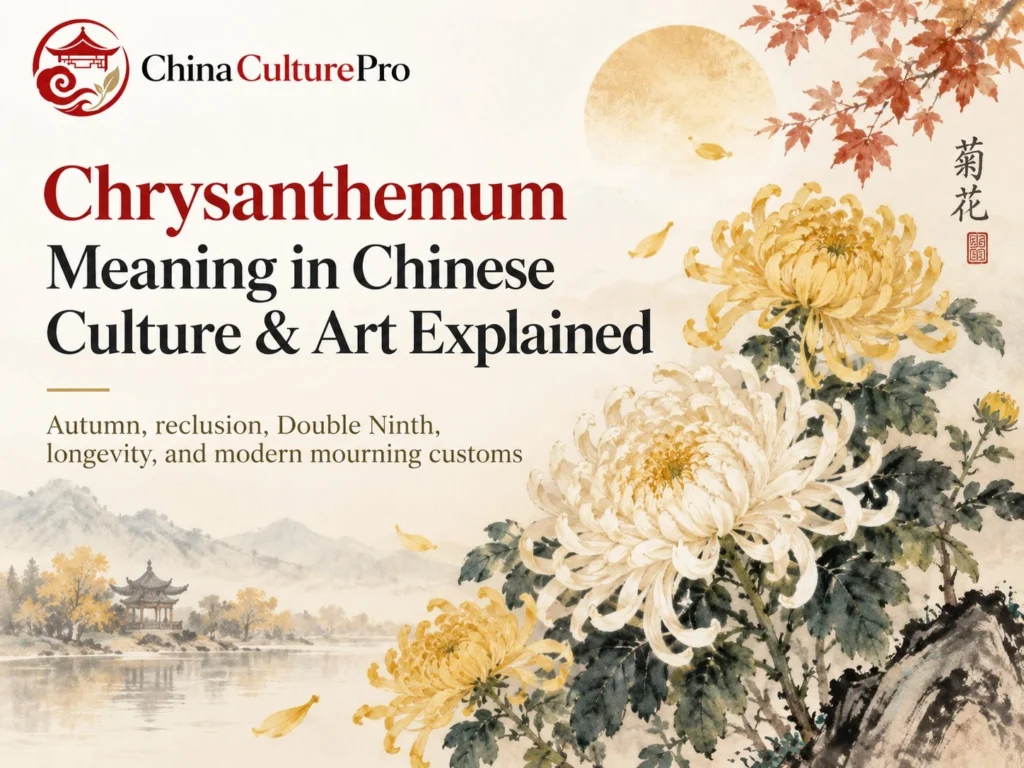

Quick Answer: What Does the Chrysanthemum Symbolize in Chinese Culture?
The chrysanthemum (菊花, júhuā) has several established associations in Chinese culture, but no single meaning applies to every painting, poem, object, or modern flower arrangement. Its most common readings are:
- Autumn and resilience: Late blooming and endurance through cool weather make it a seasonal emblem of life under frost.
- Reclusion and inner freedom: Tao Yuanming’s poetry connects chrysanthemums with leaving official life and finding fulfillment in the countryside.
- Literati integrity: In the Four Gentlemen (四君子, sì jūnzǐ), the flower represents autumn, independence, and self-possession.
- Longevity wishes: During the Double Ninth Festival (重阳节, Chóngyáng Jié) and on birthday objects, chrysanthemums can support wishes for health and long life.
- Modern remembrance: White and yellow chrysanthemums are commonly used for mourning in many present-day Chinese communities.
Context remains decisive. A naturalistic flower study may simply show autumn scenery or brushwork, while a birthday vessel needs supporting longevity signs such as cranes, tortoises, pine, or the character shou. These meanings are cultural expressions, not powers that extend life, attract wealth, or change fortune.
The chrysanthemum (菊花, júhuā) does not carry one fixed meaning in Chinese culture. In Du Jin’s Ming painting Tao Yuanming Enjoying Chrysanthemums, the poet, autumn flowers, and inscription evoke withdrawal from office and sorrow over the fallen Jin dynasty. On a twelfth-century Ding-ware dish shaped like chrysanthemum petals, tortoise-and-crane imagery makes longevity the leading message. The flower participates in both works, but it performs a different job in each.[1][2] Date, medium, inscription, accompanying images, and intended use—not a one-word “flower meaning”—determine the most defensible reading. For a broader comparison, see the guide to Chinese flower symbols.
Ju, Juhua, Autumn Chrysanthemum, and Garden Mums: What Is the Difference?
English “chrysanthemum” can hide several distinctions that matter when reading Chinese texts and art.
| Term | Meaning | Interpretive limit |
|---|---|---|
| Ju / juhua (菊 / 菊花, jú / júhuā) | The ordinary traditional and modern names for chrysanthemum | They do not identify one modern cultivar |
| Autumn chrysanthemum (秋菊, qiūjú) | A seasonal or poetic expression emphasizing autumn | It is not a separate botanical species |
| Yellow flower (黄花, huánghuā) | A poetic name that can refer to chrysanthemum | Translate it as chrysanthemum only when autumn, the Double Ninth, or another clue supports the reading |
| Ink chrysanthemum (墨菊, mòjú) | A chrysanthemum painted in ink | This is an artistic format, not a plant variety |
| Garden mum or florist’s chrysanthemum | A modern horticultural category | It does not automatically inherit every classical association |
Kew treats Chrysanthemum × morifolium as an accepted hybrid with a complex parentage.[11] That name is useful for modern botany, but a stylized blossom in an old painting or ceramic pattern usually cannot be identified to a modern cultivar. When the image is ambiguous, follow the museum’s title, inscription, and catalogue rather than counting petals.
The same caution applies to poetic names. “Yellow flower” may identify a chrysanthemum in an autumn poem, yet the phrase can describe other blossoms elsewhere. Translation should follow the sentence and season, not replace every historical plant word with a modern species label.
Why Does the Chrysanthemum Suggest Autumn, Reclusion, and Longevity?
Three different processes created the best-known meanings.
| Source of meaning | How the association formed | Where it applies |
|---|---|---|
| Seasonal observation | Chrysanthemums bloom prominently in late autumn and withstand cool weather, making them signs of the season and resilience | Calendrical writing, autumn paintings, flower studies |
| Literary association | Tao Yuanming’s poetry and later images linked chrysanthemums with rural retirement, self-sufficiency, and distance from official life | Scholar painting, poetry, works with Tao-related cues |
| Festival and decorative use | Double Ninth customs joined seasonal chrysanthemums to wishes for long duration; birthday art added other longevity signs | Festival scenes, birthday gifts, auspicious decorative objects |
The third mechanism is often misstated. Chrysanthemum, jú (菊), does not sound the same as “long-lasting,” jiǔ (久). The exact Mandarin homophone is nine, jiǔ (九), and long-lasting, jiǔ (久). Because the Double Ninth falls on the ninth day of the ninth lunar month, repeated nine supports the wish for duration. Chrysanthemums enter through season and custom, not because the flower’s name equals “long.” Natural hardiness supplied artists with a metaphor; it did not give the plant human will or proven life-extending power.
How Chrysanthemum Symbolism Changed Across Chinese History
Early Seasonal Chrysanthemums Before the “Hermit Flower”
Early texts first establish a seasonal plant. The Monthly Ordinances in the Book of Rites states that in the last month of autumn, “the chrysanthemum has yellow flowers.” The surrounding passage records natural signs of the season, so this is phenology rather than a complete moral or lucky-flower code.[6] The Songs of Chu also uses autumn chrysanthemum among fragrant plants associated with refinement. Neither source proves that all early chrysanthemum images meant reclusion, longevity, or the Four Gentlemen.
Tao Yuanming and the Literati Chrysanthemum
The decisive literary turn came with Tao Yuanming (365–427). His line “Picking chrysanthemums beneath the eastern fence, I calmly see the southern mountain” joined the flower to a life away from court.[7] Later readers made Tao the model of the scholar-recluse: someone who relinquished office yet retained moral and imaginative independence. The association is strongest when an artwork includes Tao, a rustic fence, wine, a mountain retreat, or a relevant inscription. A lone blossom is insufficient evidence.
Song–Yuan Painting and Moral Meaning
Song and Yuan artists developed parallel traditions. Detailed bird-and-flower pictures could observe autumn growth, garden varieties, and natural form; ink painters could use the same plant for personal expression. Chrysanthemum gradually became a vehicle for principled self-possession, but the complete Four Gentlemen label had not yet crystallized. Calling every Song or Yuan chrysanthemum a “Four Gentlemen painting” therefore puts a later framework onto an earlier work.
Ming–Qing Decoration and Auspicious Expansion
In the Ming and Qing periods, older literary readings continued while chrysanthemums spread across porcelain, lacquer, textiles, and birthday furnishings. Some compositions invoked Tao Yuanming; some supported seasonal or longevity wishes; many were primarily decorative. Lu Zhi’s sixteenth-century Planting Chrysanthemums, for example, uses poetry and a gift between friends to articulate an ideal of reclusion, whereas a patterned vessel may emphasize craft, symmetry, or occasion.[4] Later date alone does not make a chrysanthemum auspicious.
Tao Yuanming and the “Hermit Among Flowers”
Tao Yuanming is the central person behind the chrysanthemum’s reclusive identity. Zhou Dunyi’s eleventh-century essay On the Love of the Lotus later condensed this tradition into the phrase “the chrysanthemum is the recluse among flowers.” Zhou strengthened an existing association; he did not originate it.[8]
Look for several clues before identifying a Tao scene:
- a scholar presented or named as Tao Yuanming;
- an eastern fence, country path, garden, or southern mountain;
- wine vessels, a servant carrying flowers, or the act of picking chrysanthemums;
- an inscription mentioning “returning home,” the southern mountain, or the three overgrown paths.
Du Jin’s Tao Yuanming Enjoying Chrysanthemums (object 2001.746.2) supplies multiple clues. Its poem says Tao returned along the three paths, watched the sun move over yellow flowers and a wattle fence, recognized that he could not restore the Jin dynasty, and could only become deeply drunk.[1] The painting therefore carries both the broad recluse tradition and a work-specific meditation on dynastic loss. A generic chrysanthemum scroll without these cues cannot sustain the same political reading.
Chrysanthemums and the Double Ninth Festival
The Double Ninth Festival takes place on the ninth day of the ninth lunar month, when chrysanthemums are seasonally prominent. Traditional activities have included climbing to high places, wearing or carrying dogwood, viewing chrysanthemums, and drinking chrysanthemum wine.[9] In art and festive writing, those practices can connect the flower with autumn, health wishes, and long duration.
The phonetic logic belongs to the date: nine, jiǔ (九), and lasting, jiǔ (久), are exact homophones in Mandarin. Chrysanthemum, jú (菊), is not. A more accurate explanation is therefore “a seasonal flower used at a festival whose repeated nines evoke duration,” not “chrysanthemum sounds like longevity.”
Historical participation in a health-oriented custom is evidence of cultural belief, not medical proof. Modern Senior Citizens’ Day policy also should not be treated as the ancient origin of the symbol. Double Ninth chrysanthemum and modern funeral chrysanthemum are separate contexts; one does not cancel the other.
What Does the Chrysanthemum Mean in the Four Gentlemen?
The Four Gentlemen are plum blossom, orchid, bamboo, and chrysanthemum. In this literati framework, chrysanthemum corresponds conventionally to autumn and suggests composure under frost, reclusion, and integrity outside social competition. Plum, orchid, and bamboo contribute different models of cultivated character; they are not interchangeable synonyms.
The plants had individual literary histories long before the collective name. Public museum material traces the Four Gentlemen analogy to the Wanli reign of the Ming dynasty, when Chen Jiru inscribed the phrase in a painting manual devoted to the four plants.[10] It is therefore safer to say the label crystallized in the late Ming rather than that an unchanged four-plant system existed from antiquity.
A single chrysanthemum can recall qualities later gathered into this framework, but it is not a complete Four Gentlemen composition. See the related guides to plum blossom and bamboo for the distinct histories of two other members.
Common Chrysanthemum Motifs and Their Meanings in Chinese Art
A catalogue that names only the visible motif does not prove that an object had no symbolic meaning; museums often separate basic identification from fuller interpretation. The safer method is to combine the title with date, provenance, inscription, visual companions, and object type. Assign a leading reading only when several clues converge, and keep other plausible layers secondary.
A Single Chrysanthemum, Rock, or Autumn Garden
A single stem, chrysanthemums beside a rock, or an autumn garden should first be read as a flower study, seasonal scene, or display of brushwork. Gao Fenghan’s eighteenth-century Chrysanthemums by a Rock (object 1989.363.159) is celebrated for the force of the artist’s left-handed brushwork and its integration with calligraphy.[3] The rock does not automatically add “support,” longevity, or a feng shui “backing.” An inscription may introduce another layer, but the visible plant alone does not prove it.
Tao Yuanming, the Eastern Fence, Wine, and Pine
When chrysanthemum appears with a scholar, wine, an eastern fence, or a returning-home inscription, Tao Yuanming is the leading possibility. Pine does not always turn the scene into a birthday wish. In Wen Zhengming’s Chrysanthemums and Pine Tree, the pair alludes to Tao’s Returning Home: the paths are overgrown, yet the pines and chrysanthemums remain.[5] This composition concerns reclusion and moral choice even though pine can express longevity elsewhere.
Chrysanthemum with Crane, Tortoise, Pine, or Shou
On a birthday gift or longevity object, chrysanthemum may appear with crane, tortoise, pine, or the character shou (寿, shòu), “longevity.” The surrounding signs and the object’s use make the long-life reading secure. The Jin-dynasty Ding-ware dish Chrysanthemum-Petal Dish with Longevity Signs of Tortoise and Cranes (object 2010.58) states this hierarchy in its museum title: the tortoise and cranes carry explicit longevity associations, while the petal-shaped dish adds a floral and seasonal frame.[2] For the animal layers, compare the site’s guides to crane symbolism and turtle and tortoise symbolism.
Quail, Chrysanthemum, and Fallen Leaves: Anju Leye
The rebus Anju Leye (安居乐业, ānjū lèyè), “live in peace and enjoy one’s work,” appears on some Qing export and decorative porcelains. A Gardiner Museum catalogue identifies a dish with quails and chrysanthemums by this title.[12] The sound play is approximate and should be described precisely:
- quail, an (鹌, ān), matches peace, an (安, ān);
- chrysanthemum, ju (菊, jú), resembles reside, ju (居, jū), but the tones differ;
- fallen leaves, luoye (落叶, luòyè), approximate enjoy one’s work, leye (乐业, lèyè), at phrase level.
Because rebuses depend on recognized composition, title, and use, do not mechanically decode every naturalistic quail-and-flower scene. Fallen leaves or a museum title strengthen the full reading; their absence does not justify inventing one.
What Does the Chrysanthemum Mean in Chinese Poetry and Language?
Poetry can push the flower far beyond a general idea of autumn.
| Text or phrase | Leading meaning | Why it cannot define every image |
|---|---|---|
| Tao Yuanming, “Picking chrysanthemums beneath the eastern fence…” | Reclusion, inward freedom, rural self-sufficiency | The reading depends on Tao’s poem and later persona |
| Huang Chao, “On the Chrysanthemum, After Failing the Examination” | Martial force and political ambition | The poem imagines autumn blossoms overwhelming other flowers and filling Chang’an with “golden armor”; it is a particular late-Tang voice, not a lucky meaning |
| “Tomorrow’s yellow flowers” (明日黄花, míngrì huánghuā) | Something past its proper moment or no longer timely | The phrase grew from writing about chrysanthemums after the Double Ninth and is not an auspicious greeting |
These examples show why literary context cannot simply be transferred to porcelain or textiles. A chrysanthemum may voice withdrawal in one poem and defiant ambition in another. An inscription can activate one of those readings; without it, start from the object’s genre and use.
Are Chrysanthemums Funeral Flowers in China?
White and yellow chrysanthemums are widely used today at funerals, memorials, and grave-sweeping observances in mainland China and in many Chinese communities. They communicate mourning, remembrance, and respect; contemporary reporting repeatedly documents their use when people pay tribute to the dead.[13]
This is a modern etiquette context, not a timeless definition of the flower. An old painting of yellow chrysanthemums may concern autumn, Tao Yuanming, a garden variety, or brushwork. It does not become funerary because a similar color is used at a present-day memorial. Customs also vary by region, family, occasion, and the type of arrangement.
The historical origin of this funeral convention is less secure than its present use. It is therefore better to describe what white and yellow chrysanthemums communicate in many communities today than to invent one ancient starting date or claim an unchanged national rule.
For a modern celebratory gift, white or yellow chrysanthemums may trigger mourning associations, so local knowledge and the recipient’s preferences matter. That practical caution should not become the absolute rule that “all chrysanthemums are forbidden gifts.” Nor should modern funeral use erase colorful chrysanthemums in ordinary displays.
What a Chinese Chrysanthemum Symbol Does Not Automatically Mean
| Common claim | More accurate boundary |
|---|---|
| Every chrysanthemum means longevity | Longevity is strongest in Double Ninth, birthday, or compound longevity contexts |
| Every white or yellow chrysanthemum means death | Mourning is a modern use; historical yellow and white flowers may have seasonal, literary, or decorative roles |
| Ju sounds exactly like “long-lasting” | Jú (菊) and jiǔ (久) are different; jiǔ (九), “nine,” is the exact homophone of jiǔ (久) |
| Chrysanthemum is China’s imperial emblem | Chinese courts used chrysanthemum decoration, but China did not make the sixteen-petal Japanese imperial crest its own emblem |
| Each color has a fixed meaning for love, money, or status | No color code applies consistently across Chinese periods and media |
| Any chrysanthemum represents Tao Yuanming | A Tao reading needs a figure, fence, wine, landscape, inscription, or documented title |
| Chrysanthemum art changes health, wealth, or luck | The meanings are cultural associations and artistic wishes, not supernatural mechanisms |
This context-first approach also applies across Chinese flower and plant symbolism. Museum catalogues, inscriptions, and object function outrank modern “one flower, one meaning” charts.
How to Interpret or Use a Chinese Chrysanthemum Symbol Correctly
Use this six-step sequence for paintings, porcelain, embroidery, memorial flowers, tattoos, or logos:
- Identify the subject: Confirm that the motif is a chrysanthemum; when stylization makes the species uncertain, follow the official object title.
- Establish the date: Separate early seasonal writing, Tao-related literature, Song–Yuan painting, Ming–Qing decoration, and modern etiquette.
- Identify the medium and function: A handscroll, album leaf, birthday dish, robe, funeral arrangement, and commercial logo do not speak the same visual language.
- Read the complete composition: Look for a scholar, wine, fence, pine, crane, tortoise, longevity character, quail, fallen leaves, or an inscription.
- Choose the correct system: Decide whether the leading layer is seasonal, literary, moral, festive, rebus-based, funerary, or simply decorative.
- Separate history from new design: A modern tattoo or logo may assign a personal meaning, but that choice should not be presented as an ancient universal rule.
In a museum, Du Jin’s figure, fence, autumn flowers, and poem support a Tao Yuanming reading. On the Ding-ware dish, tortoise and cranes make longevity explicit. For a contemporary chrysanthemum tattoo, “resilience in autumn” or “independent character” can be an honest modern interpretation; there is no inherited rule for lucky colors, petal counts, or direction. The broader guide to reading Chinese symbols explains why complete compositions matter more than isolated motifs.
FAQs About Chrysanthemum Meaning in Chinese Culture
Does the Chrysanthemum Always Symbolize Longevity?
No. Chrysanthemum carries longevity wishes most clearly at the Double Ninth Festival and on birthday objects with supporting signs such as cranes, tortoises, pine, or shou. Autumn studies and Tao Yuanming paintings need not express longevity, and the symbolism has no life-extending effect.
Are White and Yellow Chrysanthemums Always Funeral Flowers in China?
No. They are common in modern Chinese funerals, memorials, and grave-sweeping, but historical paintings and ceramics may use the same colors for autumn, natural observation, poetry, or decoration. Contemporary gift etiquette also varies by family and region.
Is the Chrysanthemum One of the Four Gentlemen?
Yes. Chrysanthemum joins plum, orchid, and bamboo in the Four Gentlemen and conventionally represents autumn, reclusion, and integrity under frost. A picture containing only chrysanthemums, however, is not automatically a complete Four Gentlemen work.
Is the Chrysanthemum an Imperial Symbol in China?
No. Chinese court art used chrysanthemum motifs, but the flower was not a single state or imperial crest across Chinese history. The well-known sixteen-petal chrysanthemum emblem belongs to Japan’s imperial institution and should not define Chinese objects.
What Does a Chinese Chrysanthemum Tattoo Mean?
There is no ancient Chinese chrysanthemum tattoo canon. A modern design can reference autumn, resilience, personal independence, Tao Yuanming-style reclusion, or remembrance. Its meaning comes from the chosen composition and the wearer’s intention, not from fixed color, number, or direction rules.
Sources
[1] The Metropolitan Museum of Art. Tao Yuanming Enjoying Chrysanthemums
[2] The Metropolitan Museum of Art. Chrysanthemum-Petal Dish with Longevity Signs of Tortoise and Cranes
[3] The Metropolitan Museum of Art. Chrysanthemums by a Rock
[4] The Metropolitan Museum of Art. Planting Chrysanthemums
[5] Smithsonian National Museum of Asian Art. Chrysanthemums and Pine Tree
[6] Chinese Text Project. Book of Rites: Monthly Ordinances
[7] Chinese Text Project. Tao Yuanming’s Chrysanthemum Passage
[8] Internet Encyclopedia of Philosophy. Zhou Dunyi
[9] Chinese Text Project. Double Ninth Chrysanthemum-Wine Records
[10] Hong Kong Museum of Art. The Four Gentlemen: A Selection of Flower Paintings from the Hong Kong Museum of Art Collection
[11] Royal Botanic Gardens, Kew. Chrysanthemum × morifolium
[12] Gardiner Museum. Chinese Porcelain for Japan and Europe
[13] China Daily. Rent in Peace at China’s Cemeteries