
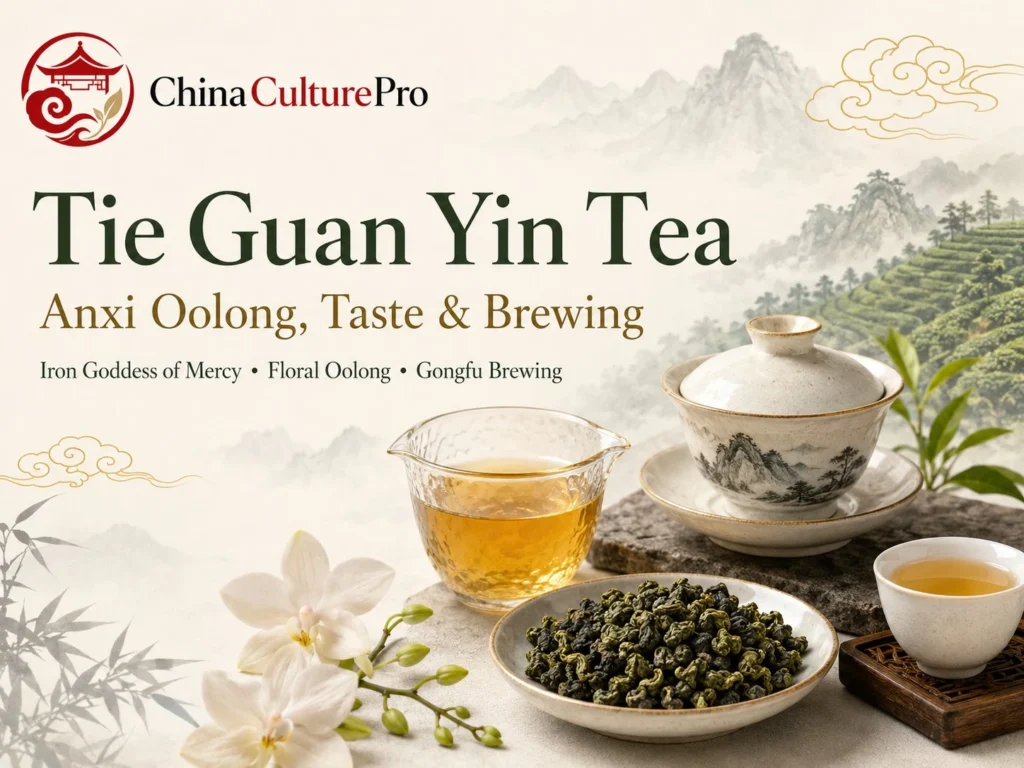

Quick Answer: What Is Tie Guan Yin Tea?
Tie Guan Yin Tea, also written as Tieguanyin, is one of China’s most famous oolong teas. Its English name is often translated as Iron Goddess of Mercy. The tea is most closely associated with Anxi County in Fujian Province, where Anxi Tie Guan Yin became one of the most representative Chinese oolong teas.
Tie Guan Yin is not green tea. It is a partially oxidized oolong tea. Its character comes from the Tie Guan Yin cultivar, Anxi oolong craftsmanship, partial oxidation, shaping, roasting, and repeated brewing.
The basic points are:
Tea Type: Chinese oolong tea, not green tea.
Core Origin: Anxi, Fujian Province.
Common English Name: Iron Goddess of Mercy.
Typical Aroma: orchid, floral, ripe fruit, roasted, or aged notes, depending on style.
Taste: smooth, sweet, layered, and often long-lasting.
Core Feeling: Guan Yin Yun, a lingering charm that combines aroma, mouthfeel, and returning sweetness.
Main Styles: Qing Xiang, Nong Xiang, and Chen Xiang Tie Guan Yin.
Brewing: high-temperature Gongfu brewing with a gaiwan or small teapot.
Key Judgment: good Tie Guan Yin should still have aroma, sweetness, and strength in later infusions.
Key Point: Tie Guan Yin is not green tea, and it is not a general name for every orchid-scented oolong. Good Tie Guan Yin should be judged by origin, cultivar, oxidation and shaping skill, roasting, aroma, mouthfeel, returning sweetness, and endurance across infusions.
Tie Guan Yin, Tieguanyin, and Iron Goddess of Mercy: Are They the Same?
The names can be confusing because tea sellers use several English spellings. In most cases, Tie Guan Yin, Tieguanyin, and Iron Goddess of Mercy refer to the same famous oolong tea.
| Term | Chinese | Meaning | Scope |
|---|---|---|---|
| Tie Guan Yin Tea | 铁观音 | the common spaced pinyin name | broad term for Tie Guan Yin tea |
| Tieguanyin | 铁观音 | the joined pinyin spelling | same tea name, different spelling |
| Iron Goddess of Mercy | 铁观音 | common English translation | same tea, translated by meaning |
| Anxi Tie Guan Yin | 安溪铁观音 | Tie Guan Yin from Anxi, Fujian | the most famous and classic origin type |
| Muzha Tie Guan Yin | 木栅铁观音 | Tie Guan Yin from Muzha, Taiwan | another important branch, often more traditionally roasted |
| Tie Guan Yin-Style Oolong | 铁观音风格乌龙 | oolong made in a similar style | may be drinkable, but should not be treated as Anxi Tie Guan Yin |
A simple way to remember it: Anxi Tie Guan Yin is Tie Guan Yin, but not all Tie Guan Yin is Anxi Tie Guan Yin. This article focuses mainly on Anxi Tie Guan Yin, while also noting Muzha and other Tie Guan Yin-style oolongs where useful.
Why Anxi Tie Guan Yin Is So Famous
Anxi Tie Guan Yin is famous because of origin, cultivar, craftsmanship, aroma, and cultural reputation. Its value does not come from the name alone. It comes from how the tea plant, mountain environment, and oolong processing work together.
Its reputation comes from several factors:
- Anxi Origin: Anxi in Fujian is the core home of Tie Guan Yin and one of China’s most important oolong tea regions.
- Tie Guan Yin Cultivar: the cultivar itself has distinctive aromatic potential when handled well.
- Orchid Aroma: good Tie Guan Yin is known for a natural orchid-like fragrance that should feel elegant, not sharp.
- Guan Yin Yun: experienced drinkers use this term for the lingering charm of aroma, mouthfeel, sweetness, and aftertaste.
- Complex Craftsmanship: withering, shaking, partial oxidation, fixing, rolling, wrapping, drying, and roasting all shape the final tea.
- Market Influence: because Anxi Tie Guan Yin is famous, ordinary tea is sometimes sold under the Tie Guan Yin name.
A Chinese tea master would not say that every Anxi Tie Guan Yin is automatically good. Origin matters, but village, season, leaf material, oxidation, roasting, storage, and the tea maker’s skill still decide the cup.
Where Tie Guan Yin Tea Comes From
Tie Guan Yin is most closely connected with Anxi, Fujian, but other regions also produce Tie Guan Yin or Tie Guan Yin-style oolong.
| Origin | Chinese Name | Location | General Style | Typical Price Position |
|---|---|---|---|---|
| Anxi Tie Guan Yin | 安溪铁观音 | Anxi, Fujian; areas such as Xiping, Xianghua, and Gande are often mentioned | orchid aroma, Guan Yin Yun, many styles from fresh to roasted | highest |
| Muzha Tie Guan Yin | 木栅铁观音 | Muzha, Taiwan | more traditional roasted style, deeper aroma, steadier taste | medium to high |
| Other Fujian Tie Guan Yin-Style | 福建其他铁观音风格茶 | other Fujian production areas | may resemble Anxi style, but character varies | medium |
| Other Tie Guan Yin-Style Oolong | 其他铁观音风格乌龙 | other regions | may look similar, but aroma and mouthfeel can differ greatly | varies |
Origin affects value and style, but it is not the only standard. A famous origin can still produce weak tea if processing or storage is poor. A less famous Tie Guan Yin-style oolong can still be enjoyable if it is clean, well-made, and honestly labeled.
What Does Tie Guan Yin Tea Taste Like?
Good Tie Guan Yin should taste smooth, clean, layered, and long-lasting. The aroma depends on style. A Qing Xiang tea may show orchid and fresh floral notes. A Nong Xiang tea may show roasted, nutty, ripe fruit, or caramel-like depth. A Chen Xiang tea may show aged, woody, or medicinal-style aroma if stored cleanly.
| Tasting Point | Good Tie Guan Yin | Weak Or Poor Tie Guan Yin |
|---|---|---|
| Aroma | natural orchid, floral, ripe fruit, clean roasted, or aged aroma | perfume-like smell, heavy grassiness, stale odor, or burnt smell |
| Aroma In The Liquor | fragrance is present when drinking, not only in the lid aroma | smells strong but tastes thin |
| Liquor | clear, bright, golden, orange-gold, or amber depending on style | dull, muddy, cloudy, or lifeless |
| First Sip | smooth, sweet, clean, and balanced | harsh, thin, sour, or rough |
| Mouthfeel | has body and substance | watery or empty |
| Bitterness | light and able to fade | heavy bitterness that stays |
| Hui Gan | clean returning sweetness | weak or absent aftertaste |
| Later Infusions | still carry aroma, sweetness, and strength | collapses after two or three brews |
Good Tie Guan Yin is not perfume-like. Its aroma should be natural and clean, and it should enter the tea liquor. If the lid smells very fragrant but the tea tastes thin, the tea lacks substance.
For many Chinese oolong drinkers, the better sign is not the loudest first aroma. It is the combination of smooth liquor, clean sweetness, natural fragrance, and endurance across later infusions.
Qing Xiang, Nong Xiang, and Chen Xiang Tie Guan Yin
Tie Guan Yin has several major styles. They should not be judged by one standard. A fresh Qing Xiang Tie Guan Yin, a roasted Nong Xiang Tie Guan Yin, and an aged Chen Xiang Tie Guan Yin can taste very different.
| Style | Chinese | Processing Direction | Aroma | Liquor Color | Taste | Best For |
|---|---|---|---|---|---|---|
| Qing Xiang | 清香型 | lighter oxidation and lighter roasting | clear orchid aroma, fresh floral notes | pale gold to light yellow-green | fresh, sweet, smooth, lively | drinkers who like clean floral aroma |
| Nong Xiang | 浓香型 | more traditional roasting and deeper processing | roasted aroma, ripe fruit, nutty notes, caramel-like warmth | golden to orange-gold | fuller, warmer, thicker, more mellow | drinkers who like roasted oolong |
| Chen Xiang | 陈香型 | aged and often re-roasted over time | aged aroma, woody notes, medicinal-style fragrance if clean | amber to deep orange-red | thick, smooth, settled, aged | drinkers who like old-tea character |
There is no absolute ranking among the three. Qing Xiang is not automatically better because it looks greener and smells brighter. Nong Xiang is not automatically better because it tastes deeper. Chen Xiang is not just old tea stored casually.
Each style has its own standard: Qing Xiang should be floral, not raw and grassy; Nong Xiang should be roasted cleanly, not burnt; Chen Xiang should have clean aged aroma, not damp or moldy storage.
What Good Tie Guan Yin Tea Looks Like
Dry leaf appearance can give useful clues, especially for Tie Guan Yin, which is often tightly rolled.
| Good Signs | Warning Signs |
|---|---|
| tight, heavy, rolled granules | loose, broken, or too many crumbs |
| solid weight in the hand | light, hollow, or poorly shaped leaves |
| sand-green or glossy green tone for Qing Xiang | overly bright green or lifeless color |
| deeper roasted tone for Nong Xiang | blackened, burnt, or unevenly roasted leaves |
| dry and clean texture | damp, soft, or sticky leaves |
| natural orchid or roasted dry aroma | sour, moldy, burnt, stale, or chemical smell |
Good Tie Guan Yin often feels dense and compact. The name includes “Tie,” or iron, and many tea drinkers use that image to describe the tea’s tight, heavy dry leaf feel. Color should match style: Qing Xiang may look greener, while Nong Xiang and Chen Xiang are darker. Greener does not automatically mean better.
How Tie Guan Yin Tea Is Made
Tie Guan Yin is an oolong tea, so the key is partial oxidation. Its quality depends heavily on how the leaves are withered, shaken, oxidized, shaped, and roasted.
| Step | Chinese Term | What Happens | Why It Matters |
|---|---|---|---|
| Picking | 采摘 | more mature leaves are picked than in green tea | oolong needs leaf strength and aroma potential |
| Sun Withering | 晒青 | leaves lose moisture under sunlight | starts aroma development and softens the leaf |
| Cooling | 凉青 | leaves rest in shade | balances moisture before shaking |
| Shaking / Making Green | 摇青 / 做青 | leaves are shaken and rested repeatedly | creates partial oxidation and floral aroma |
| Sha Qing | 杀青 | heat stops oxidation | locks in the aroma and processing result |
| Rolling / Wrapping | 揉捻 / 包揉 | leaves are rolled into tight granules | creates the compact Tie Guan Yin shape |
| Drying | 干燥 | leaves are dried | stabilizes the tea |
| Roasting | 焙火 | roasting level depends on style | shapes Qing Xiang, Nong Xiang, or Chen Xiang character |
The most important craft stage is often Yao Qing / Zuo Qing (摇青 / 做青). Repeated shaking lightly bruises the leaf edges and drives partial oxidation. This is where much of Tie Guan Yin’s floral aroma and Yun begin to form. Roasting then decides whether the final tea feels fresh, roasted, or aged.
Spring Tea, Autumn Tea, and Other Seasons
Tie Guan Yin should not be judged with the same seasonal logic as green tea. For green tea, early spring tenderness is often central. For Tie Guan Yin, autumn tea also matters.
| Season | Chinese Name | Time | Characteristics | Common Impression |
|---|---|---|---|---|
| Spring Tea | 春茶 | often around late April to May | fuller body, stronger taste, deeper mouthfeel | valued for substance and Yun |
| Autumn Tea | 秋茶 | often around September to October | higher fragrance, clearer aroma, famous “autumn aroma” | valued for aroma |
| Summer Tea | 夏茶 / 暑茶 | summer | stronger bitterness, rougher taste, usually weaker quality | generally less prized |
| Winter Tea | 冬茶 | late year in some areas | smaller volume, style varies | niche and less central |
Tie Guan Yin has a common saying in tea circles: spring tea is valued for water, and autumn tea is valued for aroma. In practical terms, spring Tie Guan Yin often has more body, while autumn Tie Guan Yin often has higher fragrance. One is not always better; they suit different preferences.
How to Brew Tie Guan Yin Tea
Tie Guan Yin is oolong tea, so it needs heat. Do not brew it like delicate green tea. Low water temperature may leave the tightly rolled leaves closed and the aroma locked inside.
| Brewing Method | Teaware | Water Temperature | Leaf Amount | Steeping Time | Best For |
|---|---|---|---|---|---|
| Gongfu Brewing | gaiwan or small teapot | 95–100°C | 5–8g / 100ml | 10–20 seconds for first infusion, then increase gradually | best way to show aroma and multiple infusions |
| Gaiwan Brewing | porcelain gaiwan | 95–100°C | 5–6g / 150ml | 20–30 seconds for first infusion | tasting and control |
| Small Teapot Brewing | small clay or porcelain pot | 95–100°C | 5–6g / 150ml | 30–45 seconds for first infusion | sharing and fuller body |
| Western-Style Brewing | mug or larger pot | 90–95°C | 2–3g / 250ml | 2–3 minutes | convenient, but less precise |
Brewing tips:
- Use hot water. 95–100°C works well for most Tie Guan Yin. Qing Xiang can be slightly lower, but not green-tea low.
- Use Gongfu brewing when possible. Multiple short infusions show how aroma, sweetness, and mouthfeel change.
- Rinse quickly if needed. A 5–10 second rinse can help tightly rolled leaves open, especially for roasted or aged styles.
- Do not over-steep the first infusion. The first full brew should be short.
- Watch later infusions. Good Tie Guan Yin should still give fragrance and sweetness after several rounds.
To see how multiple short infusions reveal Tie Guan Yin’s aroma, read our Gongfu Cha guide. For water temperature and brewing control, read our How to Brew Chinese Tea guide. For gaiwans, small teapots, and Gongfu tools, read our Chinese Teaware guide.
How to Taste Tie Guan Yin Tea
Tasting Tie Guan Yin should focus on aroma, aroma-in-liquor, mouthfeel, Guan Yin Yun, Hui Gan, and endurance. Do not judge it only by how fragrant the lid smells.
| Tasting Check | What To Look For |
|---|---|
| Dry Leaf | tight, heavy, clean, and suitable for its style |
| Dry Aroma | natural orchid, floral, roasted, or aged aroma; no sour or moldy smell |
| Liquor Color | clear and bright; pale gold for Qing Xiang, deeper gold or amber for roasted styles |
| Lid Aroma | fragrant but not sharp or artificial |
| Aroma In Liquor | fragrance should be felt while drinking, not only while smelling |
| First Sip | smooth, clean, sweet, and not rough |
| Mouthfeel | has body and thickness, not watery |
| Bitterness | light if present, and able to fade |
| Guan Yin Yun | aroma, mouthfeel, Hui Gan, and throat comfort stay together after swallowing |
| Later Infusions | fifth or eighth infusion still has aroma, sweetness, or strength |
| Spent Leaves | thick, soft, flexible, and natural-looking |
Good Tie Guan Yin may not always be the loudest tea in the room. If it smells modest but drinks smoothly, carries sweetness, and stays strong across later infusions, it may have better substance than a tea with only high fragrance.
For aroma, mouthfeel, Hui Gan, and aftertaste, read our Chinese Tea Tasting guide.
Tie Guan Yin vs Other Oolong Teas
Tie Guan Yin belongs to the broader oolong family, but it has a distinct identity. It should not be judged as Da Hong Pao, Phoenix Dan Cong, or Taiwanese high mountain oolong.
| Point | Tie Guan Yin | Da Hong Pao | Phoenix Dan Cong | Taiwanese High Mountain Oolong |
|---|---|---|---|---|
| Core Aroma | orchid, floral, Guan Yin Yun | roasted, mineral, rock character | sharp floral-fruity single-bush aroma | creamy, sweet, high mountain freshness |
| Dry Leaf Shape | tightly rolled granules | twisted strips | twisted strips | semi-ball or rolled shape |
| Mouthfeel | smooth, sweet, substantial | deeper, mineral, structured | aromatic, clear, sometimes sharp | soft, creamy, delicate |
| Roasting | Qing Xiang, Nong Xiang, Chen Xiang | often medium to heavy | light to medium, varies | usually light |
| Classic Origin | Anxi, Fujian | Wuyi Mountain, Fujian | Phoenix Mountain, Guangdong | Taiwan high mountain regions |
| Best Brewing | Gongfu brewing | Gongfu brewing | Gongfu brewing | Gongfu brewing |
These teas are not ranked by superiority. They show different oolong traditions. Tie Guan Yin is especially useful for understanding orchid aroma, rolling, partial oxidation, roasting style, and the way Gongfu brewing reveals changes across infusions.
To understand where Tie Guan Yin fits among Chinese oolong teas, read our Chinese Oolong Tea guide.
How to Choose and Buy Tie Guan Yin Tea
Tie Guan Yin is widely sold, so buying carefully matters. A beautiful orchid aroma on the lid is not enough. The tea must also have clean liquor, smooth mouthfeel, returning sweetness, and endurance.
| What To Check | Good Sign | Warning Sign |
|---|---|---|
| Origin | clearly says Anxi, Fujian, or a specific Anxi area | vague “Tie Guan Yin” with no origin detail |
| Style | Qing Xiang, Nong Xiang, or Chen Xiang is stated clearly | style is unclear or marketing language replaces real details |
| Dry Leaf Shape | tight, heavy, clean granules | loose, broken, dusty, or uneven leaves |
| Aroma | natural orchid, floral, roasted, or aged aroma | perfume-like scent, sourness, mold, burnt smell, or chemical fragrance |
| Aroma In Liquor | fragrance is present when drinking | lid smells strong, but tea tastes thin |
| Liquor | clear and bright for its style | muddy, dull, or cloudy |
| Mouthfeel | smooth, substantial, and clean | watery, rough, sour, or throat-irritating |
| Roast | clean roasting for Nong Xiang | burnt, smoky, or harsh roasted bitterness |
| Storage | clean, dry, no stale or moldy odor | damp, sour, or musty smell, especially in Chen Xiang |
| Price | matches origin, style, and seller credibility | very cheap “premium Anxi Tie Guan Yin” |
| Packaging | sealed and informative | luxury box with vague tea information |
The safest approach is not buying the most fragrant tea. It is buying a tea whose origin, style, aroma, liquor, mouthfeel, and storage all make sense. Tie Guan Yin that smells impressive but drinks thin is not a strong tea.
How to Store Tie Guan Yin Tea
Tie Guan Yin storage depends on style. Qing Xiang, Nong Xiang, and Chen Xiang should not be stored in exactly the same way.
| Style | Storage Method | Key Notes |
|---|---|---|
| Qing Xiang Tie Guan Yin | sealed, cool, dry, away from light and odors; refrigeration can help | most sensitive to oxidation and aroma loss; drink sooner after opening |
| Nong Xiang Tie Guan Yin | sealed, dry, away from light and odors; room temperature can be acceptable | roasting makes it more stable, but moisture and odors still damage it |
| Chen Xiang Tie Guan Yin | sealed, dry, clean, odor-free, checked regularly | aged aroma must be clean; damp, moldy storage ruins the tea |
General storage rules: keep it sealed, avoid moisture, avoid strong odors, avoid direct sunlight, and do not store it near spices, coffee, flower tea, or damp-storage tea.
Clean storage is especially important for Chen Xiang Tie Guan Yin. Aged aroma is not the same as mold. Good aged Tie Guan Yin should smell clean, settled, and comfortable.
Common Mistakes With Tie Guan Yin Tea
Many Tie Guan Yin problems come from treating it like green tea or judging only by fragrance.
| Mistake | Better Method |
|---|---|
| Treating Tie Guan Yin like green tea | remember it is oolong; use hotter water |
| Brewing with water that is too cool | use 95–100°C for most Tie Guan Yin |
| Long glass-cup steeping | use a gaiwan or small teapot with short infusions |
| Thinking greener means better | judge by style, aroma, liquor, mouthfeel, and aftertaste |
| Thinking stronger fragrance means better tea | check whether the aroma enters the liquor |
| Only smelling the lid aroma | drink the tea and judge mouthfeel and Hui Gan |
| Mistaking raw green smell for orchid aroma | Qing Xiang should be floral, not grassy or raw |
| Mistaking burnt flavor for traditional roasting | clean roasting is warm and layered, not harsh or burnt |
| Ignoring style differences | Qing Xiang, Nong Xiang, and Chen Xiang have different standards |
| Buying Chen Xiang without checking storage | aged tea must be dry, clean, and free from mold |
A practical order is: first learn how to brew Tie Guan Yin, then learn how to buy it. If the water is too cool or the first infusion is over-steeped, even good tea can perform badly.
Tie Guan Yin Tea Benefits
Tie Guan Yin tea is often enjoyed because it is aromatic, refreshing, and suitable for repeated brewing. It is a daily tea for many oolong drinkers.
Tie Guan Yin may fit a daily tea routine because it is:
- Refreshing: it contains caffeine and can feel clear and lively.
- Low In Calories: plain Tie Guan Yin has almost no calories when unsweetened.
- Rich In Tea Polyphenols: like other teas, it contains natural plant compounds.
- A Sugar-Free Drink: it gives aroma and taste without sweeteners.
- Good For Slow Tea Sessions: Gongfu brewing allows many infusions from one serving of leaves.
Tie Guan Yin is tea, not medicine. It should not be presented as a treatment for disease, weight loss, blood pressure, or cancer.
How Tie Guan Yin Tea Connects to Chinese Tea Culture
Tie Guan Yin is one of the classic examples of Chinese oolong tea. Use these guides to place it inside the larger Chinese tea cluster:
- To understand where Tie Guan Yin fits among Chinese oolong teas, read our Chinese Oolong Tea guide.
- To see how multiple short infusions reveal Tie Guan Yin’s aroma, read our Gongfu Cha guide.
- To compare Tie Guan Yin with other tea categories, read our Chinese Tea Types guide.
- For water temperature and brewing control, read our How to Brew Chinese Tea guide.
- For aroma, mouthfeel, Hui Gan, and aftertaste, read our Chinese Tea Tasting guide.
- For gaiwans, small teapots, and Gongfu tools, read our Chinese Teaware guide.
- To understand the larger cultural background, read our Chinese Tea Culture guide.
Final Thoughts
Tie Guan Yin is not green tea, and it is not a general name for every orchid-scented oolong.
Real Tie Guan Yin should be judged by origin, cultivar, oxidation and shaping skill, roasting, aroma, mouthfeel, returning sweetness, and endurance across infusions. Good Tie Guan Yin is not simply greener or more strongly fragrant.
A good cup should have a natural, clean aroma, such as orchid, floral, ripe fruit, or clean roasted notes; clear liquor; smooth and substantial mouthfeel; light bitterness that can fade; clean Hui Gan; and later infusions that still carry aroma, sweetness, and strength.
FAQs About Tie Guan Yin Tea
What is Tie Guan Yin tea?
Tie Guan Yin tea, also written as Tieguanyin, is a famous Chinese oolong tea from Anxi, Fujian. It is known for orchid aroma, smooth mouthfeel, returning sweetness, and multiple infusions.
Is Tie Guan Yin the same as Tieguanyin?
Yes. Tie Guan Yin and Tieguanyin are two spellings of the same tea name, 铁观音.
What does Iron Goddess of Mercy mean?
Iron Goddess of Mercy is the common English translation of Tie Guan Yin. The name is connected with Guanyin, the bodhisattva of compassion, and traditional tea legends.
Is Tie Guan Yin green tea or oolong tea?
Tie Guan Yin is oolong tea, not green tea. It is partially oxidized and shaped through oolong processing, which gives it more aroma layers and more brewing endurance than most green teas.
Where does Tie Guan Yin tea come from?
The most famous Tie Guan Yin comes from Anxi, Fujian Province. Muzha in Taiwan also produces a well-known roasted Tie Guan Yin style.
What does Tie Guan Yin tea taste like?
Good Tie Guan Yin tastes smooth, sweet, clean, and layered. Depending on style, it can show orchid aroma, floral notes, ripe fruit, roasted notes, aged aroma, and clean returning sweetness.
What is the difference between Qing Xiang and Nong Xiang Tie Guan Yin?
Qing Xiang Tie Guan Yin is fresher and more floral, often with clear orchid aroma and lighter liquor. Nong Xiang Tie Guan Yin is more roasted, warmer, thicker, and often has ripe fruit, nutty, or roasted notes.
How do you brew Tie Guan Yin tea?
Use a gaiwan or small teapot with 95–100°C water. Gongfu brewing works best: use more leaves, short infusions, and increase steeping time gradually across later brews.
How can you tell if Tie Guan Yin tea is good?
Good Tie Guan Yin has natural aroma, clear liquor, smooth and substantial mouthfeel, light bitterness that fades, clean Hui Gan, and later infusions that still carry aroma and sweetness.
How should Tie Guan Yin tea be stored?
Qing Xiang Tie Guan Yin should be sealed, cool, dry, and away from odors. Nong Xiang and Chen Xiang should be sealed, dry, clean, and protected from moisture and strong smells.