
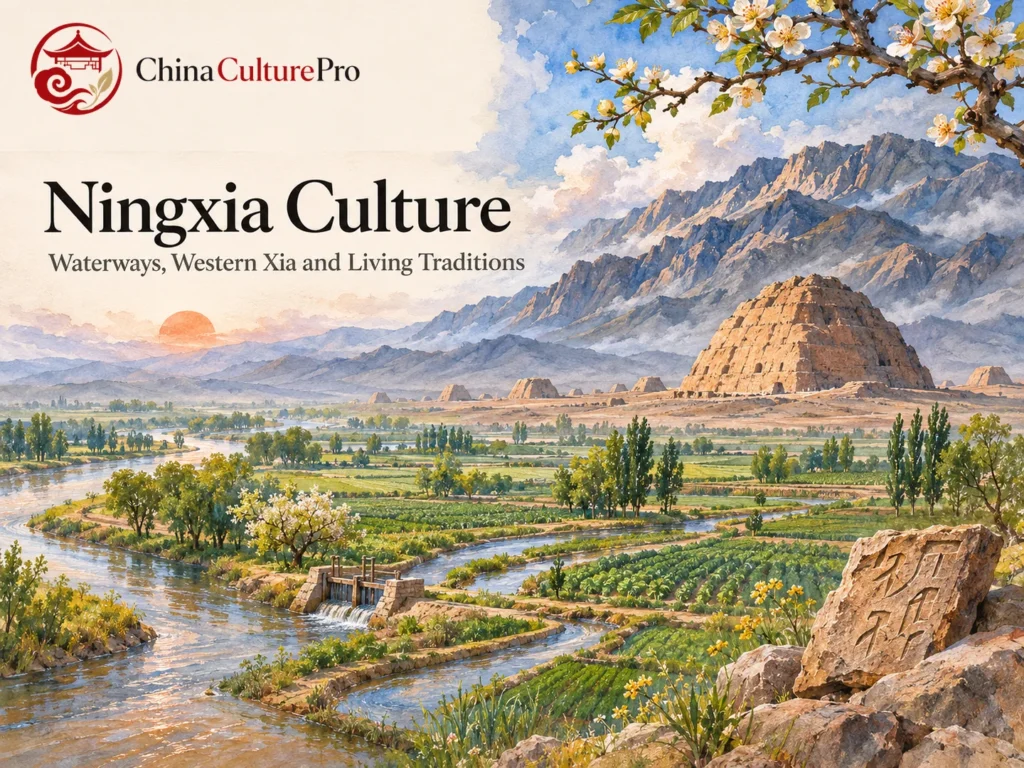

Quick Answer: What Defines Ningxia Culture?
Ningxia (宁夏, Níngxià) is a region of northwest China where the Yellow River, the Helan Mountains and communities with different histories meet. Irrigation shaped farming on the plains. The Western Xia (西夏, Xīxià) tombs preserve a Tangut dynasty’s history, while food, craft and mountain songs show how people continue to form regional traditions.[1][2][3][4][5]
- Water: Canals moved and distributed water from the Yellow River, bringing agriculture to parts of an arid region.[1]
- Dynastic history: The Western Xia tombs and inscriptions near the Helan Mountains preserve evidence of a dynasty established by the Tanguts.[2]
- Community traditions: Ningxia’s Hui communities are associated with practices such as paper cutting and mountain Hua’er (山花儿, shān huā’ér), while Wuzhong is known for serving Eight Treasures Tea.[3][4][5]
The canals, tombs and living customs reflect different periods and kinds of activity in Ningxia.
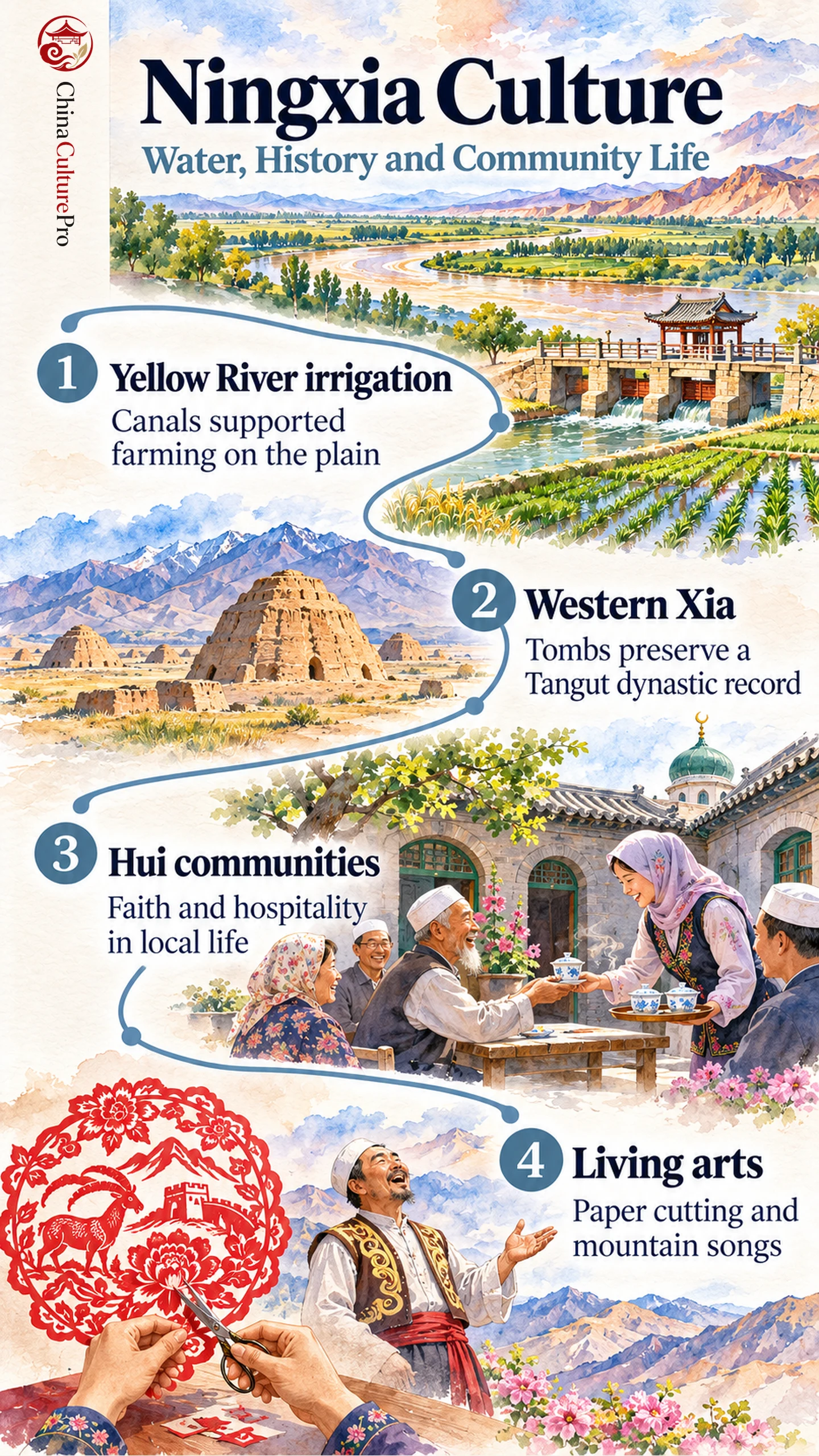
A canal gate and an earthen tomb look like different ways of shaping the land. Both leave records around the same plain. A welcome offered in a lidded tea bowl brings the story into a different setting.
Four Ways to Read Ningxia Culture
| Starting point | What to notice | What it explains |
|---|---|---|
| Yellow River irrigation | Canals, water gates and drainage | How people distributed river water to farms and settlements.[1] |
| Western Xia tombs | Earthen mausoleums and Tangut inscriptions | An imperial tradition with a regional written record.[2] |
| Wuzhong tea tables | A lidded bowl and a tea blend with dried fruit | One regional practice of sharing food and welcoming guests.[5] |
| Hui paper cutting and songs | Cut-paper designs and mountain singing | Local forms with connections across communities.[3][4] |
How the Yellow River Shaped the Plain
Ningxia’s historic Yellow River irrigation system includes supply canals, drains and structures for controlling water. Water diversion is recorded as early as the Han dynasty. Later generations extended routes and adapted them for farming needs. The International Commission on Irrigation and Drainage recognized the system in 2017.[1]
The canals show how life on parts of the plain depended on shared infrastructure. Bringing water to a field also meant maintaining channels and working out how to distribute and drain the supply. Agricultural and pastoral areas within the region had different arrangements of land and work.[1]
What the Western Xia Tombs Preserve
The tombs at the foot of the Helan Mountains are associated with Western Xia, also called Xixia, a dynasty established by the Tanguts. The complex formed between the eleventh and thirteenth centuries. The surviving remains include imperial and subordinate tombs, along with fragments of carved inscriptions in Tangut script.[2]
UNESCO added the complex to the World Heritage List in 2025. The site and its objects document an imperial lineage, its burial practices and cultural exchange across the region. Those records belong to a particular dynasty within Ningxia’s longer history.[2]
Hui Community Life and Local Traditions
In Ningxia, Hui culture has its own local forms. The national heritage register documents Hui paper cutting as a community art, and describes the role of women in carrying it forward in the region. Paper patterns make visible some of the traditions people develop across family and community settings.[3]
Ningxia’s mountain Hua’er is a local song tradition associated with Hui areas and performed by artists from more than one community. Other forms of Hua’er are found in Gansu and Qinghai. Different tune families and singing occasions give the shared tradition local character.[4][6]
A cup of Eight Treasures Tea can be a gesture of welcome in Wuzhong. Blends may include tea, dried fruit and sugar in a covered bowl. Ingredients vary. Tea may accompany local dishes and snacks, including meals where hand-grabbed mutton is served.[5][7]
FAQs About Ningxia Culture
Why Does Irrigation Matter to Ningxia’s History?
The canal network made farming possible in parts of the dry Yellow River plain. Its history includes channels, water distribution and generations of maintenance.[1]
What Do the Western Xia Tombs Tell Us?
The mausoleums and inscriptions document a Tangut dynasty and its burial practices. They preserve evidence of an earlier society in the Helan foothills.[2]
Does Eight Treasures Tea Always Have Eight Ingredients?
The name describes a style of blended tea. A documented Wuzhong preparation allows the drinker to select fewer or more ingredients.[5]
Sources
[1] International Commission on Irrigation and Drainage. Ningxia Ancient Yellow River Irrigation System
[2] UNESCO World Heritage Committee. Decision to Inscribe the Xixia Imperial Tombs
[3] China Intangible Cultural Heritage Digital Museum. Hui Paper Cutting
[4] China Intangible Cultural Heritage Digital Museum. Ningxia Hui Mountain Hua’er
[5] Ningxia Department of Culture and Tourism. Eight Treasures Tea
[6] China Intangible Cultural Heritage Digital Museum. Hua’er Traditions and Their Communities
[7] Ningxia Department of Agriculture and Rural Affairs. Mutton Traditions in Ningxia