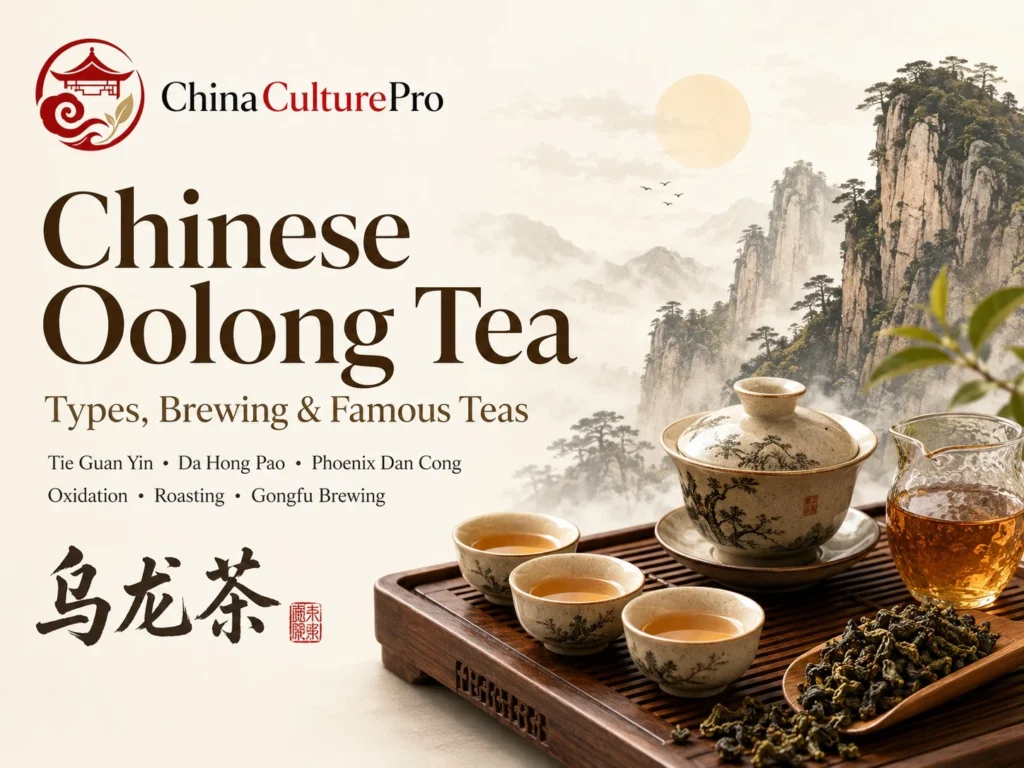

Quick Answer: What Is Chinese Oolong Tea?
Chinese oolong tea, also written as Wulong Tea (乌龙茶), is one of the six major types of Chinese tea. It is a partially oxidized tea, with oxidation levels ranging from very light to relatively heavy.
But oolong tea is not simply “between green tea and black tea.” It is an independent tea category built around Zuoqing, Yao Qing, oxidation control, roasting, and repeated infusions.
Good Chinese oolong is not only fragrant. Its aroma should enter the tea liquor, the tea body should have structure, the aftertaste should return, the throat feeling should be clean, and the flavor should keep changing across multiple brews.
| Item | Detail |
|---|---|
| Main Topic | Chinese Oolong Tea / 乌龙茶 / Wulong Tea |
| Tea Category | Partially oxidized tea |
| Core Craft | Zuoqing, shaking, oxidation control, roasting |
| Taste Direction | Floral, fruity, roasted, mineral, creamy, honey-like |
| Famous Examples | Tie Guan Yin, Da Hong Pao, Phoenix Dan Cong |
| Best Brewing Style | Gaiwan, small teapot, Gongfu-style infusions |
Key Point: Chinese oolong tea is about aroma, rhyme, roast, body, and change. It does not preserve fresh leaf character like green tea, and it does not rely on full oxidation like black tea. Its beauty comes from controlled transformation.
Why Oolong Tea Matters in Chinese Tea Culture
Oolong tea matters in Chinese tea culture because it is one of the most craft-driven tea types. Green tea values freshness. Black tea values full oxidation and sweet warmth. Pu’er and other dark teas often value aging and post-fermentation. Oolong tea values aroma, rhythm, roast, and layered change.
It also has a deep connection with Gongfu Cha. In southern Fujian, Wuyi, Chaozhou, and the Phoenix Mountain area, oolong is often brewed in small vessels, poured into small cups, and tasted through many short infusions.
In Chinese tea practice, oolong is judged through several layers:
- Craft complexity: Withering, shaking, oxidation, fixing, rolling, roasting, and resting all affect the final tea.
- Aroma entering the liquor: Good oolong should not only smell fragrant. The fragrance should appear in the tea soup itself.
- Hui Gan / returning sweetness: After swallowing, sweetness should return in the mouth.
- Hou Yun / throat feeling: The throat should feel clean, smooth, lightly cooling, or comfortable.
- Yan Yun / rock rhyme: Wuyi Rock Tea may show mineral structure, mountain character, and a firm tea body.
- Mountain environment: Origin, slope, soil, exposure, and local climate all affect taste.
- Infusion stamina: A good oolong can keep changing across many brews.
- Clean roast: Roast should add depth and stability, not burnt, dry, or harsh flavor.
Oolong tea has a more changing cultural character than green tea. A green tea may show spring freshness clearly in one or two cups. A good oolong often needs many rounds. One infusion may show floral fragrance. Another may show fruit. Later brews may show roast, mineral structure, sweetness, or throat feeling.
A Chinese tea master might say that oolong should not be judged only by the first smell. If the aroma is only on the surface, it is not enough. A good oolong carries fragrance into the liquor and leaves something behind in the mouth and throat.
That is why oolong tea represents one of the most technical and expressive sides of Chinese tea culture.
How Chinese Oolong Tea Is Made
Chinese oolong tea is not green tea, and it is not black tea. Its identity comes from partial oxidation and controlled transformation.
The most important craft stages are Zuoqing (做青), Yao Qing (摇青), oxidation control, fixing, rolling, roasting, and resting. Together, these steps create the aroma, body, roast, and layered taste of oolong tea.
| Step | Chinese Term | What It Does | Key Point |
|---|---|---|---|
| Picking | 采摘 | usually uses more mature leaves than green tea | oolong needs enough leaf substance to support aroma, body, rolling, roasting, and repeated brewing |
| Withering | 萎凋 | reduces moisture and softens the leaf | prepares the leaf for shaking and oxidation |
| Shaking | 摇青 | bruises leaf edges and starts aroma formation | one of the souls of oolong tea; shaking weight, timing, rounds, and intervals shape aroma |
| Oxidation | 氧化 / 发酵 | creates floral, fruity, honey-like depth | can be light, medium, or heavier depending on style |
| Fixing | 杀青 | stops oxidation at the desired level | similar principle to green tea Sha Qing, but the timing is different |
| Rolling / Shaping | 揉捻 / 包揉 | shapes the leaf and helps flavor release | Anxi oolong is often ball-rolled; Wuyi and Dan Cong are usually strip-shaped |
| Roasting | 烘焙 / 焙火 | adds roast aroma, body, depth, and stability | good roast should be clean and integrated, not burnt, smoky, or dry |
| Resting | 退火 | lets roast sharpness settle | freshly roasted tea may need weeks or months for the fire to soften |
Yao Qing is especially important. The leaves are shaken, tossed, or moved so that the leaf edges lightly bruise. These bruised edges begin to oxidize, while the inner part of the leaf remains less oxidized. This is the origin of the traditional phrase “green leaf with red edges,” though not every finished oolong will show it clearly.
Two tea makers can start with similar fresh leaves and produce very different teas through shaking, timing, oxidation control, and roasting. This is why oolong is a tea of skill.
A good oolong is not made by one simple step. It is shaped through timing, movement, heat, rest, and repeated judgment.
Chinese Oolong Tea vs Other Tea Types
Chinese oolong tea is different from other tea types because it depends on controlled transformation. It is not a mixed tea, and it is not simply a middle point between green tea and black tea.
| Tea Type | Difference From Oolong | Taste Direction |
|---|---|---|
| Green Tea | unoxidized, fixed early | fresh, clear, grassy |
| White Tea | lightly withered, minimal processing | soft, sweet, gentle |
| Yellow Tea | yellowing step after fixing | mellow, smooth |
| Black Tea | fully oxidized | sweet, malty, warm |
| Dark Tea | post-fermented and often aged | earthy, deep, mellow |
Oolong tea follows its own path: it controls oxidation first, then often uses roasting to shape aroma, body, stability, and depth. Its core is not “halfway.” Its core is controlled change.
This is why oolong has one of the widest flavor ranges among Chinese teas.
Main Chinese Oolong Tea Regions and Style Families
Chinese oolong tea is easier to understand by style family first, then by individual tea name.
The major style families are Anxi Oolong, Wuyi Rock Tea, Phoenix Dan Cong, and Taiwan Oolong. Fujian and Guangdong should remain the main focus of Chinese oolong, while Taiwan oolong is an important related extension.
| Style Family | Chinese Name | Main Region | Famous Teas | Taste Direction | What It Teaches |
|---|---|---|---|---|---|
| Anxi Oolong | 闽南乌龙 | Southern Fujian | Tie Guan Yin, Huang Jin Gui, Ben Shan, Mao Xie | orchid, floral, creamy, ball-rolled | fragrance, Guan Yin Yun, light and traditional oolong styles |
| Wuyi Rock Tea | 闽北乌龙 / 岩茶 | Northern Fujian, Wuyi Mountains | Da Hong Pao, Shui Xian, Rou Gui | roasted, mineral, rocky, deep | Yan Yun, roast skill, mountain character, structured tea liquor |
| Phoenix Dan Cong | 广东乌龙 | Chaozhou, Guangdong | Mi Lan Xiang, Ya Shi Xiang, Huang Zhi Xiang | high aroma, floral, fruity, mountain character | cultivar aroma, single-bush tradition, fast-pouring Gongfu brewing |
| Taiwan Oolong | 台湾乌龙 | Taiwan | Dong Ding, High Mountain Oolong, Baozhong, Oriental Beauty | smooth, creamy, floral, honey-like | high mountain smoothness, honeyed aroma, softer oolong styles |
A simple way to remember the four families is this: Anxi oolong shows fragrance, Wuyi rock tea shows rhyme, Phoenix Dan Cong shows aroma variety, and Taiwan oolong often shows smoothness.
Famous Chinese Oolong Teas
Chinese oolong has many famous teas. This section gives a practical overview rather than a full history of each tea.
| Tea | Chinese Name | Region | Style | Taste Direction | Quick Note |
|---|---|---|---|---|---|
| Tie Guan Yin | 铁观音 | Anxi, Fujian | Anxi Oolong | orchid, floral, smooth | one of the best-known oolongs; appears in light fragrant and traditional roasted styles |
| Da Hong Pao | 大红袍 | Wuyi, Fujian | Wuyi Rock Tea | roasted, mineral, deep | famous rock tea; judge by origin, roast, body, and liquor quality, not only mother-tree legends |
| Rou Gui | 肉桂 | Wuyi, Fujian | Wuyi Rock Tea | cinnamon-like, spicy, sharp | highly recognizable Wuyi cultivar with strong aromatic identity |
| Shui Xian | 水仙 | Wuyi, Fujian | Wuyi Rock Tea | mellow, woody, thick | often associated with depth, body, and old-bush character |
| Phoenix Dan Cong | 凤凰单丛 | Chaozhou, Guangdong | Guangdong Oolong | floral, fruity, high aroma | famous for many cultivar aroma types and mountain character |
| Mi Lan Xiang | 蜜兰香 | Chaozhou, Guangdong | Phoenix Dan Cong | honey-orchid, sweet, aromatic | one of the most popular Dan Cong aroma types |
| Ya Shi Xiang | 鸭屎香 | Chaozhou, Guangdong | Phoenix Dan Cong | high floral, almond-like | strange name, impressive aroma; should not be treated as a gimmick only |
| Dong Ding Oolong | 冻顶乌龙 | Nantou, Taiwan | Taiwan Oolong | roasted, nutty, rounded | classic Taiwan oolong with roast and roundness |
| Oriental Beauty | 东方美人 | Taiwan | Taiwan Oolong | honey, fruit, sweet | known for honeyed aroma and richer oxidation |
| Baozhong | 包种 | Taiwan | Taiwan Oolong | floral, light, gentle | closer to the lighter end of oolong |
Each of these teas can become its own guide. This page gives the map.
For the Taiwan oolong extension, see our Dong Ding Oolong Tea, Oriental Beauty Tea, and Baozhong Tea guides.
Tie Guan Yin, Da Hong Pao, and Phoenix Dan Cong: Three Beginner Anchors
Beginners can feel overwhelmed by Chinese oolong tea. A practical way to start is to use three anchor teas: Tie Guan Yin, Da Hong Pao, and Phoenix Dan Cong.
Together, they create a simple taste map.
| Beginner Anchor | Style Family | Taste Direction | What It Teaches | Beginner Note |
|---|---|---|---|---|
| Tie Guan Yin | Anxi Oolong | orchid-like, floral, smooth | light and floral oolong | teaches fragrance, smoothness, and the idea of aroma entering the liquor |
| Da Hong Pao | Wuyi Rock Tea | roasted, mineral, deep | rock tea, roast, and body | teaches Yan Yun, clean roast, and structured tea liquor |
| Phoenix Dan Cong | Guangdong Oolong | high aroma, floral-fruity | cultivar aroma and fragrance | teaches high aroma, mountain character, and the need for fast pouring |
A Chinese tea practitioner might say: do not chase the most expensive Da Hong Pao or old-bush Dan Cong at the beginning. First build three coordinates: Tie Guan Yin for floral aroma, Da Hong Pao for rock rhyme, and Phoenix Dan Cong for high fragrance.
Once these three are clear, the wider oolong world becomes much easier to read.
What Chinese Oolong Tea Tastes Like
Chinese oolong tea has one of the widest flavor ranges in Chinese tea. It should not be described as one single taste.
A light Tie Guan Yin, a roasted Wuyi Rock Tea, and a Phoenix Dan Cong can all be oolong teas, but they may taste completely different. What connects them is not one flavor, but the craft logic of controlled oxidation and transformation.
Common aroma and taste directions include:
- Floral / orchid-like: common in Tie Guan Yin, Baozhong, and some high mountain oolong teas.
- Fruity / honey-like: often found in Phoenix Dan Cong and Oriental Beauty.
- Roasted / nutty: common in Dong Ding, traditional Tie Guan Yin, and many Wuyi teas.
- Mineral / rocky: most strongly associated with Wuyi Rock Tea and the idea of Yan Yun, or rock rhyme.
- Spicy / cinnamon-like: linked with Rou Gui, one of the most recognizable Wuyi cultivars.
- Woody / old-bush: often used for Lao Cong Shui Xian and older-bush Wuyi styles.
- Creamy / smooth: found in some high mountain or lightly roasted oolong styles.
- Honey-orchid: a common direction in Mi Lan Xiang and related Dan Cong styles.
Taste is only one part of oolong. Texture and aftertaste matter just as much.
Important tasting dimensions include:
- Aroma entering the liquor: the fragrance should not only stay in the dry leaves or lid aroma. It should appear in the tea soup itself.
- Body: the liquor should have structure. It should not feel thin, watery, or hollow.
- Hui Gan / returning sweetness: sweetness should come back after swallowing.
- Hou Yun / throat feeling: the throat should feel clean, smooth, comfortable, or lightly cooling.
- Infusion stamina: good oolong should change across many brews.
- Clean roast: roasted oolong should not taste burnt. Fire aroma should blend with tea aroma.
Oolong tea cannot be judged only by the first infusion. A tea may smell impressive at first but become empty quickly. Another tea may begin quietly, then open into sweetness, mineral feeling, roast depth, or throat comfort after several brews.
Good oolong is not just “fragrant.” It has fragrance, liquor, body, aftertaste, and change. For a broader framework for evaluating aroma, mouthfeel, and aftertaste, read our Chinese Tea Tasting guide.
How to Brew Chinese Oolong Tea
Chinese oolong tea usually needs hotter water than green tea. Many oolongs are made from more mature leaves, have more structure, and respond well to Gongfu-style brewing.
The best method is usually small-vessel brewing: a gaiwan or small teapot, small cups, a higher leaf ratio, short infusions, and many rounds.
| Oolong Style | Water Temperature | Brewing Method | Note |
|---|---|---|---|
| Light Tie Guan Yin | 85–90°C | gaiwan, quick infusions | protect floral aroma; avoid long steeping, which can make aroma dull |
| Traditional Tie Guan Yin | 90–95°C | gaiwan or small teapot | reveal roast, body, and a rounder liquor |
| Wuyi Rock Tea | 95–100°C | gaiwan or Yixing teapot | high heat brings aroma, roast, body, and rock character |
| Phoenix Dan Cong | 90–95°C | gaiwan or Chaozhou small pot | pour quickly; Dan Cong is aromatic but can become bitter |
| Taiwan High Mountain Oolong | 90–95°C | gaiwan or porcelain teapot | short infusions preserve soft floral aroma |
Basic Gongfu-style rules:
- Use a small vessel: a gaiwan, small Yixing teapot, Chaozhou small pot, or small porcelain pot.
- Use more leaf than green tea: depending on leaf shape, the leaves may fill about one-third to one-half of the gaiwan.
- Use short infusions: the first brew may be around 5–20 seconds, depending on the tea.
- Adjust by style: tightly rolled teas may need time to open; strip-style teas may release flavor more quickly.
- Extend later brews: after the tea opens, add time gradually.
- Taste across many infusions: a good oolong can often brew 7–15 times.
The purpose of brewing oolong is not to extract everything at once. The purpose is to let the tea unfold. A good oolong may show fragrance in the early brews, body in the middle brews, and aftertaste in later brews.
Best Teaware for Chinese Oolong Tea
Oolong tea is closely connected with Gongfu Cha, so teaware matters. The right vessel helps control heat, aroma, pouring speed, and infusion strength.
| Teaware | Best Use | Why It Works / Caution |
|---|---|---|
| Gaiwan | tasting most oolong teas | clean aroma, flexible pouring, easy comparison; best all-purpose choice for beginners |
| Yixing Teapot | Wuyi Rock Tea, roasted oolong, older teas | holds heat and can round the liquor; not always ideal for light fragrant oolong because it may soften high floral aroma |
| Chaozhou Small Pot | Phoenix Dan Cong, Gongfu style | small-volume brewing concentrates aroma and supports fast pouring |
| Porcelain Cup | observing liquor and aroma | neutral, clean, does not absorb aroma; useful for comparing teas |
| Aroma Cup | high-fragrance oolong | helps smell lingering aroma; useful but optional |
| Gong Dao Bei | sharing tea evenly | keeps each cup consistent after pouring |
Teaware is not about price first. It is about control: heat, pouring speed, aroma, and balance.
Oxidation, Roasting, and Oolong Tea Styles
To understand oolong tea, two axes matter most: oxidation and roasting. Oxidation shapes whether the tea feels floral, green, fruity, honey-like, or deep. Roasting shapes whether the tea feels high-aroma, nutty, warm, thick, mineral, or mellow.
| Style Combination | Example | Taste Direction | Key Point |
|---|---|---|---|
| Light oxidation + light roast | light Tie Guan Yin, Baozhong | floral, fresh, high aroma | fragrant and clean, but should not be thin |
| Light oxidation + medium roast | traditional Tie Guan Yin | floral and roast balance | shows both aroma and body |
| Medium oxidation + stronger roast | Wuyi Rock Tea | mineral, roasted, deep | needs clean fire and structured liquor |
| Higher oxidation + light roast | Oriental Beauty | honey-like, fruity, sweet | closer to a sweet, honeyed oolong direction |
| Higher roast and aging | some aged oolong | woody, mellow, deeper | depends on storage and roast quality |
Oxidation is not better when higher. Roasting is not better when heavier. A light floral oolong is not automatically lower-level, and a heavily roasted oolong is not automatically better.
The standard is balance. Does the aroma enter the liquor? Does the roast feel clean? Does the tea have body? Does the aftertaste return? Does the flavor continue across multiple brews?
Good roasting should be transparent and well-integrated. The fire should support the tea’s aroma and structure, not sit on the surface as burnt, smoky, or dry flavor.
Oolong Tea Benefits: What to Say Carefully
Many people search for oolong tea benefits, but this topic should be handled carefully. Oolong tea can be part of a healthy lifestyle, but it is not medicine.
Oolong tea contains polyphenols, caffeine, amino acids such as theanine, aromatic compounds, and other tea constituents. These are often discussed in relation to alertness, antioxidant intake, metabolism research, and general wellness.
- Focus and alertness: Oolong tea contains caffeine, which may support alertness. The effect depends on tea strength, serving size, and personal sensitivity.
- After-meal refreshment: Many Chinese people drink oolong tea after meals because it feels clean, aromatic, and comfortable. This is a daily habit, not a medical treatment.
- Antioxidant compounds: Oolong tea contains tea polyphenols and other compounds commonly discussed for antioxidant activity.
- Weight management: Oolong tea is not a standalone weight-loss solution. Diet, exercise, sleep, and overall lifestyle matter much more.
- Caffeine caution: People sensitive to caffeine should drink moderately. Strong oolong on an empty stomach may be uncomfortable for some people.
Oolong tea should not be presented as a cure for disease, a guaranteed fat-loss drink, or a medical solution. In Chinese daily life, many people value oolong because it smells good, feels good after food, gives the mind something to follow, and changes across many brews.
That is already valuable. A tea does not need to become medicine to be worth drinking.
Common Mistakes About Chinese Oolong Tea
Chinese oolong tea is easy to misunderstand because the category is so wide. These are the most common mistakes.
- Thinking oolong is green tea mixed with black tea: Oolong tea is an independent tea category. It has its own craft system, built around Zuoqing, shaking, oxidation control, roasting, and resting.
- Thinking all oolong tea tastes the same: Oolong has one of the widest flavor ranges in Chinese tea. It can be floral, creamy, roasted, mineral, fruity, honey-like, woody, or spicy.
- Knowing only Tie Guan Yin: Tie Guan Yin is important, but it is only one major oolong style. Wuyi Rock Tea and Phoenix Dan Cong are completely different worlds.
- Using light Tie Guan Yin as the whole oolong standard: Light fragrant Tie Guan Yin is only one end of the oolong spectrum. Traditional Tie Guan Yin, Wuyi Rock Tea, Dan Cong, Dong Ding, and Oriental Beauty can taste very different.
- Brewing Wuyi Rock Tea with green tea water temperature: Rock tea needs high heat to open aroma, roast, body, and Yan Yun. Water that is too cool can make the tea flat.
- Oversteeping Phoenix Dan Cong: Dan Cong is highly fragrant, but it can become bitter quickly. Quick pouring is important, especially in early infusions.
- Thinking heavier roast means higher quality: Roast should be clean, integrated, and balanced. Burnt, dry, smoky, or harsh roast is not a sign of quality.
- Thinking stronger aroma always means better tea: Good oolong aroma should enter the liquor. If the tea smells strong but tastes thin, the fragrance may be only on the surface.
- Judging only the first infusion: Good oolong changes across many infusions. The first brew may show aroma, but later brews reveal body, sweetness, throat feeling, and stamina.
- Chasing Da Hong Pao mother-tree legends: Mother-tree stories are famous, but real buying should focus on origin, material, roasting, grade, blending, and drinking quality.
- Using a large mug for long steeping: Oolong usually performs better with small-vessel multiple infusions. Long mug steeping can flatten its layers.
- Thinking all oolong has milky aroma: Milk-like aroma belongs to specific cultivars or styles. It should not be treated as the standard for all oolong tea.
The better rule is simple: good oolong is not only fragrant. It should balance aroma, liquor, body, roast, aftertaste, throat feeling, and infusion stamina.
How to Choose Chinese Oolong Tea for Beginners
Beginners should not start by asking, “Which oolong tea is the best?” A better question is: “Which direction do I want to understand first?”
- For floral and refreshing oolong: Start with Tie Guan Yin, especially a clean light fragrant style. It teaches orchid-like aroma, smooth liquor, and the basic charm of Anxi oolong.
- For rock tea and roast: Try Da Hong Pao or Shui Xian from a reliable source. Do not begin by chasing expensive labels, old-bush claims, or mother-tree stories.
- For high floral-fruity aroma: Try Phoenix Dan Cong, especially Mi Lan Xiang. It shows the dramatic fragrance and cultivar aroma of Guangdong oolong.
- For roasted and mellow taste: Try Dong Ding Oolong or traditional Tie Guan Yin. These teas help beginners understand roast, warmth, and rounder body.
- For mineral character: Try Wuyi Rock Tea such as Rou Gui or Shui Xian. These teas help explain Yan Yun, rock character, and structured tea liquor.
- For soft and smooth drinking: Try Taiwan High Mountain Oolong. It is often sweet, smooth, floral, and beginner-friendly.
- For aroma comparison: Try several Phoenix Dan Cong aroma types, such as Mi Lan Xiang, Huang Zhi Xiang, and Ya Shi Xiang. This helps beginners understand how different cultivar aromas can be.
- For limited budget: Start with reliable entry-level tea. Do not begin with expensive old-bush, Zhengyan, competition, or legendary-name teas. Build your taste standard first.
Oolong tea entry is about direction. Clear fragrance, roast, rock rhyme, high aroma, floral-fruit notes, creamy texture, body, and returning sweetness are all different goals.
Once you know what direction you like, choosing oolong becomes much easier.
How Chinese Oolong Tea Connects to Chinese Tea Culture
Chinese oolong tea is the second major tea-type page under the Chinese Tea Culture core guide, after Chinese Green Tea. It connects the six-type tea system with Gongfu brewing, regional tea families, famous oolong teas, teaware, and careful tasting vocabulary.
- To understand the full tea system first, read our Chinese Tea Culture guide.
- To compare oolong with green, white, yellow, black, and dark tea, read our Chinese Tea Types guide.
- To see how oolong differs from fresh unoxidized tea, read our Chinese Green Tea guide.
- To compare oolong with fully oxidized Chinese red tea, read our Chinese Black Tea guide.
- For skilled small-vessel brewing, read our Gongfu Cha guide.
- For gaiwans, Yixing teapots, small pots, and aroma cups, read our Chinese Teaware guide.
- For floral Anxi oolong, read our Tie Guan Yin guide.
- For the most famous Wuyi rock tea, read our Da Hong Pao guide.
- For mineral roasted oolong from Fujian, explore the Wuyi styles covered by the Da Hong Pao, Shui Xian, and Rou Gui guides below.
- For high-fragrance Guangdong oolong, read our Phoenix Dan Cong guide.
- For mellow Wuyi oolong with old-bush depth, read our Shui Xian Tea guide.
- For cinnamon-like Wuyi rock tea, read our Rou Gui Tea guide.
- For broader brewing temperatures and infusion timing, read our How to Brew Chinese Tea guide.
- For cautious wellness wording, see the Oolong Tea Benefits section above rather than treating oolong tea as medicine.
Final Thoughts
Chinese oolong tea is not about fragrance alone. It is about aroma, rhyme, roast, body, and change.
Unlike green tea, which preserves the fresh clarity of spring leaves, or black tea, which gains sweetness through full oxidation, oolong tea depends on Zuoqing, shaking, partial oxidation, and roasting.
A good oolong should have aroma entering the liquor, structured tea body, strong returning sweetness, clean throat feeling, and changing flavor across repeated infusions.
To understand Chinese oolong tea, readers need more than the names Tie Guan Yin, Da Hong Pao, and Phoenix Dan Cong. They need to understand floral aroma, rock rhyme, roast skill, mountain character, cultivar fragrance, and infusion stamina.
That is the Chinese oolong tea aesthetic: not one fixed taste, but a living balance of fragrance, fire, mountain, water, and time.
FAQs About Chinese Oolong Tea
What is Chinese oolong tea?
Chinese oolong tea, or Wulong Tea, is one of the six major Chinese tea types. It is partially oxidized and shaped through Zuoqing, shaking, oxidation control, fixing, rolling, roasting, and resting. Its flavor can range from floral and creamy to roasted, mineral, fruity, honey-like, or woody.
Is oolong tea green tea or black tea?
Oolong tea is neither green tea nor black tea. It is an independent tea category. Green tea is unoxidized or minimally oxidized, while black tea is fully oxidized. Oolong tea is partially oxidized and has its own craft system based on controlled transformation.
What does Chinese oolong tea taste like?
Chinese oolong tea can taste floral, orchid-like, fruity, honey-like, roasted, nutty, mineral, woody, creamy, or spicy. Tie Guan Yin is often floral, Wuyi Rock Tea is often roasted and mineral, and Phoenix Dan Cong is known for high floral-fruity aroma.
What are the most famous Chinese oolong teas?
Famous Chinese oolong teas include Tie Guan Yin, Da Hong Pao, Wuyi Rock Tea, Rou Gui, Shui Xian, Phoenix Dan Cong, Mi Lan Xiang, Ya Shi Xiang, Dong Ding Oolong, Oriental Beauty, and Baozhong. Each belongs to a different regional or stylistic family.
Is Tie Guan Yin an oolong tea?
Yes. Tie Guan Yin is one of the most famous Chinese oolong teas. It comes from Anxi in southern Fujian and is known for orchid-like aroma, smooth liquor, and the idea of Guan Yin Yun. It can appear in light fragrant and more traditional roasted styles.
Is Da Hong Pao an oolong tea?
Yes. Da Hong Pao is a famous Wuyi Rock Tea, which belongs to the oolong category. It is associated with roasted aroma, mineral structure, rock rhyme, and deep tea body. It should not be judged only by mother-tree legends.
What is Wuyi Rock Tea?
Wuyi Rock Tea, or Yan Cha, is a family of oolong teas from the Wuyi Mountains in Fujian. Famous examples include Da Hong Pao, Rou Gui, Shui Xian, Tie Luo Han, Bai Ji Guan, and Shui Jin Gui. Its character often includes roast, mineral quality, and Yan Yun.
What is Phoenix Dan Cong?
Phoenix Dan Cong is a Guangdong oolong from the Phoenix Mountain area near Chaozhou. It is famous for single-bush traditions and many aroma types, such as Mi Lan Xiang, Ya Shi Xiang, Huang Zhi Xiang, and Zhi Lan Xiang. It is highly fragrant but needs careful brewing.
How do you brew Chinese oolong tea?
Chinese oolong tea is usually best brewed Gongfu style. Use a gaiwan or small teapot, a higher leaf ratio, small cups, hot water, and short infusions. Many oolongs brew well at 90–100°C, depending on style. Pour quickly and taste through multiple rounds.
What water temperature is best for oolong tea?
Most Chinese oolong teas brew well between 90–100°C. Light Tie Guan Yin may use slightly lower water around 85–90°C to protect floral aroma. Wuyi Rock Tea often needs near-boiling water to open roast, aroma, body, and rock character.
Can oolong tea be brewed many times?
Yes. Oolong tea is one of the best tea types for multiple infusions. A good oolong may brew 7–15 times, depending on leaf quality, tea style, vessel, and brewing method. Each infusion can show a different balance of aroma, body, sweetness, roast, and aftertaste.
Is oolong tea caffeinated?
Yes. Oolong tea contains caffeine. The amount depends on cultivar, leaf maturity, oxidation, roasting, tea amount, water temperature, and infusion time. People sensitive to caffeine should drink moderately and avoid strong oolong late in the day.
Is oolong tea good for weight loss?
Oolong tea may be part of a healthy lifestyle, but it is not a standalone weight-loss solution. It contains caffeine and tea polyphenols, but body weight depends on diet, activity, sleep, metabolism, and overall habits. Oolong tea should not be treated as a diet medicine.
What is the difference between Chinese oolong and Taiwanese oolong?
Chinese oolong is often centered on Fujian and Guangdong styles such as Tie Guan Yin, Wuyi Rock Tea, and Phoenix Dan Cong. Taiwan oolong includes Dong Ding, High Mountain Oolong, Baozhong, and Oriental Beauty. Both are oolong, but their regional traditions and flavor directions differ.
What is the best oolong tea for beginners?
For floral aroma, start with Tie Guan Yin. For roast and rock character, try Da Hong Pao or Shui Xian. For high fragrance, try Phoenix Dan Cong, especially Mi Lan Xiang. For a softer and smoother style, try Taiwan High Mountain Oolong. Choose by taste direction, not only by fame.