


Quick Answer: What Is Chinese Snuff Bottle Inside Painting?
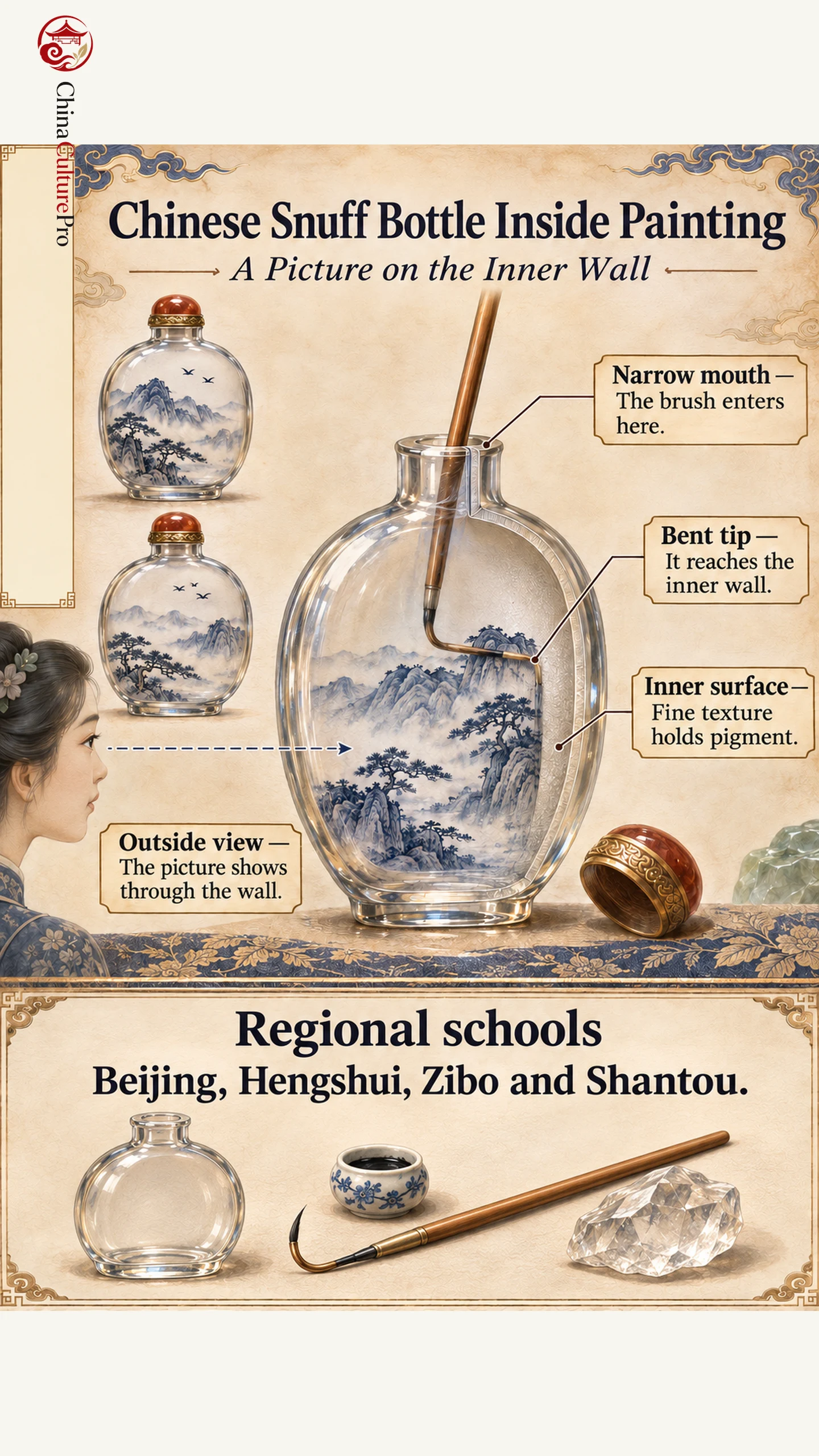
Chinese snuff bottle inside painting (内画, nèihuà) places a miniature picture on the inner wall of a small bottle. The artist guides a fine, curved brush through the mouth, then works with the tip turned toward the glass or crystal. The viewer sees the picture through the wall from outside. [1][2][3]
- Surface: A clear or translucent wall lets the image show through.
- Brush: A bent tip reaches the inner face through a narrow mouth.
- View: A bottle can carry a different scene on each side. [1][2][3]
The narrow mouth limits the painter’s movements. The front and back walls each give room for a design, as the dated pieces below show.
Turn an inside-painted bottle and a landscape can give way to birds or a line of writing. Each scene shares the same tiny space behind the neck. Its composition has to work through the curve and thickness of the wall.
How a Brush Reaches the Inner Wall
The inner surface needs enough texture for pigment to grip. A National Palace Museum note describes using fine abrasive and small bearings to roughen a glass bottle inside. The outer face stays smooth, letting the viewer look through it at the brushwork. Glass and rock crystal are both documented in museum examples. [1][2]
A narrow neck limits the angle of the brush shaft. The curved tip reaches sideways to the inner wall. The painter can see the image through the vessel while moving the brush from the back of the painted surface. The artist works on the back of the image as seen by the viewer. In a written inscription, the order and direction of the strokes have to make sense when read through the glass. [1][2][3]
To identify the technique, look at where the design sits. Other Chinese snuff bottles can carry a design in carved stone, layered glass or enamel on the outside. In layered glass, for instance, a design can be cut into an outer layer to expose the color below it. [2][3]
What Three Dated Bottles Show
The National Palace Museum’s six-centimeter glass bottle by Zhou Leyuan shows travelers and buildings in a landscape. The museum places it in the Guangxu reign (1875–1908) and records a signature near the neck. It comes from the former Qing court collection. Look from the people and buildings to the shaded hills. Those shifts in scale and tone create the sense of distance on a wall only a few centimeters wide. [1]
In 1907 Ma Shaoxuan painted the late Qing official Duan Fang inside a rock crystal bottle. The Hong Kong Museum of Art compares the portrait’s precision to photography. Its collection also has a glass bottle that Wang Xisan painted in 1968, with a paradise flycatcher on one side and swallows on the other. The museum notes that Wang added an inscription when he saw the bottle again in 1992. The two examples have different subjects and materials. The crystal wall carries a single likeness, while the glass bottle’s two sides invite the viewer to turn from a perched bird to birds in flight. [2]
Four Regional Schools of Inside Painting
The national heritage register groups Beijing, Hengshui, Zibo and Shantou as regional traditions. The schools share a way of working through the bottle mouth. They also overlap. Wang Xisan trained with members of the Ye family in Beijing before developing his practice in Hebei. Shandong’s heritage record describes local glass blanks and training through families and apprenticeships. The workshops of Wu Songling and his son Wu Zekun in Shantou also trained new painters. The regional names record connections between places, teachers and materials. [4][5][6][7]
| School | Center | Documented feature |
|---|---|---|
| Beijing | Beijing | Late Qing artists include Zhou Leyuan, Ma Shaoxuan and Ye Zhongsan. [4] |
| Hebei | Hengshui | Wang Xisan trained in the Beijing lineage and developed a hooked brush with a metal shaft. [5] |
| Shandong | Zibo | Makers draw fine lines on locally produced glass blanks. [6] |
| Guangdong | Shantou | Wu Songling’s lineage combines Lingnan color with forms that can include exterior gilt decoration. [7] |
FAQs About Chinese Snuff Bottle Inside Painting
Are all Chinese snuff bottles painted inside?
Chinese snuff bottles use several kinds of decoration. Some have designs carved in relief or painted in enamel. Inside-painted bottles have pigment on the wall facing the hollow interior. [2][3]
Why is inside painting called reverse painting?
The artist applies pigment on the inner face of the wall so the viewer can see the finished design through the other side. The strokes are oriented for that outside view. [1][2][3]
Were inside-painted bottles used to hold snuff?
Snuff bottles were made to hold powdered tobacco. The Hearst Museum explains that inside-painted bottles were often kept for display to protect the artwork on the inner wall. [1][3]
Sources
[1] National Palace Museum. Glass Inside-Painted Snuff Bottle with a Traveling Scene
[2] Hong Kong Museum of Art. Fuyun Xuan Collection of Chinese Snuff Bottles
[3] Phoebe A. Hearst Museum of Anthropology. Snuff Bottles: About the Methods Used to Make the Bottles
[4] China Intangible Cultural Heritage Network. Inside Painting: Beijing Inside-Painted Snuff Bottles
[5] China Intangible Cultural Heritage Network. Hengshui Inside Painting
[6] China Intangible Cultural Heritage Network. Inside Painting: The Shandong School
[7] China Intangible Cultural Heritage Network. Inside Painting: Guangdong