


Quick Answer: What Is Chinese Shadow-Puppet Leather Carving?
In Chinese shadow-puppet leather carving, a maker cuts thin, translucent hide into pieces for a shadow puppet (皮影, píyǐng). Colored leather and open cutouts shape the image on a backlit screen. Some pieces are joined so a performer can move the figure with rods. [1][2][3]
- Hide: Scraped and smoothed leather can transmit light.
- Pattern: Color, cutouts and the outer edge define the costume and face.
- Movement: Joints let separate parts of the figure turn. [1][2][3]
To see how carving contributes to the performance, follow the light through the puppet and watch where its parts overlap.
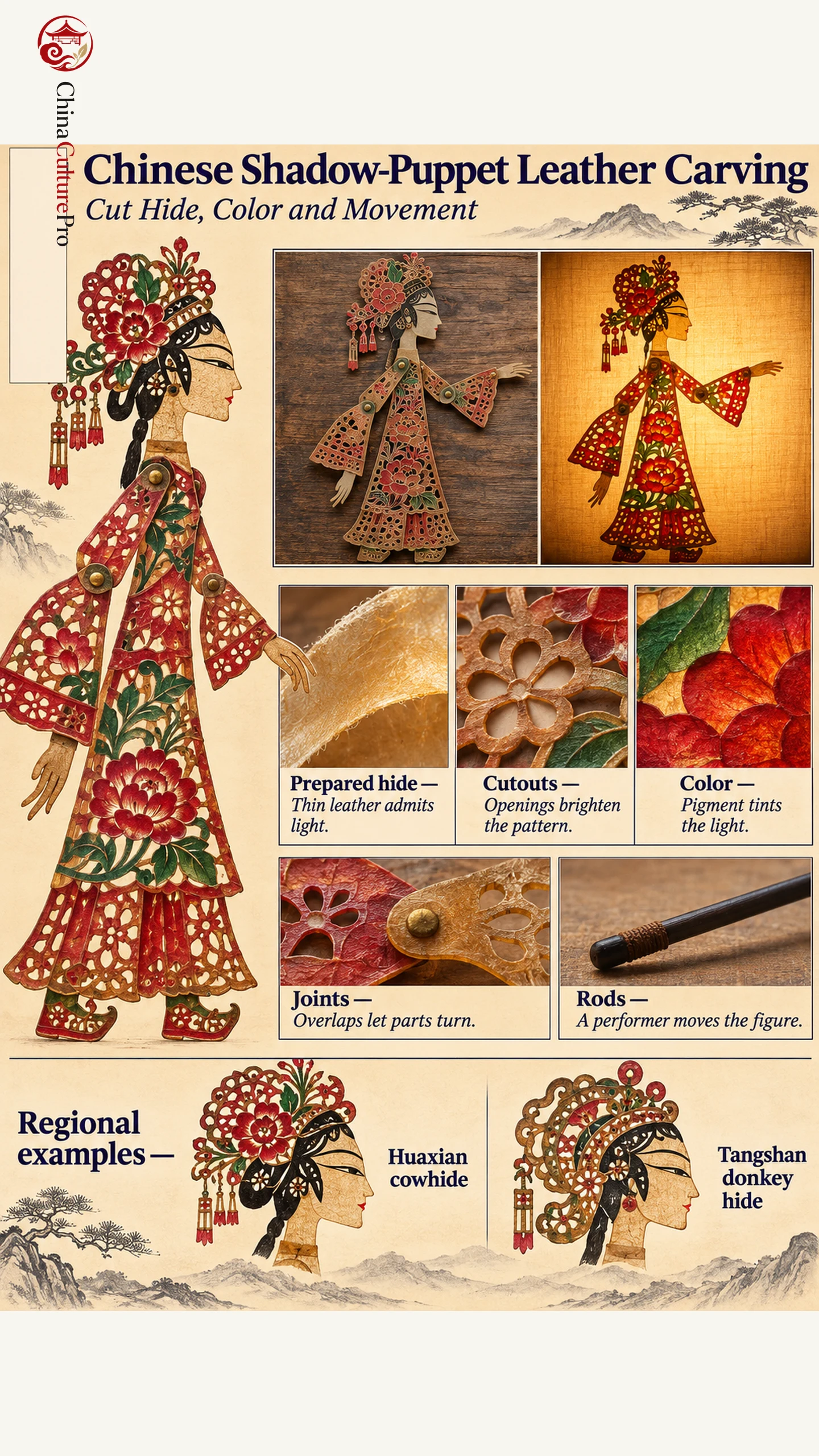
As a figure raises its hand, a line of bright holes along the sleeve rises with it. The puppeteer moves the arm. The carver decided where to leave leather and where to open it, giving the sleeve a pattern that can be seen even in motion.
How Hide Carries Color and Light
The Shaanxi Provincial Cultural Center describes Huaxian makers soaking and scraping cowhide until it is thin enough to admit light, then smoothing the surface. In performance the lamp shines through the hide as well as through the cloth screen. The cutouts pass more light than the colored areas, making small patterns visible. [1][2][3]
After carving, makers apply color and flatten the pieces before joining them. A thinner, lightly colored patch can glow against darker outlines and denser pigment. This is why a puppet on the bench and the same puppet against a lit cloth reveal different details. For the role of rods, singers and musicians in a full performance, see Chinese shadow puppetry. [1][2][3]
What Carvers Cut Into the Leather
Huaxian makers use inherited pattern drawings to lay out a figure. A metal point transfers the outline and inner designs to the prepared hide. The pieces for the head, arms and body are traced separately. A set of blades with different widths helps the maker cut broad shapes and closely spaced details. [2]
The carving method associated with Huaxian involves moving the hide against the blade to follow a curve. The national heritage network records that Wang Tianwen began learning with Li Zhanwen at age twelve. He practiced moving the hide before he progressed to flowers and then to figures. Turning the hide lets the carver follow the changing direction of a curve. Thin bridges between openings keep the design connected, even where the light picks out a dense pattern. [2][3][4]
Wang’s Shadow Museum shows how cutouts can describe different costumes. Its examples include armor with herringbone patterns and scholars’ robes with flowers or birds. On the screen, a repeated mark across the armor reads as a surface pattern even if the audience cannot see the individual knife cuts. [3]
How Joints and Rods Make a Figure Move
A Huaxian account describes a human figure with eleven pieces. These include the head, chest and abdomen, and pairs of legs, upper arms, forearms and hands. Holes in overlapping leather sections take small hide pins or ties made from narrow strips of leather. Each connection must let the pieces turn while keeping them close to the plane of the screen. [2]
Rods carry the puppeteer’s movement to the leather. A description of Tangshan performances identifies one main rod and two hand rods. The figure can travel across the cloth while the hands move separately. [1][5]
Two Regional Traditions and a Living Workshop
Huaxian, now Huazhou District in Weinan, Shaanxi, has a documented cowhide tradition. Tangshan in Hebei is known for donkey-hide figures. The national heritage account also associates Tangshan performances with singing in the Laoting dialect. [2][5]
A Shaanxi heritage report documents a 2020 event in which Wang Tianxi and his daughter demonstrated Huaxian work. Visitors tried coloring pieces, then performed with puppets behind the screen. A coloring exercise shows the maker what the leather takes up. Using the puppet behind a lighted cloth shows how the colors and cutouts look from the other side. [6]
FAQs About Chinese Shadow-Puppet Leather Carving
Are all Chinese shadow puppets made of leather?
Paper figures are also part of Chinese shadow puppetry. UNESCO included both paper and leather figures in its description of the theatre tradition inscribed on the Representative List in 2011. [1][2][5]
Do all shadow puppets have the same number of pieces?
The number varies with the design and the regional tradition. The eleven-piece figure described in the Shaanxi record is one model for a Huaxian human character. [1][2]
Why do parts of the puppet look dark on the screen?
Dark pigment, thicker hide or overlapping pieces allow less light through. Open cutouts appear brighter because the light can reach the cloth through the holes. [1][2][3]
Sources
[1] UNESCO. Chinese Shadow Puppetry
[2] Shaanxi Provincial Cultural Center. Huaxian Shadow-Puppet Making
[3] Wang’s Shadow Museum. The Traditional Art Form of Chinese Shadow Puppetry
[4] China Intangible Cultural Heritage Network. Shadow-Puppet Carver Wang Tianwen
[5] China Intangible Cultural Heritage Network. National Intangible Cultural Heritage: Shadow Puppetry
[6] Shaanxi Intangible Cultural Heritage Network. Traditional Crafts Demonstration in Shaanxi