
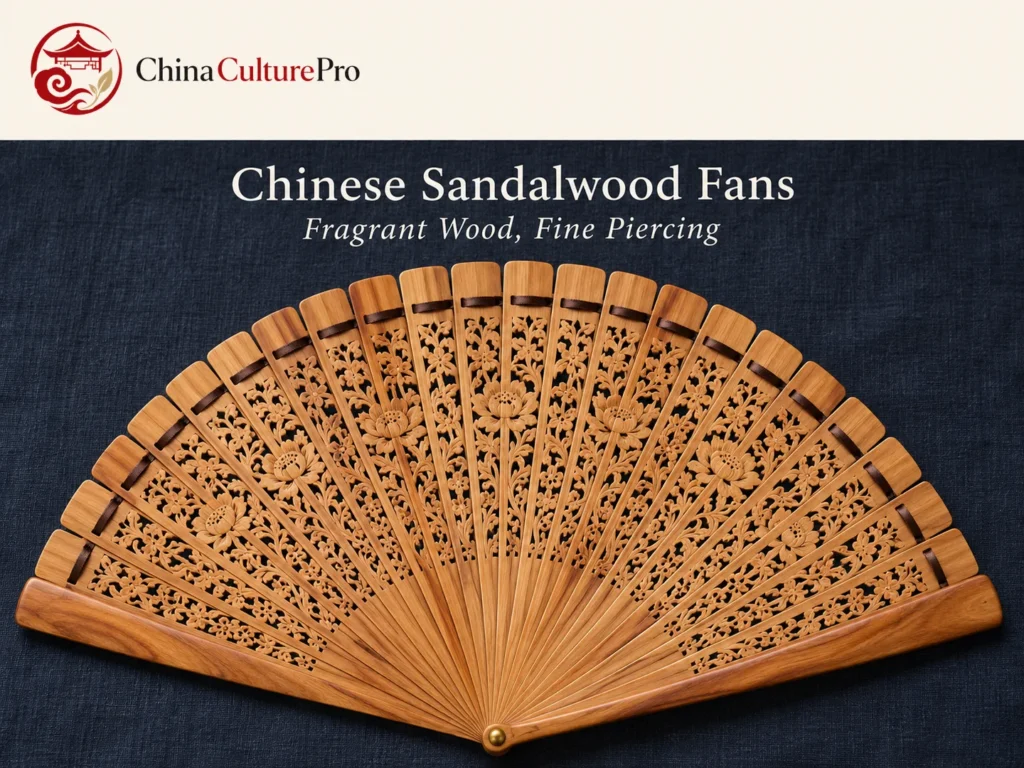

Quick Answer: What Is a Chinese Sandalwood Fan?
A Chinese sandalwood fan (檀香扇, tánxiāngshàn) folds into a stack of aromatic wooden sticks. Suzhou is an important center of the craft. When spread open, those sticks become the surface for pierced, heat-drawn, carved or painted decoration. [1][2][4]
- Material: Sandalwood gives the fan a natural fragrance.
- Construction: A pivot lets the sticks spread, and a ribbon can hold them at even intervals.
- Decoration: Pierced holes let light through, while heat leaves brown marks on the wood. [1][3][4]
Look for the join between the wooden sticks near the top of an open fan, then follow the sticks down to their shared pivot.

A pale band of flowers can come into view as a sandalwood fan opens. Each stick carries only part of the band. At full spread, the fragments form a continuous design. As the fan closes, the sticks slide over one another and the flowers disappear into the stack.
How the Wooden Sticks Form the Fan
A common construction uses thin wooden sticks that widen toward the outer edge. They turn around a shared pivot at the narrow end. A ribbon links the sticks higher up and limits how far each can move. The thicker outer sticks, called guards, protect the thinner ones when they lie in a stack. [3][4]
A folding fan covered in a pleated paper or silk leaf creates its surface in a different way. Its ribs support the leaf. On an all-wood sandalwood fan, the wide portions of the sticks make the visible surface themselves. The difference is easiest to see beside other types of Chinese fans. [1][2][4]
Four Ways to Decorate the Wood
Suzhou’s heritage records name four decorative methods. For pierced work, or lāhuā (拉花), a fine saw removes wood from within a pattern. The openings form part of the drawing. In the Hangzhou workshop photographed by Xinhua, a fine wire saw moves through a thin wooden stick. Look across the finished sticks to see how separately cut openings continue a motif from one stick to the next. In heat drawing, or tànghuā (烫花), a heated point darkens the wood in shades of brown. [1][2][3]
Carving, or diāohuā (雕花), cuts lines or relief into the wood. Painted decoration, or huàhuā (画花), adds pigment to the surface. The techniques can be combined. Hold a pierced area against the light to see the cut edges. On a solid area, tilt the wood to distinguish a carved groove from brown shading or a layer of color. [1][2][3][6]
What an 1870 Fan Reveals
The Los Angeles County Museum of Art catalogues a Chinese brisé fan dated 1870. Its record lists sandalwood sticks, a silk ribbon and a brass loop and rivet. The outer guard has a pierced floral design. The object makes it possible to see carved detail alongside the fastenings that keep the fan together. [4]
The guard measures just over 24 centimeters and the open fan spans just over 40. The ribbon is one reason that a narrow stack can open into such a broad surface. Suzhou’s heritage record describes the local tradition. LACMA’s attribution is to China, so this fan can illustrate the construction without tying it to a particular Suzhou workshop. [1][4]
How Suzhou Makers Carry the Craft Forward
Suzhou fan making entered China’s national intangible cultural heritage list in 2006. The listing includes sandalwood fans, other folding fans and silk palace fans. Xing Weizhong entered the Suzhou Sandalwood Fan Factory in 1970 and studied with fan maker Zhou Tianmin. The national register records a 50-centimeter fan he created in the 1980s, inspired by a story about the painter Tang Yin and Qiuxiang. Xing used piercing and heat drawing on the same piece. The fine openings admit light while the burn marks give solid parts of the composition a range of tones. [1][6]
In a 2022 interview, Suzhou maker Chen Qin discussed the cost of sourcing Indian sandalwood and the use of Australian sandalwood as an alternative in the workshop. She described using some machine work alongside handwork to bring down the cost of producing fans. She also identified training as a challenge because the decorative work draws on both tool control and drawing skills. [7]
FAQs About Chinese Sandalwood Fans
Are all sandalwood fans from Suzhou?
Suzhou has a documented sandalwood fan tradition, and Hangzhou workshops have also made sandalwood fans. Look for a maker or collection record to identify where an individual fan came from. [1][3][4]
What does brisé mean in a fan catalogue?
Brisé describes a folding fan whose sticks form the fan face. A ribbon or other connector can link them. The sticks can be wood, ivory or other materials. [4][5]
Can a fan’s scent identify how it was made?
Sandalwood naturally has a fragrance. The pattern, tool marks and how the sticks are fastened tell you more about the construction. Use workshop or collection records if you need to establish a maker or technique. [1][4][7]
Sources
[1] China Intangible Cultural Heritage Network. Fan-Making Techniques: Suzhou
[2] Suzhou Intangible Cultural Heritage Information Network. Suzhou Fan-Making Techniques
[3] Xinhua. Traditional Craft: Folding Fans
[4] Los Angeles County Museum of Art. Brisé Fan, 1870
[5] The Metropolitan Museum of Art. Brisé Fan, with Representations of Pastoral Scenes
[6] China Intangible Cultural Heritage Network. Xing Weizhong
[7] Chen Jie, China Jiangsu Network. Old Skills and New Stories in Intangible Heritage