

Quick Answer: What Is the Paixiao?
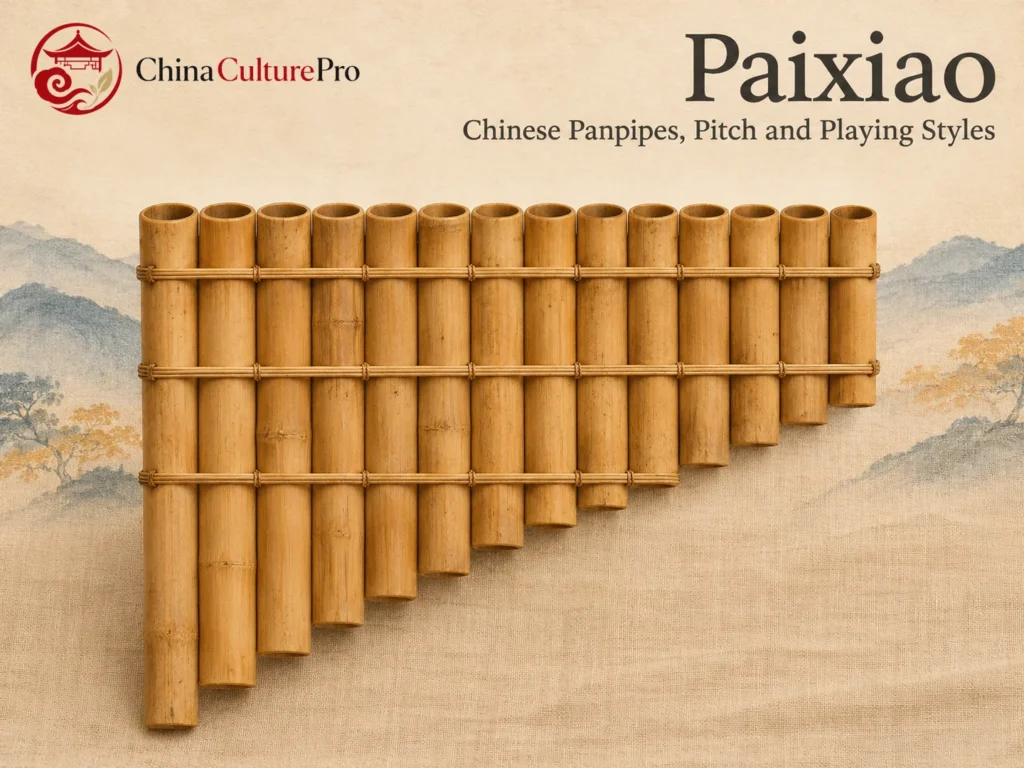
The paixiao (排箫, páixiāo) is a set of Chinese panpipes. The player blows across the ends of graduated tubes and moves along the row to sound different notes.[1][3]
- Sound source: The breath meets the edge of a tube opening and excites the air inside.[3]
- Museum example: A Warring States paixiao in the Hubei Provincial Museum has 13 bamboo tubes.[1]
- Design variation: Historical and modern instruments vary in their number of pipes.[2][4]
When watching a player, follow which tube comes to the lips at each change of pitch.

A row of bamboo tubes may look like one large flute from a distance. Up close, the separate openings reveal the playing method. Each tube has its own sounding length, and the player selects notes by shifting along the row.
How a Row of Pipes Makes a Melody
Blow across the open rim of a panpipe and a narrow air jet interacts with the edge. The vibrating air inside the pipe reinforces a pitch. In a row of otherwise comparable pipes, a longer sounding length generally gives a lower note. The player selects another note by directing the breath across a different opening.[3]
The ends of the tubes matter. The Palace Museum describes historical paixiao with sealed and unsealed bottoms. The modern orchestra guide describes adjustable corks that allow individual pipes to be tuned. Check the construction before using visible length as a precise guide to pitch.[2][4]
What the Zeng Hou Yi Find Shows
Two sets of panpipes came from the tomb of Zeng Hou Yi (曾侯乙, Zēng Hóu Yǐ), the Marquis Yi of Zeng. In an exhibit record from the National Museum of China, one set consists of 13 bitter-bamboo tubes held by three bamboo braces and wrapped with fine cord. The burial was excavated in Suizhou, Hubei, in 1978.[1]
The detail tells you how one ancient maker kept individual pipes aligned. In a catalog photograph, look for the braces crossing the row and the ties around them. The Warring States find provides evidence for the materials and assembly of that instrument.[1]
From Tang Figures to Qing Court Music
A painted Tang ceramic figure in the Palace Museum holds a set of panpipes with both hands. The 34-centimeter figure depicts a playing posture. The museum describes paixiao in banquet entertainment as well as in ensembles for ceremonial processions.[2]
The Qing court’s Zhonghe Shaoyue (中和韶乐, Zhōnghé Sháoyuè) included paixiao among its ceremonial instruments. The Palace Museum lists it separately from the xiao (箫, xiāo), sheng and xun. The ensemble therefore included several kinds of wind instrument alongside bells, stone chimes and drums.[5]
How to Recognize Paixiao in Performance
The paixiao appears occasionally in modern Chinese orchestral practice. An Instrumental Guide to the Chinese Orchestra describes varying tube counts and ranges. Its repertoire examples include Du Cong’s arrangement of Liu Furong’s Spring in the Pamirs.[4]
If a performance video shows the player clearly, notice the sideways movement across openings. On a single xiao flute, a performer changes notes primarily through the finger holes along one tube. Compare the two hand positions in a video. One player selects a pipe at the mouth, while the other changes which holes are covered.[3][6]
FAQs About Paixiao
Does every paixiao have 13 pipes?
Thirteen is the count on one excavated instrument from the Zeng Hou Yi tomb. Other historical examples and modern concert instruments can have different numbers.[1][4]
What is the difference between paixiao and xiao?
Paixiao uses a bank of separate pipes. In modern instrument names, xiao usually means a single vertical flute with finger holes. The older term xiao can also occur in accounts of panpipes.[2][4]
Does paixiao use a reed?
The air jet strikes the edge of a pipe opening to make a sound. The Chinese musical instruments guide puts that mechanism in context alongside reed and percussion instruments.[3]
Sources
[1] National Museum of China. Bronze Age Finds from Hubei: Panpipes
[2] The Palace Museum, Beijing. Painted Ceramic Figure Holding Panpipes
[3] Neville H. Fletcher, Journal of the Acoustical Society of America. Stopped-Pipe Wind Instruments: Acoustics of the Panpipes
[4] Lithuanian Academy of Music and Theatre, Intermusic. An Instrumental Guide to the Chinese Orchestra
[5] The Palace Museum, Beijing. Zhonghe Shaoyue
[6] The Metropolitan Museum of Art. Xiao, Late Nineteenth Century