

Quick Answer: What Is a Zhiju Robe?
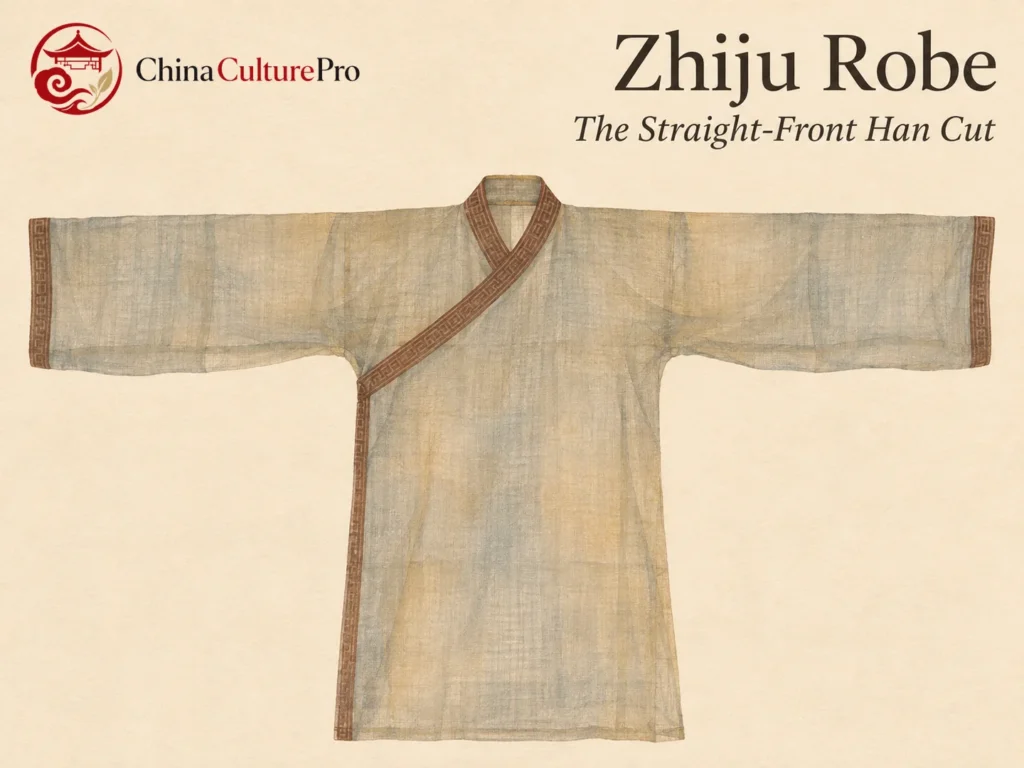
A zhiju (直裾, zhíjū) robe has a straight-falling lower front edge. A robe can have that edge and a crossed collar at the same time. The straight-front silk gauze gown from Xin Zhui’s tomb at Mawangdui is a Western Han example.[3][6]
- Front edge: Follow the lower overlap to see whether it falls directly or continues around the body.[6]
- Comparison: A quju robe (曲裾, qūjū) has an extended front that forms a wrap.[1]
- One measured object: The straight-front Mawangdui gown weighs 49 grams. Its curved-front counterpart weighs 48 grams.[2]
Identify the cut separately from the weight, lining and use of a particular garment.

A crossed neckline tells you how the upper front overlaps. To identify the lower cut, trace the same edge downward. The straight-front and curved-front gowns from Mawangdui make this distinction visible in two objects from the same burial.
Follow the Lower Front Edge
The straight-front gown has a crossed collar that closes toward the wearer’s right. Its lower front falls directly. The extended lower front of the curved garment has a triangular piece that continues the wrap. Both have a diagonal line at the neckline, so the collar alone is an unreliable way to distinguish them.[1][3]
In a flat view, trace the outermost edge below the waist until it reaches the bottom. In a worn view, also look from the side to see where the edge finishes. For another garment with a crossed collar, compare jiaoling ruqun, where the top and skirt are separate pieces. Similar upper lines can sit over different lower constructions.
Compare the Two Mawangdui Gowns
Two unlined silk gauze garments were found in Tomb No. 1, the burial of Xin Zhui, at Mawangdui in Changsha. They are both described as susha danyi (素纱单衣, sùshā dānyī). Hunan Museum reports the following measurements for the two Western Han dynasty garments.[2]
| Garment | Length | Span across both sleeves | Weight |
|---|---|---|---|
| Straight-front gauze gown | 128 cm | 190 cm | 49 g |
| Curved-front gauze gown | 160 cm | 195 cm | 48 g |
The straight-front gown has looped-pile brocade edging at the collar and cuffs. The longer curved-front piece uses plain silk at those edges. The two weights are measurements of finished objects, including their trim.[1][2]
The garments were found among other clothing in a basket. Researchers have proposed different ways the gauze could have been layered, including over decorated garments or underneath other clothing. The basket records which pieces were stored together. The order of clothing on the body remains uncertain.[3][4]
What Zhiju and Shenyi Describe
Zhiju describes the lower front. The straight-front Mawangdui gown has upper and lower sections sewn together and has been discussed as a shenyi (深衣, shēnyī) example. Shenyi has a broader history as a robe type in dress scholarship. When one label describes the front and another describes a broader construction, both can apply to a single object.[1][5]
Some current clothing catalogs use zhiju as shorthand for early straight-front robes. Check the reference’s period and cut when a listing uses that name. The later zhishen robe belongs to a different dress context and has distinct side-panel details.[6]
Choose Cloth and Check the Overlap
Decide whether you are reproducing the gauze object or using its silhouette for an opaque robe. In 2019 the Hunan museum and Nanjing Brocade Research Institute completed a replica of the straight-front gown after studying its cloth and cut. A modern piece for everyday wear can use its own fabric, with different weight and movement.[4]
Test the overlap with the layer you intend to wear underneath. Walk, sit and turn with the robe closed. Watch where the lower front falls and how much of the overlap remains while sitting. The hanfu dressing guide covers the order of layers and closures.
FAQs About the Zhiju Robe
Does zhiju mean the robe has no crossed collar?
The term describes the lower front. The Mawangdui straight-front example has a crossed collar and fastens toward the wearer’s right.[3]
Did all zhiju robes weigh about 49 grams?
The 49-gram figure belongs to the specific unlined silk gauze robe from Mawangdui. Cloth, edging, dimensions and lining affect the weight of another garment.[2][6]
What was worn under the Mawangdui gauze gown?
The garment’s exact layering is debated. Some researchers have proposed gauze above patterned clothing and others have proposed it as an inner layer.[4]
Sources
[1] Beijing Municipal Cultural Heritage Bureau, via People’s Daily. The Mawangdui Gauze Gowns and Their Construction
[2] Hunan Provincial Department of Culture and Tourism. Curving-Front Plain Unlined Gauze Gown at Hunan Museum
[3] Xinhua. Mawangdui Plain Unlined Silk Gauze Garments
[4] China Intangible Cultural Heritage Network. Reproducing Xin Zhui’s Straight-Front Gauze Gown
[5] National Museum of China. The Formation of Hanfu: Archaeology of Dress From the Eastern Zhou Through the Han
[6] Hanfupedia. Zhijupao, Straight-Front Robe