
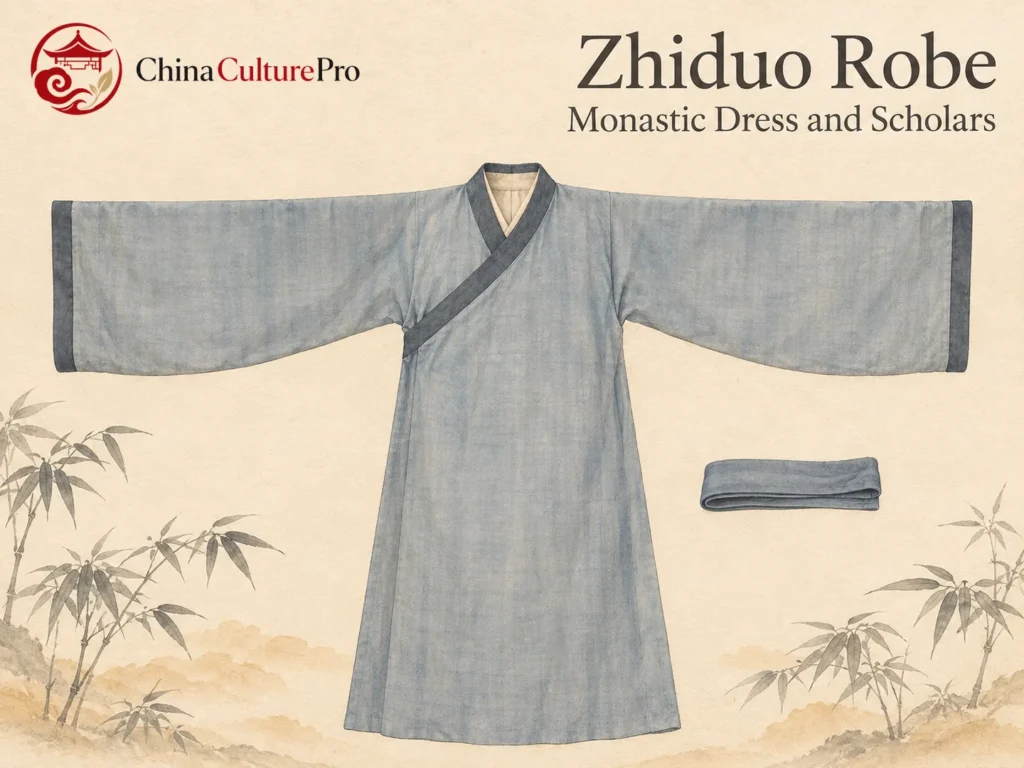

Quick Answer: What Is a Zhiduo?
The zhiduo (直裰, zhíduō) is a long Chinese robe associated with Buddhist and Daoist wearers and with scholars. Historical descriptions use the name in more than one setting. In paintings of scholars, dress historians identify some long, broad-sleeved robes as zhiduo.[1][2][3]
- Construction: A monastic account describes joining an upper garment and a skirt into one robe.[6]
- Images: Song and Ming artists dressed scholarly figures in long robes with different details.[3]
- Related labels: Some sources use overlapping names for zhiduo and other long robes.[2][8]
Use a dated source and its setting before choosing a cut or identifying a painted figure’s clothing.
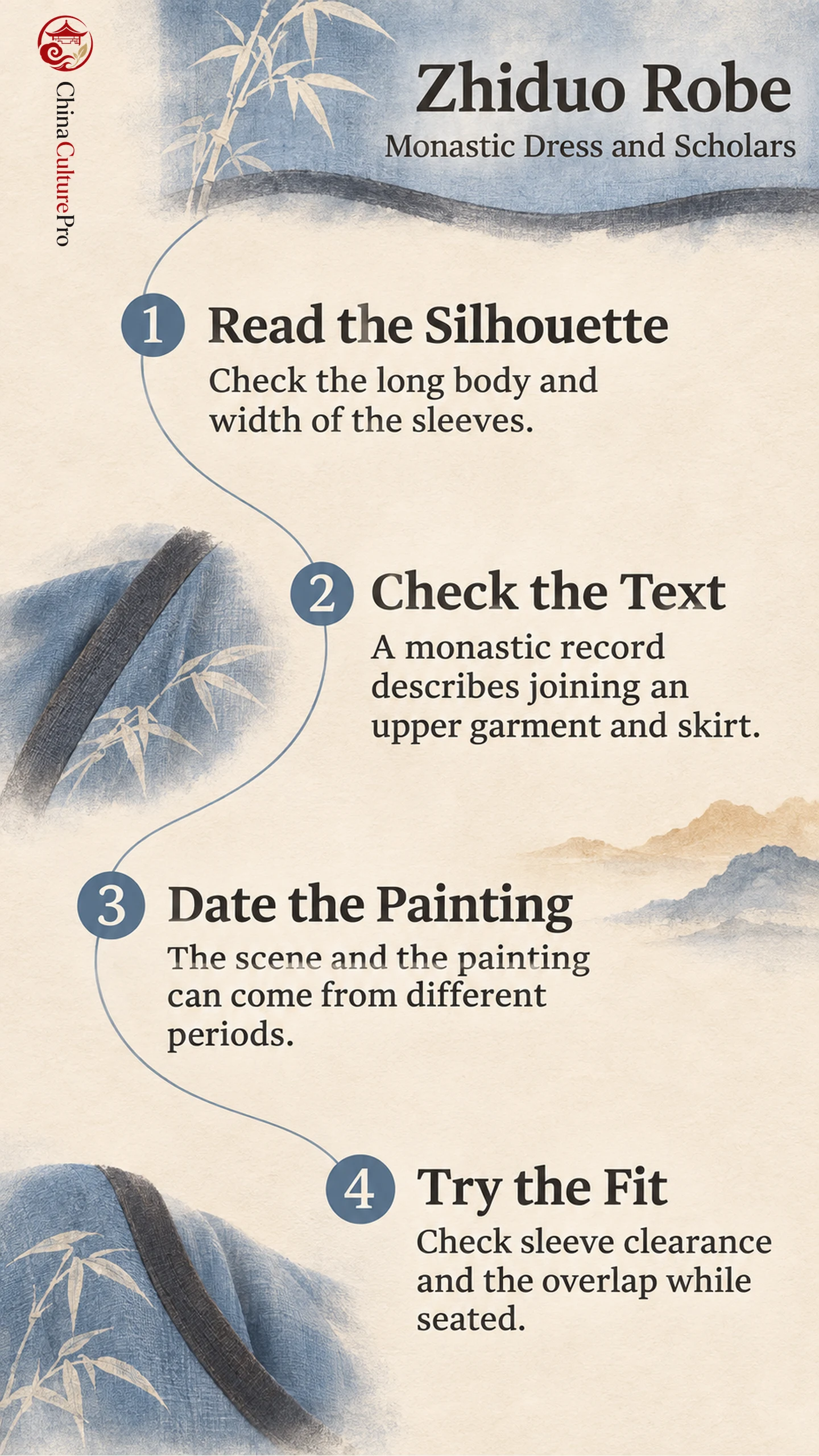
The word zhiduo may appear in a temple text, a novel or a description of a figure in a handscroll. Each tells you something different. A text can explain how people used the name, while an image gives you the sweep of the body and sleeves.
Read the Long Body and Sleeves
A study of Ming scholar paintings discusses robes with wide sleeves, a long body and visible edge treatment. Start with the line from shoulder to hem, then check where the front edges overlap. Contrast at the collar and cuffs can make the edge easy to follow in a painting. A belt or fold can hide whether the fabric is joined at the waist.[3]
The related zhishen robe (直身, zhíshēn) has overlapping terminology in some descriptions. In a specific Ming comparison, Dong Jin identifies zhishen with side panels placed on the outside. A Palace Museum study also describes a long cut with a back seam reaching to the hem. Ask for a side view and a back view before trusting a name on a modern pattern. The sewn waist of a tieli robe gives another feature to compare.[7][8]
What the Monastic Record Says
A Yuan compilation of monastic rules records a tradition in which the pianshan (偏衫, piānshān), an upper garment, and a separate skirt were combined into a single zhiduo. The passage identifies the pieces that were joined. A reconstruction also needs a garment or a pattern with dimensions.[6]
Literature shows how widely the word could travel. The Ministry of Education dictionary cites a Buddhist monk in Water Margin in a dark robe, and men in The Scholars in robes and headcloths. If you are reading a portrait, compare the headwear and setting along with the garment. A scholar’s headcloth is another item that needs its own identification.[2]
How Painters Dressed the Nine Elders
The Palace Museum’s Song handscroll depicts an earlier gathering traditionally dated to 845. A Ming handscroll attributed to Xie Huan, now in Cleveland, returns to the same subject. Both works depict the gathering retrospectively. The date of the gathering and the date of a depicted dress style can differ.[4][5]
Huang Mingyao identifies Song-style robes on scholarly figures across three versions of the subject, with a wider range of cuts in the Ming examples. Use the Song dynasty and Ming dynasty contexts to place the paintings. If a robe has a dark band near the hem, compare a lanshan robe and ask whether the band is an applied edge or a separate joined panel.[3]
How to Choose a Modern Zhiduo
Decide which source you are following. For a painting, list the features you can see, such as sleeve length, edge color and how the front lies over the body. If a maker supplies a pattern diagram, use it to check the side openings and back construction that an image may hide.
Try the robe over the layers you want to wear. Reach forward and check whether the sleeve opening clears the wrist and your hands can move without catching the fabric. Sit down and test the overlap at the lap. The hanfu history guide gives context for modern uses of historical names, and the dressing guide explains basic layering.
FAQs About the Zhiduo Robe
How do you pronounce 直裰?
The Chinese dictionary Zdic lists zhíduō. Taiwan’s Ministry of Education dictionary lists zhí duó. Searching for the written name helps you find records under both readings.[1][2]
Was the zhiduo worn only by monks?
The word also appears in descriptions of clothing associated with Daoists and scholars. A monastic account gives one specific historical setting for the name.[1][6]
Are zhiduo and zhishen interchangeable names?
Some dictionaries and garment histories use related names for overlapping forms. When the source distinguishes them by construction, read its criteria for the back seam and side panels.[2][7][8]
Sources
[1] Zdic. Zhiduo, Chinese Dictionary Entry
[2] Taiwan Ministry of Education. Zhiduo, Revised Mandarin Chinese Dictionary
[3] Huang Mingyao, National Central University. Wide-Sleeved Robes of Scholars in Ming Paintings
[4] Palace Museum. Nine Elders of Huichang
[5] Cleveland Museum of Art. The Nine Elders of the Mountain of Fragrance
[6] Baizhang’s Monastic Regulations. Zhiduo, Volume 5
[7] Dong Jin, Palace Museum. Ming Imperial Informal Dress
[8] Palace Museum. Costumes in Ming Court Drama