
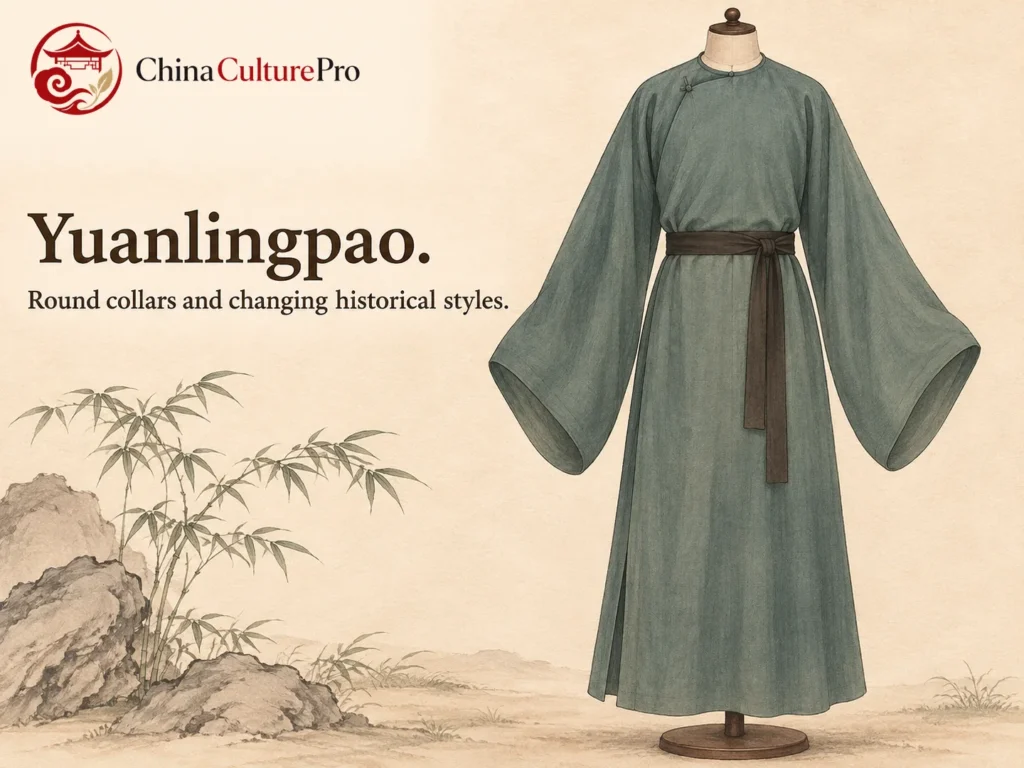

Quick Answer: What Is a Yuanlingpao?
Yuanlingpao(圆领袍,yuánlǐngpáo)means a round-collar robe. Its rounded neckline is a visible feature, while the front closure, sleeves, body and accompanying garments determine the fuller historical style.
- The construction: A rounded neck can close over an overlapping front.
- The history: Tang representations and Ming garments show changing proportions and uses.
- The outfit: Hats, belts, underlayers and decoration help place a robe in context.
The name does not identify one unchanging pattern. A plain modern interpretation, a reconstructed historical ensemble and a surviving court garment need to be understood on their own terms.
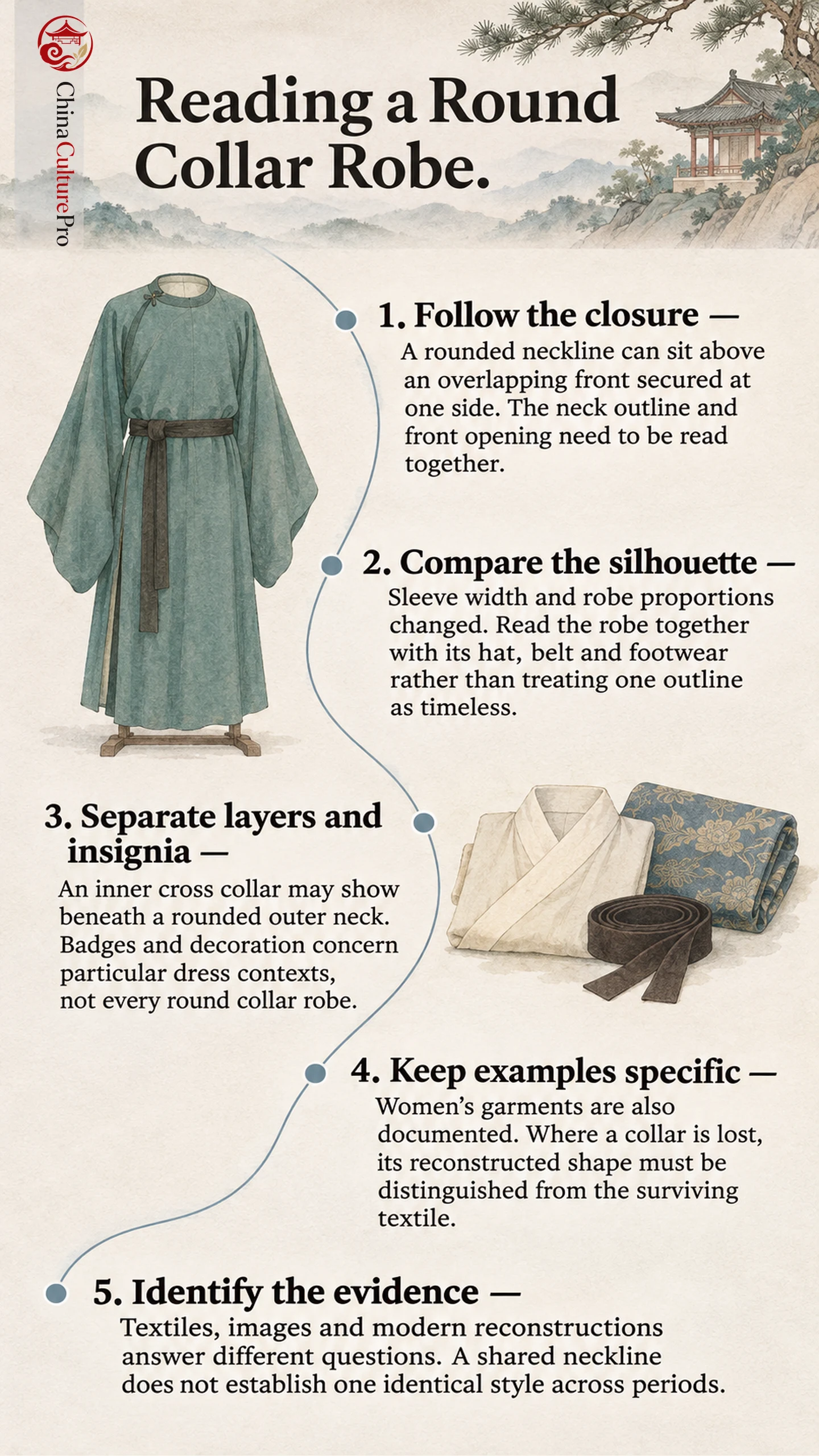
A rounded neckline closes above an overlapping front, while a belt gathers the robe’s long body. In another image, the sleeves spread much wider and an inner collar appears at the neck. Yuanlingpao belongs to Chinese clothing history, where a familiar outline can connect garments with different dates, wearers and functions.
The Rounded Neckline and Overlapping Front
Begin at the neck, then follow the opening. Wuxi Museum explains the rounded neckline through overlapping fronts lifted and secured at one side of the neck. The resulting closed outline differs from the diagonal V made by an exposed cross-collar front.[1]
A round neckline does not mean the garment is pulled over the head like a modern T-shirt. The position of the fastening and the overlap below it are important parts of its structure. Looking only at the opening around the throat can hide how the robe actually closes.
A turned-back lapel needs context too. In its discussion of a painting of Li Bai, Wuxi Museum interprets the loosened collar as a deliberate informal arrangement.[1] This interpretation applies to the depicted dress. A painting’s date also needs to be distinguished from the historical scene it represents.
Tang Robes, Belts and Changing Silhouettes
A Tang male figurine in the National Museum of China wears a round-collar robe as part of an ensemble with headwear and boots. The museum describes the basic silhouette as relatively narrow-sleeved, with the robe extending below the knees or toward the feet.[2]
The same account notes a move toward broader bodies and sleeves after the middle Tang period. “Tang style” therefore does not mean one permanently narrow outline. A sleeve can change substantially while the rounded neckline remains recognizable.
The museum also connects dress distinctions with color, materials, patterns and accessories.[2] That does not give every modern viewer a universal color chart for reading rank. An outfit must be placed within the rules and practices of its own period.
The Tang dynasty context matters because the robe was part of a larger dress culture. A hat, belt and boots contribute to the ensemble; identifying the collar explains only one component.
Ming Robes, Layers and Official Dress
A Palace Museum account of Ming imperial clothing describes round-collar robes with a fastening at the right of the neck and ties securing the overlapping front. It also records changes from narrower to wider sleeves.[3] An imperial example cannot supply a pattern for every Ming wearer.
Ming examples make the importance of the whole outfit especially clear. The National Museum’s clothing exhibition describes official dress through the combination of round-collar robes, headwear and belts, with badges, patterns and other details distinguishing status.[4] The robe’s cut and its official insignia perform different jobs.
The Palace Museum account also describes cross-collar underlayers beneath round-collar outer robes.[3] When an inner collar shows, two necklines are visible together. The diagonal inner layer does not turn the outer robe into a cross-collar garment.
For Chinese rank badges, read the badge together with the garment and documented setting. A badge can indicate a regulated dress context; the rounded collar describes the garment’s structure.
Wearers Beyond One Male Official
Surviving evidence also includes women’s garments. China National Silk Museum’s conservation account examines a Ming robe from the burial of a woman surnamed Xu at Wangdian, Jiaxing.[5] Its textile and chest-and-back insignia survive in fragments.
The original collar is missing. Researchers inferred its rounded form from the surviving front structure and an inner garment in the same burial.[5] The classification therefore includes an explained reconstruction of lost structure, rather than a completely intact collar available for direct inspection.
The report also separates conservation of the surviving textile from making a technical reconstruction. New supporting cloth used to stabilize fragments and a newly made garment illustrating the original construction are different kinds of intervention.
The example documents a woman’s garment in a particular setting; it cannot represent every woman’s dress.
Reading Historical Evidence and Modern Hanfu
Three kinds of evidence answer different questions: surviving textiles reveal materials and seams; images show dress as represented; reconstructions test an interpretation of how pieces fit together. None should silently substitute for the others.
Cultural exchange also shaped the robe’s history. In a research abstract hosted by the National Museum, Zhao Lianshang discusses the incorporation of round-collar robes into official dress in the Sui period and their continued institutional importance through the Ming.[6] That is a history of transmission and adaptation, rather than a story about one inventor.
A rounded neckline also occurs in later clothing. An Asian Art Museum Qing informal robe combines it with a right-side opening and horse-hoof-shaped cuffs.[7] Sharing one neckline does not make that robe structurally identical to a Ming garment.
When considering hanfu styles today, ask what evidence a reconstruction follows. Date, sleeve shape, front opening, fabric and accompanying layers explain more than a dynasty label alone. A contemporary design can openly adapt those features without claiming to reproduce one excavated object.
FAQs About Yuanlingpao
Is a yuanlingpao a cross-collar robe?
Its outer neckline is rounded. A visible cross-collar underlayer can appear beneath it as a separate garment.
Were yuanlingpao only worn by men?
No. Museum research also documents women’s examples, including a Ming garment from Wangdian.
Do all yuanlingpao have rank badges?
No. A badge relates to particular dress contexts; it is not the defining feature of a rounded neckline.
Does any round-necked robe count as the same style?
No. The front opening, sleeves, period and use must also be considered.
Sources
[1] Wuxi Museum. Tang Dress in Paintings: Rounded Necklines and Turned-Back Lapels
[2] National Museum of China. Tang Male Figurine and Its Round-Collar Robe
[3] Palace Museum. Illustrated Ming Court Dress: Round-Collar Robes and Underlayers
[4] National Museum of China. Ancient Chinese Clothing Culture: Ming Official Dress
[5] Wang Shujuan and Jiang Yuqiu, China National Silk Museum. Conserving and Reconstructing a Ming Round-Collar Robe from Wangdian
[6] Zhao Lianshang, National Museum Clothing Research Forum. Round-Collar Robes and the History of Official Dress
[7] Asian Art Museum. Man’s Informal Robe, Qing Dynasty