

Quick Answer: What Is Xuanzi Painting?
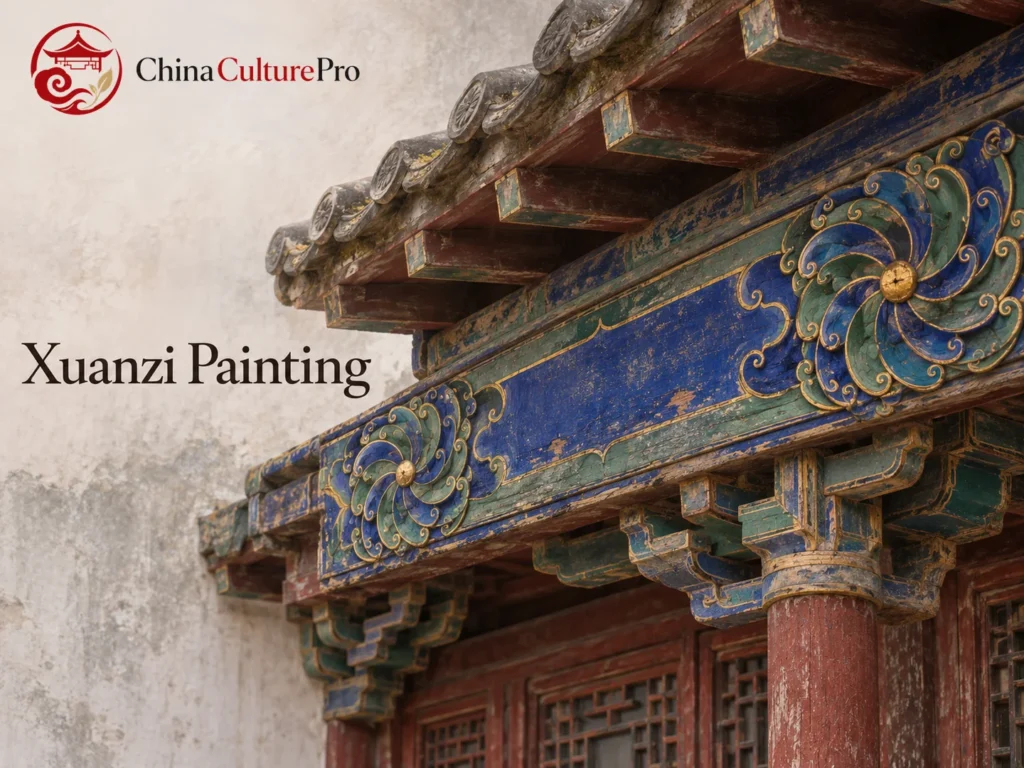
Xuanzi painting (旋子彩画, xuánzǐ cǎihuà) is a Ming and Qing architectural painting tradition named for its swirling flower forms. Look for rosettes with curling petals in the sections between the long center and the ends of a beam. The outlines can be gilded or painted in darker colors.[1][2][3]
- Look for rosettes: Layered petals curl around a center.[1][2]
- Check their position: The designs often sit toward the ends of a painted timber.[1][2]
- Read the finish: The placement of gold varies across examples.[1][2][4]
The side rosettes are a better guide to the style than the amount of gold alone.[1][2]

To read a painted beam, move your eye from the long central field outward. The smaller spaces beyond it can contain the pattern that gives the style its name.[1][2]
Where the Spiral Flowers Appear
The side fields (找头, zhǎotóu) sit between the central field and the end bands. In Xuanzi painting, these fields commonly contain spiraling flowers or parts of them. A study of Prince Kung’s Palace records one arrangement with a whole rosette and two partial ones. The complete and cropped forms fit within the available painted space.[1][2][4]
Look for the curved petals and their centers even where part of a rosette meets the border. Some figures in the long central field can differ from those in the side fields. A dragon or floral emblem in the middle can catch the eye first. Check the repeated rosettes on either side before assigning a style.[1][4]
How Gold and Ink Change the Appearance
The Palace Museum lists several forms of Xuanzi that use different amounts and placements of gold. A pattern can have gold outlines or highlighted centers. Some versions rely more heavily on dark outlines. In either case, the rosettes remain useful for identification.[1][2][4]
Compare the motifs as well as the colors. Hexi painting can emphasize dragons and phoenixes in its own formal arrangement. Suzhou-style painting often gives more room to landscape or figure scenes. These are distinct traditions within Chinese architectural decoration, even when they share colors or appear in the same compound.[2][3][4]
Reading Examples at Prince Kung’s Palace
A Palace Museum study identifies Xuanzi paintings at Jiale Hall and Duofu Belvedere. It describes a dark-outlined variant near the ridge at Jiale Hall and a gold-outlined form with prominent gold accents at Duofu Belvedere. The examples are on specific surfaces. Duofu Belvedere also retains traces of another category of decoration, so one label cannot describe the whole building.[4]
In the part of the residence surveyed, the study distinguishes historic traces inside from modern painting on the outer eaves. A style name describes the design. A record of its placement and repainting history helps establish when the visible paint was applied. A separate Palace Museum study compares the shapes of end bands, rosette centers and the boundaries of central fields across dated examples.[4][5]
FAQs About Xuanzi Painting
Where should I look for the rosettes?
Look in the side fields of painted horizontal beams, between the long center and the end bands.[1][2]
Does Xuanzi always have gold leaf?
The style includes forms with different uses of gold and forms with dark outlines. The spiral flowers are a more consistent clue.[1][2]
Does the building’s date also date its paint?
A painted surface can be renewed later. Compare the beam’s pattern and condition with records of work on the building.[4][5]
Sources
[1] The Palace Museum. Xuanzi Architectural Painting
[2] China Intangible Cultural Heritage Digital Museum. Beijing Architectural Painting
[3] Prince Kung’s Palace Museum. Polychrome Decorative Painting
[4] Palace Museum Journal. Research on Polychrome Painting in Prince Kung’s Mansion
[5] The Palace Museum. Chronology of Ming and Qing Royal Xuanzi Painting