
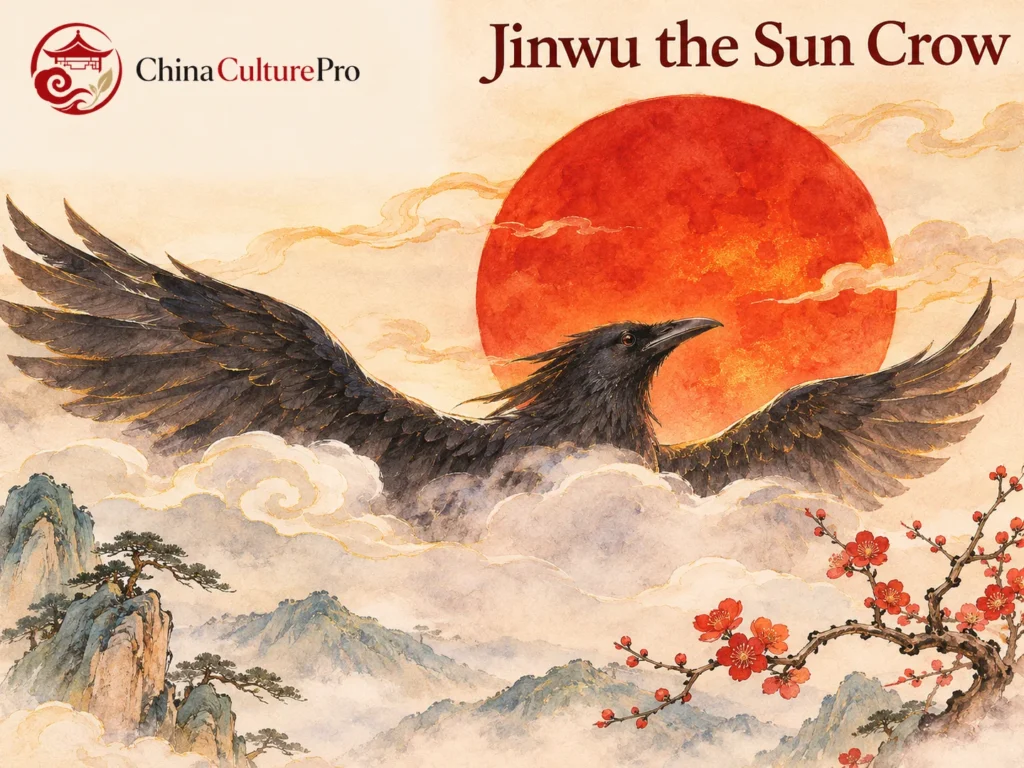

Quick Answer: What Is the Three-Legged Crow?
Jinwu (金烏, jīnwū), or golden crow, is a name for the crow associated with the sun in Chinese tradition. A three-legged crow (三足烏, sānzúwū) is described inside the sun in the Lunheng. The Classic of Mountains and Seas tells of suns carried by crows without specifying their number of legs.[1][2][3]
- The journey: One sun arrives and another departs in the eastern wilderness passage.
- The solar disk: A Western Han silk painting includes a bird in the sun.
- The lunar counterpart: A rabbit or toad can identify the moon.
The location of the bird and the source of the leg count are separate clues.[1][2][3][4]

A crow carrying the sun and a crow pictured inside the sun are related images. The position of the bird tells you something about the passage or object you are looking at.
A Crow Carries the Sun in the Great Wilderness
The Great Wilderness of the East chapter of the Classic of Mountains and Seas describes a tree at Tang Valley. One sun is arriving as another is departing, and both are carried by crows. The scene explains movement between the suns and the tree in the language of myth.[1]
The passage does not count the birds’ legs. It gives the crow a role in moving the sun. That detail can be read alongside the solar associations of Ruomu, another tree described in a different classical setting, without assuming the passages are one continuous itinerary.[1]
Where the Three Legs Appear in Early Writing
In “On the Sun,” Wang Chong reports a view that the sun contains a three-legged crow and the moon contains a rabbit and toad. He then challenges the claim. One of his questions is how a person could make out the number of feet if looking at the sun makes it difficult to see clearly.[2]
The passage is useful in two ways. It records the three legs explicitly and preserves a writer’s objection to a literal account. It preserves both a belief about the solar bird and a reason someone gave for questioning it.[2]
The Solar Crow on the Mawangdui Silk Painting
The Western Han silk painting from Mawangdui Tomb 1 places a dark bird inside the solar disk in its upper zone. The museum’s description identifies the bird with Jinwu and notes the lunar creatures elsewhere in the heavenly scene. The contrast of the solar and lunar imagery makes the two bodies recognizable.[3]
For this object, begin with the bird’s placement. The dark silhouette within a red disk is the most direct clue to the subject. Use a clear reproduction or object description before making a claim about small details of the feet. The museum identifies the figure by its place in the painting’s celestial imagery.[3]
Jinwu, the Moon Toad and the Queen Mother’s Birds
A moon toad paired with a solar crow belongs to a way of marking the two lights in the sky through animals. The toad or rabbit has its own lunar role.[3][4]
The Queen Mother’s blue birds belong to a different narrative setting. Their service, arrival or messages point to her stories. A bird inside a sun disk points to solar imagery. The other figures in a scene can clarify which kind of bird is intended.
FAQs About the Three-Legged Crow
Why is Jinwu called the golden crow?
Jinwu literally combines the words for gold and crow. It names the bird associated with the sun. The solar bird can appear as a dark silhouette in art.[3]
Do all early solar crows have three legs?
The Lunheng records three legs. The Great Wilderness of the East chapter describes crows carrying suns without giving that detail.[1][2]
What animal accompanies the moon?
A rabbit and a toad are both associated with the moon in the passages and art discussed here. They can appear beside the sun’s crow in a larger celestial scene.[2][3][4]
Sources
[1] Chinese Wikisource. Classic of Mountains and Seas, Great Wilderness of the East
[2] Chinese Text Project. Lunheng, On the Sun
[3] Hunan Museum on Google Arts & Culture. T-Shaped Painting on Silk, Mawangdui Tomb 1
[4] Cleveland Museum of Art. Fantastic Beasts in Chinese Culture and Where to Find Them