


Quick Answer: Who Were the Three Sovereigns and Five Emperors?
The Three Sovereigns (三皇, sānhuáng) and Five Emperors (五帝, wǔdì) are groups of exemplary early rulers in Chinese tradition. The names change by source. Sima Qian’s Records of the Grand Historian opens with five rulers, while different works name different sets of three sovereigns.[1][2][3]
- Three Sovereigns: The Baihu Tong lists Fuxi, Shennong and Suiren, with an alternative that substitutes Zhurong.
- Five Emperors: The Records opens with the Yellow Emperor, Zhuanxu, Di Ku, Yao and Shun.
- A later supplement: Sima Zhen’s account of the Three Sovereigns names Fuxi, Nüwa and Shennong.
Read the names with the source, especially when the Yellow Emperor appears in different groups.[1][2][3]
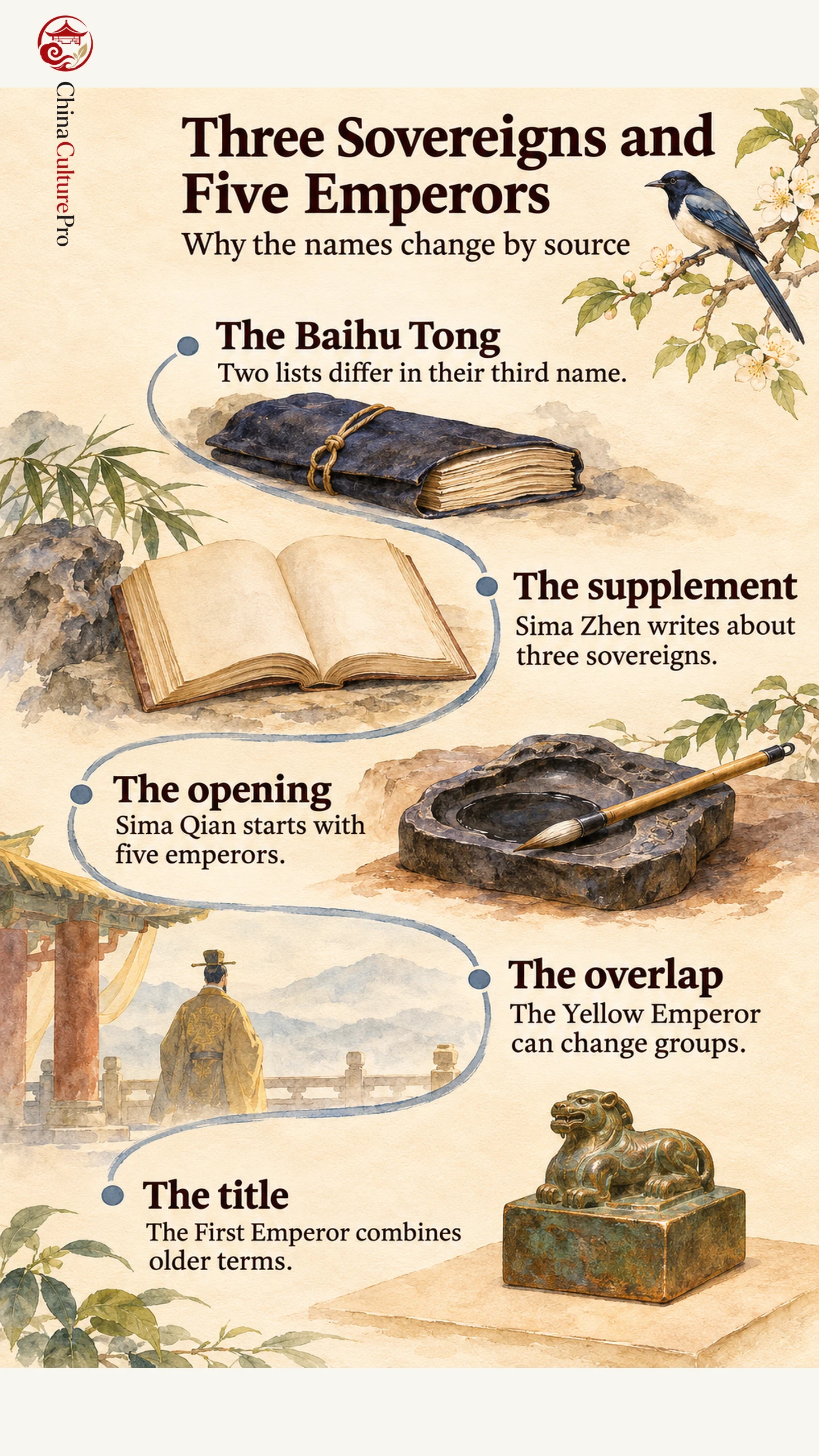
The question “Who were the Three Sovereigns and Five Emperors?” has several answers. A list is most useful when it tells you which work the names come from.
Three Sovereigns Lists in the Baihu Tong and Sima Zhen
The Baihu Tong places Fuxi and Shennong in both versions of its Three Sovereigns list. It pairs them with Suiren in one version and Zhurong in the other. The text explains the names through contributions to human life, including cultivation and the use of fire for cooked food.[1]
Sima Zhen, writing in the Tang period, composed an Annals of the Three Sovereigns. It gives an account of Fuxi, Nüwa and Shennong. He explains that he meant to supplement the opening of Sima Qian’s history, which began with the Five Emperors. Some editions place the supplement before that opening.[2][3]
The Five Emperors in the Records of the Grand Historian
Sima Qian starts with the Yellow Emperor, Zhuanxu, Di Ku, Yao and Shun. The annals give each ruler a place in a narrative of descent and exemplary government. The account of the Yellow Emperor’s family, including Leizu, is part of that narrative. The later accounts of Yao and Shun emphasize selecting a worthy successor.[3]
| Source | Group | Names |
|---|---|---|
| Baihu Tong | Three Sovereigns | Fuxi, Shennong, Suiren or Zhurong |
| Sima Zhen’s supplement | Three Sovereigns | Fuxi, Nüwa, Shennong |
| Sima Qian’s opening | Five Emperors | Yellow Emperor, Zhuanxu, Di Ku, Yao, Shun |
Read each row as that work’s arrangement of names. It gives a way to compare the accounts without turning their legendary rulers into a dated succession chart.[1][2][3]
Why the Yellow Emperor Changes Groups
The commentaries on the Five Emperors annals cite another arrangement. It puts Fuxi, Shennong and the Yellow Emperor among the Three Sovereigns and begins the Five Emperors with Shaohao. In that list Gaoxin, Tang and Yu are designations associated with Di Ku, Yao and Shun respectively. The Yellow Emperor’s move between groups helps explain why a list that includes him twice may have joined different sources.[3]
The same title Five Emperors can also appear in a different context, as in the discussion of celestial assistants to Taiyi. The people in the annals and the divinities of a ritual account need to be read in their own settings.
How the First Emperor Used the Older Titles
The First Emperor’s annals record officials proposing a title after unification. They cite three older august figures and propose an honorific using the word huang. The king keeps that element and combines it with di, the old title associated with emperors. The result is the imperial title huangdi, written with different characters from the Yellow Emperor’s personal designation.[4]
The title debate shows how a new ruler could invoke old categories for political purposes. The annals preserve a decision about a title, alongside traditions about figures from an earlier age.[3][4]
FAQs About the Three Sovereigns and Five Emperors
Who are the Three Sovereigns?
The names depend on the source. The Baihu Tong has Fuxi and Shennong with Suiren or Zhurong. Sima Zhen’s supplement gives Fuxi, Nüwa and Shennong.[1][2]
Who are the Five Emperors in the Shiji?
Sima Qian’s opening names the Yellow Emperor, Zhuanxu, Di Ku, Yao and Shun.[3]
Did Sima Qian write the Annals of the Three Sovereigns?
Sima Zhen wrote that supplement in the Tang period. Sima Qian’s history began with the Annals of the Five Emperors.[2][3]
Sources
[1] Chinese Wikisource. Baihu Tong, volume one
[2] Chinese Wikisource. Sima Zhen, Annals of the Three Sovereigns
[3] Chinese Wikisource. Records of the Grand Historian, Annals of the Five Emperors with commentaries
[4] Chinese Text Project. Records of the Grand Historian, Annals of the First Emperor