

Quick Answer: Who or What Is Taiyi?
Taiyi (太一, Tàiyī), often translated as the Great One, appears in early Chinese cosmology, ritual poetry and records of state worship. In a manuscript from Guodian, the Great One produces water. A hymn honors a deity named Eastern Sovereign Taiyi. The Western Han court also established sacrifices to Taiyi.[1][2][3][4]
- Cosmology: Water and the Great One participate in the formation of heaven.
- Poetry: The hymn evokes music and fragrant offerings.
- Court ritual: Under Emperor Wu, a shrine was set up southeast of Chang’an.
The same name can point to different kinds of evidence, including an excavated manuscript, a poem and a historical record.[1][2][3]
The Great One appears in a story of how the world takes shape and in accounts of people making offerings. The source tells you which question the name is answering.
The Great One and Water in the Guodian Text
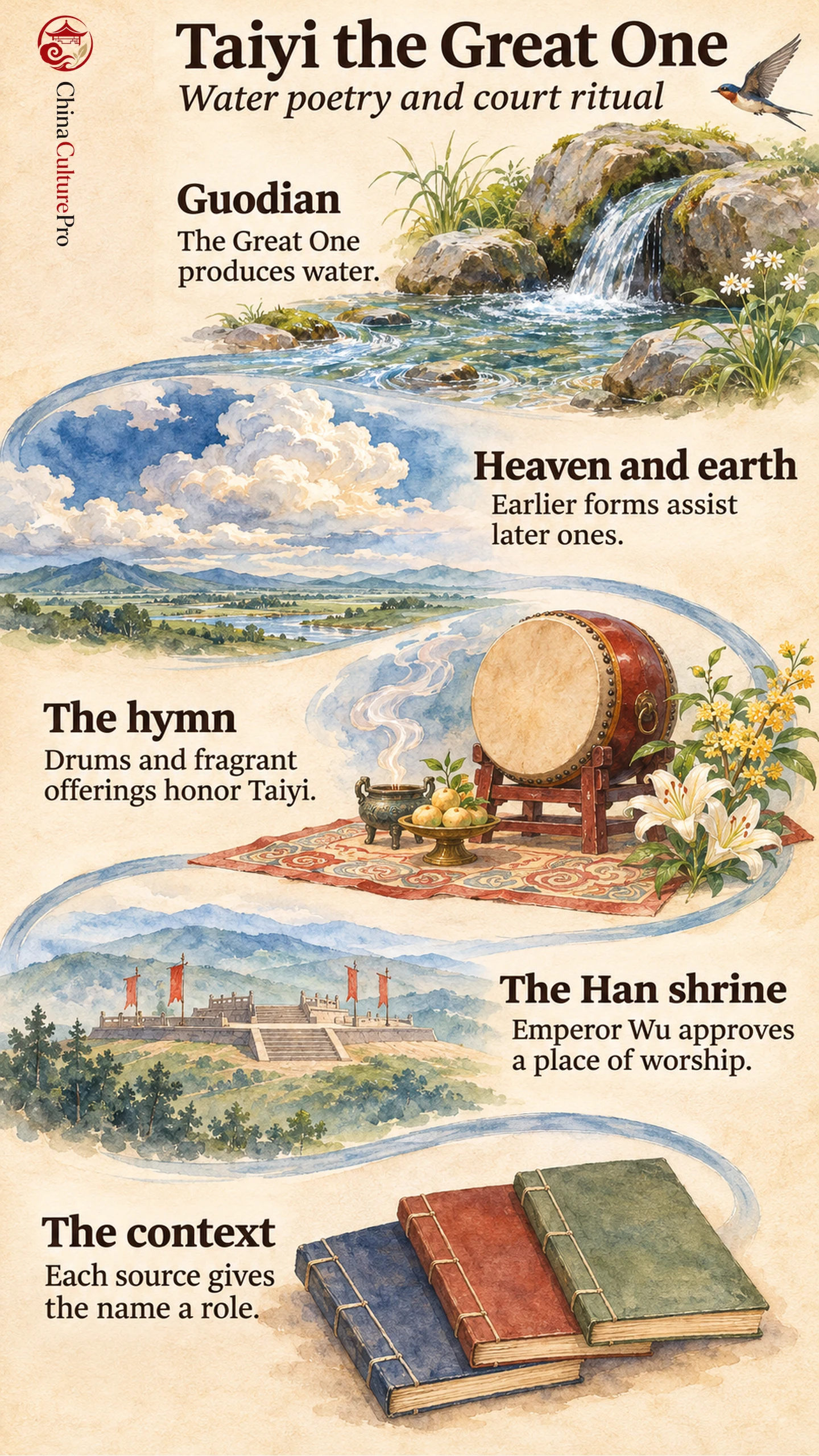
A bamboo manuscript from Guodian is known as The Great One Gives Birth to Water. Its opening sequence has the Great One produce water. Water then assists the Great One in the formation of heaven. Heaven in turn assists the Great One in forming earth. The process continues through further pairs and relationships.[1]
The creation sequence turns on cooperation. Water becomes part of what happens next. The text gives the reader a sequence in which earlier forms participate in the formation of later ones. It does not describe a temple or a rite.[1]
Taiyi in the Songs of Chu
The Songs of Chu contains a hymn to Donghuang Taiyi (東皇太一, Dōnghuáng Tàiyī), the Eastern Sovereign Taiyi. The poem prepares for a divine audience on a favorable day. It brings together fragrant food and drink, drumming, song and instruments. Its scene is one of performance and welcome.[2]
The poem’s sensory detail tells us how the divine figure is addressed. The name has a place in a song that imagines a deity enjoying the gathering. That gives Taiyi a different role from the one in the sequence about water and heaven.[1][2]
How Emperor Wu Honored Taiyi
The Records of the Grand Historian gives an account of Miu Ji proposing sacrifices to Taiyi. Miu Ji describes Taiyi as the highest-ranking celestial deity, attended by the Five Emperors. Emperor Wu directs ritual officials to establish a shrine to the southeast of Chang’an and perform the worship according to the proposal.[3]
The historian preserves both the ritual proposal and Emperor Wu’s decision to act on it. That makes the episode evidence of how the ruler and his officials organized a cult. In a study of Western Han sacrifices, Tian Tian places the rise of Taiyi as a chief deity of imperial worship in Emperor Wu’s reign. The study distinguishes that prominence from earlier recognition of the name.[3][4]
Reading the Name Across Different Sources
Read Taiyi by its setting. A sequence about water and the formation of heaven points to Guodian. A hymn with drums and fragrant offerings points to the Songs of Chu. A memorial or an official altar points to court ritual. Those clues allow a reader to compare the accounts without importing one source’s details into another.[1][2][3]
That method also helps when comparing Taiyi with other celestial figures, such as Dijun in the Classic of Mountains and Seas. A similar English title for a high deity can cover quite different names and functions.
FAQs About Taiyi
What does Taiyi mean?
The Great One or Supreme Unity are common English renderings. In the Guodian text, Taiyi is the figure from which water first emerges.[1]
Is Donghuang Taiyi the same as the Great One?
The two names share Taiyi, but their sources emphasize different roles. The hymn names an eastern sovereign and presents an offering. The Guodian text traces the formation of the world.[1][2]
When did Taiyi become prominent in Han court ritual?
The reign of Emperor Wu is the point at which Taiyi became prominent in Western Han imperial ritual. The historical account records an official response to a proposal for sacrifices.[3][4]
Sources
[1] University of Chicago workshop archive. Yong-yun Lee, A Naturalistic Understanding of Taiyi Sheng Shui’s Cosmology
[2] Chinese Wikisource. Songs of Chu, Eastern Sovereign Taiyi
[3] Chinese Wikisource. Records of the Grand Historian, Treatise on the Feng and Shan Sacrifices
[4] De Gruyter Brill. Tian Tian, Western Han Sacrifices to Taiyi