


Quick Answer: What Is The Peony Pavilion?
The Peony Pavilion (牡丹亭, Mǔdān Tíng) is a Ming play written in 1598 by Tang Xianzu (汤显祖, Tāng Xiǎnzǔ). Du Liniang (杜丽娘, Dù Lìniáng) dreams of a young scholar. After her death, Liu Mengmei (柳梦梅, Liǔ Mèngméi) finds her portrait and encounters her spirit. The play is a classic of Kunqu (昆曲, Kūnqǔ) opera.[1][2][6][8]
- Start with three scenes: Read scenes 10, 14 and 35 to follow the dream, the portrait and Du Liniang’s return to life.
- Watch for the portrait: Du leaves an image of herself that another person can encounter and interpret.
- Find the complete English play: Look for Cyril Birch’s translation, with Catherine Swatek’s introduction in the second edition.
- Check performance length: The full text has 55 scenes. The Young Lovers’ Edition selects 27 for a production in three parts.
The numbered scenes below follow the full text. A particular staging may use a different running order.
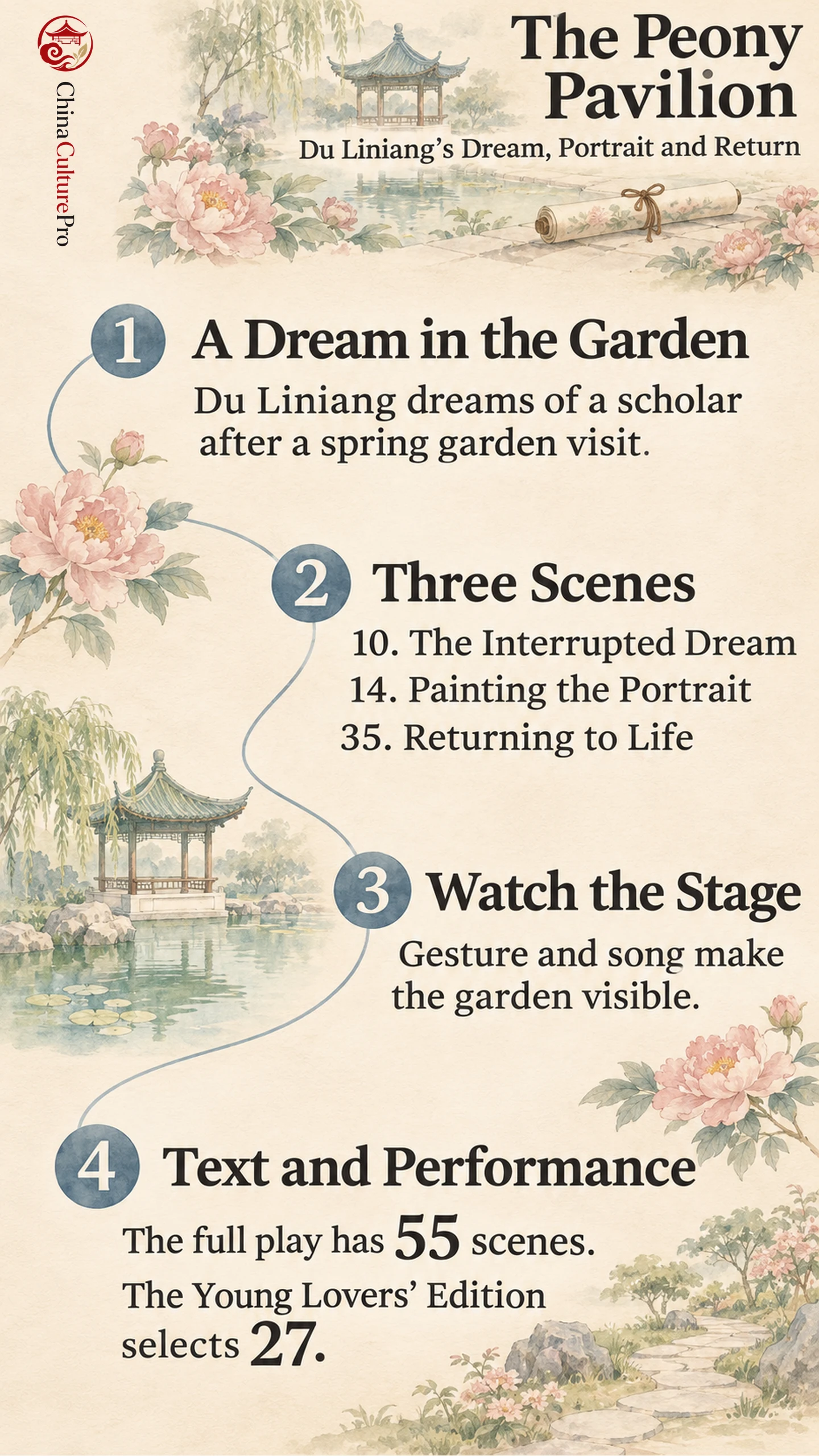
The garden in The Peony Pavilion first offers Du Liniang a place to see spring. The visit also makes her think about time passing within the household. When the garden gives way to a dream, Tang Xianzu lets the audience see something the people around her cannot see. To follow the play from there, keep track of what parts of Du’s experience can be shared and what still belongs to her alone.[3]
Du Liniang, Liu Mengmei and the Dream
Tang wrote the play in the late Ming dynasty. Its story looks back to the Southern Song dynasty.[1][6] Use the Ming date for the play’s literary context and the Southern Song setting to orient yourself to the characters’ world.
Du visits her family’s garden with her attendant Chunxiang. Her songs move from noticing flowers and neglected corners to asking what such a spring means to someone who rarely goes outside. Later, when she rests, a scholar enters her dream.[3] The change is worth watching. In the garden she notices what has been kept from her. In the dream she imagines meeting someone outside the circle she knows.
Tang’s preface treats qing (情, qíng), or deep feeling, as a force that can carry a person across the boundary between life and death. It asks why feeling experienced in a dream should count for less than feeling in waking life.[2] That question matters after Du dies, when Liu encounters her portrait and must decide what to make of the woman who appears to him.[6]
Three Scenes That Connect the Dream to the Return
Begin with The Interrupted Dream (惊梦, Jīngmèng), continue to Painting the Portrait (写真, Xiězhēn), and finish the sample with Returning to Life (回生, Huíshēng). The numbers follow the full play’s Chinese index.[2]
10. The Interrupted Dream
In the garden, Du and Chunxiang notice flowering plants, paths and pavilions. Watch for the pause after the visit, when Du reflects on what she has seen and falls asleep. The scholar enters with a willow branch. She returns to that detail when she paints the portrait in scene 14.[3]
14. Painting the Portrait
Du paints a picture of herself and inscribes a poem on it. She remembers the willow branch and considers what it might say about the name of the man she saw. The surname Liu and the word for willow use the same Chinese character, 柳 (liǔ).[4] The portrait lets her present herself to a future viewer. The poem gives the person who finds the portrait a clue the image alone cannot supply.
35. Returning to Life
Liu opens the grave and Du returns to life.[5] In the earlier scenes, a dream could be kept to oneself and a portrait could be put away. Here, Liu’s decision has consequences that other people can see and challenge. If you want to follow the gap between the portrait and the opening of the grave, add scene 24, in which he finds the picture.[2]
How Kunqu Makes the Garden Visible
Kunqu uses gesture, singing and recitation together. UNESCO describes its use of instruments such as a bamboo flute and clappers and lists The Peony Pavilion among its classic works.[8] In the garden scene, watch how the performers move as they turn toward a flower or cross a path. Their movement can give the audience a sense of the garden even when the stage is lightly furnished.
Listen to how long Du takes to move from one sight to another. Reading the words can tell you which flowers or pavilions she names. Hearing the line sung lets you attend to how much time she spends looking. The guide to Chinese opera explains related stage conventions. For another Kunqu work that uses a promise to carry feeling beyond death, see The Palace of Eternal Life.
Which Text or Performance to Choose
For the full play in English, look for Cyril Birch’s translation. Indiana University Press lists the second edition with an introduction by Catherine Swatek.[1] Keep the scene numbers in front of you if you want to compare the translation with a Chinese edition or a performance excerpt.
Kenneth Pai’s Young Lovers’ Edition uses 27 scenes from the original. UCLA describes it as a three-part production of about nine hours and hosted it over three days in 2006.[7] Those details identify a particular adaptation. For a shorter reading comparison with another play that gives an object a major role, see The Peach Blossom Fan.
FAQs About The Peony Pavilion
Is The Peony Pavilion a play or an opera?
It is a dramatic text written by Tang Xianzu and a classic in the Kunqu opera repertory. You can read the full script or watch a production that selects scenes from it.
Do I need to read all 55 scenes first?
Start with the dream, the portrait and the resurrection. Read from the beginning if you want to follow the family relationships and the later disputes around Du’s return.
Where can I find a complete English translation?
Look for Cyril Birch’s The Peony Pavilion. The Indiana University Press second edition includes Catherine Swatek’s introduction.
Sources
[1] Indiana University Press. The Peony Pavilion, Second Edition
[2] Wikisource. Mudan Ting: Preface and Chinese Scene Index
[3] Wikisource. Mudan Ting: Scene 10, The Interrupted Dream
[4] Wikisource. Mudan Ting: Scene 14, Painting the Portrait
[5] Wikisource. Mudan Ting: Scene 35, Returning to Life
[6] UCLA Center for Chinese Studies. The Peony Pavilion: Young Lovers’ Edition Synopsis
[7] UCLA Asia Pacific Center. The Peony Pavilion: Production Background
[8] UNESCO. Kun Qu Opera