

Quick Answer: What Is The New Year’s Sacrifice?
The New Year’s Sacrifice (祝福, Zhùfú) is a short story by Lu Xun (鲁迅, Lǔ Xùn), first published in 1924. A returning visitor to Luzhen (鲁镇, Lǔzhèn) meets Xianglin’s Wife (祥林嫂, Xiánglín Sǎo), a woman who once worked in his uncle’s household. As the town prepares for the Lunar New Year, her questions about the dead make him uneasy.[1][2]
- The central character: Xianglin’s Wife returns to work after a forced remarriage and further losses.
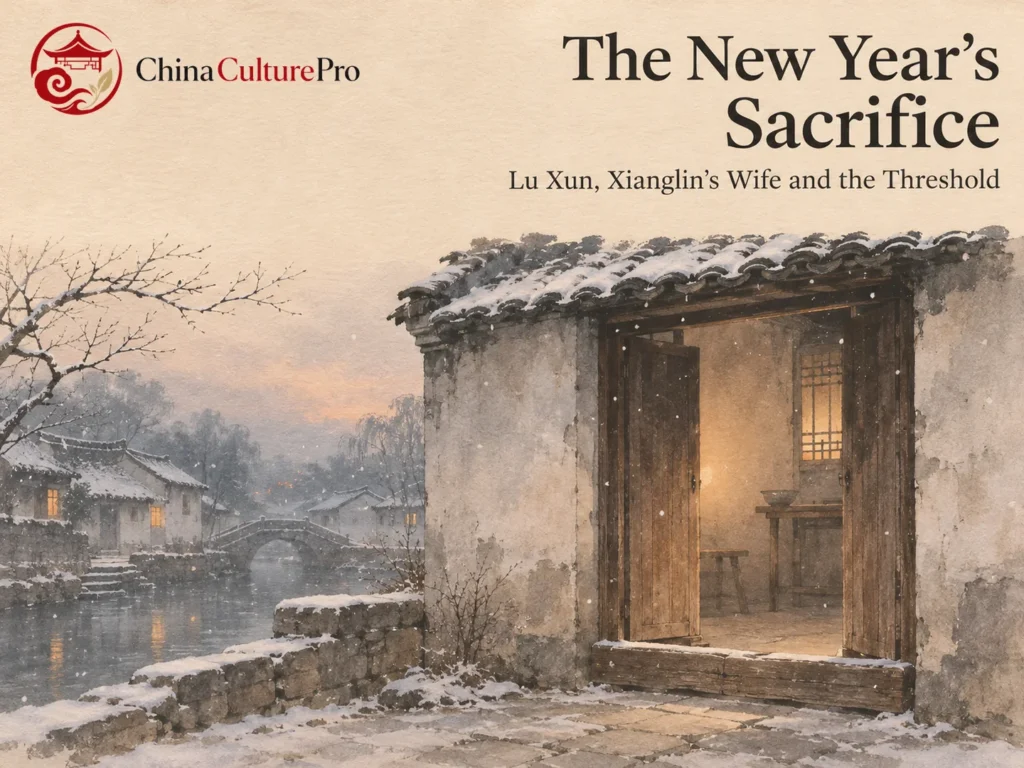
- The central image: She pays for a temple threshold in the hope that it will bear a punishment she fears.
- The story’s structure: The narrator first meets her late in her life, then pieces together her earlier years.
- Where to find it: Look for it in Wandering (彷徨, Pánghuáng), or under New Year’s Sacrifice in Julia Lovell’s English collection.
The story depicts the practices of a particular fictional town and household. Its festival setting helps explain who can join the rites and who is kept away.

The narrator comes back to his hometown, but he has no home of his own there and stays with an uncle. Firecrackers carry through the town as households prepare for the end of the lunar year. When Xianglin’s Wife asks him about the dead, the people preparing for the new year already seem more certain than he does about what the rites can do.[1]
Xianglin’s Wife and the Story’s Frame
People call the central woman Xianglin’s Wife throughout the story, even after her first husband is dead and she has been made to remarry. Lu Xun leaves her given name unstated. The town keeps using the name even when it knows more about her life than that name conveys.[6]
The narrator meets her in the present and hears news of her death before he recounts most of her life. In the earlier part of the account, she arrives as a widow and works in his uncle’s household. After her forced remarriage and the deaths of her second husband and son, she comes back to the same house. Her return creates a comparison the reader can keep in view. She knows the work, but the household changes what it will let her do.[1]
If you are following the chronology for the first time, mark where the narrator starts telling what happened earlier. A scene in the house may be years before the conversation that opened the story. This is one way Lu Xun makes the town’s account of her life part of the story itself.
The Household Offerings and the Temple Threshold
The year-end observance of the title brings the town’s households into preparations for good fortune. Lu Xun gives much of that work to women, who wash and prepare the food, while the act of making the formal offering is reserved for men in the account.[1] Readers looking for wider context can compare the range of Chinese New Year customs.
The refusal after the threshold donation takes place at a household ancestral rite at the winter solstice. Liu Ma (柳妈, Liǔ Mā) has told Xianglin’s Wife that she may suffer after death because she had two husbands. Xianglin’s Wife saves her wages and pays for a threshold at a temple so it can stand in for her and take the tread of people who pass over it. She expects to be able to help at the ancestral rite afterward.[1]
Read the two scenes where she reaches for the cups and chopsticks together. The repetition gives you a direct measure of her position. She has tried to meet the condition described to her, but the household still stops her. The temple accepted the payment. Her employer still decides who can handle the offerings. The wider tradition of Chinese ancestral offerings helps place the household scene in context.
Why the Narrator Hesitates
Xianglin’s Wife wants to know whether people have souls, whether there is an underworld, and whether family members can meet again after death. Each possible answer gives her something to fear or hope for. If reunion is possible, she may see her child. It also leaves open the fate Liu Ma has warned her about.[1][4]
Watch the narrator try to reassure her and then retreat from giving a definite answer. His uncertainty matters because she approaches him as someone whose knowledge might make a difference. One reading of the story places the pair side by side as people whose social position gives neither of them a satisfying answer to her questions.[4]
When the firecrackers return near the end, listen for the change in what those sounds mean to the narrator. The celebrations let him turn his attention away from her questions. The story leaves the reader with the contrast between the household’s confidence in the ceremony and his inability to say what could have helped her.
Where to Read The New Year’s Sacrifice
Lu Xun completed the story in February 1924. It appeared the following month in the Eastern Miscellany and was later collected in Wandering.[2] The Chinese title Zhufu is the clearest way to recognize it across editions.
A Foreign Languages Press translation, available through the Marxists Internet Archive, uses The New Year’s Sacrifice and calls the character Hsiang Lin’s Wife. Julia Lovell’s Penguin Classics collection The Real Story of Ah-Q and Other Tales of China includes the story as New Year’s Sacrifice.[3][5] If you are using that collection to read more modern Chinese literature, The True Story of Ah Q offers another example of Lu Xun making the teller’s choices part of a character’s fate.
FAQs About The New Year’s Sacrifice
What does the Chinese title Zhufu mean?
In ordinary usage it can mean wishing someone well or giving a blessing. In the story it also names the town’s end-of-year observance to seek good fortune, which explains the ritual emphasis of the English title.
Why is she called Xianglin’s Wife?
Xianglin is her first husband. The people around her continue to identify her through him, and the text does not give her a personal name.
Which collection contains The New Year’s Sacrifice?
The Chinese story is in Wandering. The Julia Lovell English translation appears in The Real Story of Ah-Q and Other Tales of China under the title New Year’s Sacrifice.
Sources
[1] Wikisource. Lu Xun: Zhufu, Chinese Text
[2] China Writers Association. A Rereading of Lu Xun’s Zhufu at Tsinghua University
[3] Marxists Internet Archive. Lu Xun: The New Year’s Sacrifice
[4] Hong Zhang, Theoretical Studies in Literature and Art. Sister Xianglin’s Doubts
[5] University of Michigan. Chinese 322: Selected Readings in Lu Xun
[6] University of Illinois Urbana-Champaign. Study of Personal Names and Identification in Modern China