
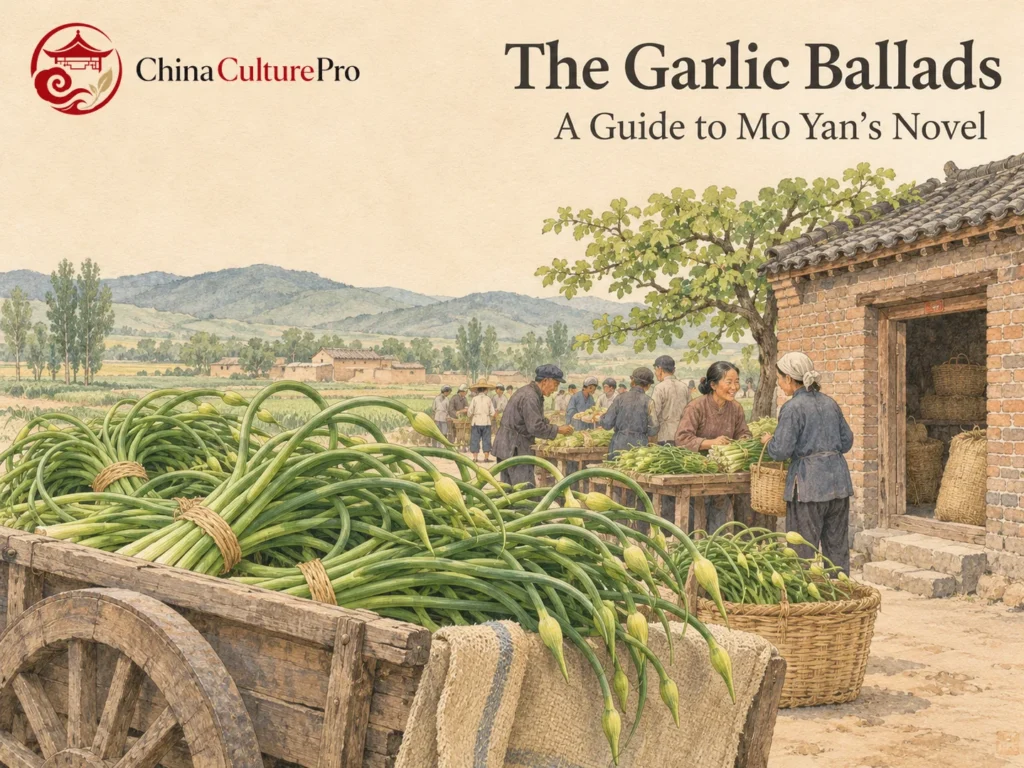

Quick Answer: What Is The Garlic Ballads About?
The Garlic Ballads (天堂蒜薹之歌, Tiāntáng Suàntái zhī Gē) is a novel by Mo Yan (莫言, Mò Yán) about farmers in fictional Paradise County. Local authorities encourage them to grow a crop, but when the buyers can no longer absorb the harvest, the people who grew it are left with the losses.
- The crop: The Chinese title names garlic scapes (蒜薹, suàntái), the flowering stalks of garlic.
- The people: A dispute over sales and fees reaches farmers’ homes, marriages and relationships.
- The voice: Zhang Kou (张扣, Zhāng Kòu), a blind singer, gives the story its recurring ballads.
An actual 1987 incident helped inspire the book. The characters and their lives belong to the novel.

The farmers in Paradise County have already invested their labor by the time they find out how hard it will be to sell the harvest. That gap between growing a crop and getting paid for it drives Mo Yan’s story. The crisis makes old tensions harder to live with and gives a singer a reason to tell the county’s story in his own words.
Why the Harvest Becomes a Crisis
Officials urge farmers to plant garlic. When the produce reaches the market, warehouses fill and growers face rising fees and blocked sales. The stalks deteriorate as they wait for someone to buy them. A household that has already committed land and labor has few ways to recover what it spent. [1]
Read the episode as a chain of decisions. Who encouraged the planting? Who controls the point of purchase? Who can wait for a better price, and who has a perishable crop? The anger becomes easier to understand when you separate the county’s ability to shape the market from a grower’s much smaller ability to leave it.
The garlic harvest carries a different kind of pressure from the crop story in The Dust Settles. There, rival chieftaincies seek an advantage through a trade crop. Here, growers are pushed toward the same market and discover that they cannot depend on it to take their produce.
What the County’s Decisions Cost the Characters
The opening shows Gao Yang (高羊, Gāo Yáng) being called outside by a village official and arrested. Starting with the arrest changes what the reader knows about cause and effect. You meet a person who is already bearing the consequences before the wider events become clear. [2][7]
Another strand follows the relationship between Gao Ma (高马, Gāo Mǎ) and Fang Jinju (方金菊, Fāng Jīnjú). Their relationship brings the question of choice into the household. A family can make demands of its members even while those same people have little control over what officials or buyers decide. [2][3]
The public protest and the intimate story make different demands on a reader. For a market scene, track who controls the sale and what happens when the buyer refuses it. For a family scene, track who is expected to obey and what refusal might cost. The situations are connected by the narrow choices available to people who live through them.
Readers interested in how modern Chinese literature moves between political change and family experience can compare the much longer historical arc of White Deer Plain. The scale is different, but both make household choices part of a wider story.
What Zhang Kou’s Ballads Add
The opening chapter starts with a song attributed to Zhang Kou. It praises the county’s landscape and produce before the prose turns to Gao Yang’s arrest. That arrangement sets two views of the same place beside each other. The song introduces a place through what it grows and how it sees itself. The arrest immediately changes the reader’s view of that portrait. [7]
The singer also offers a public voice. A farmer tells one part of what happened. A ballad makes an incident into something listeners can hear together, recall and repeat. As the novel changes register between song and prose, pay attention to where a singer emphasizes one feature of an event that the surrounding account leaves in the background. [6]
When comparing the Chinese text with Howard Goldblatt’s English, read a whole song alongside the chapter it introduces. Rhythm, diction and forms of address may do work that an isolated line does not reveal. Zhang Kou’s voice gives a useful focus for comparing how the languages handle a local speaker. [6]
The Real Incident and the English Edition
Mo Yan identified The Garlic Ballads as one of his books that grew out of actual events. In 1987, farmers in Cangshan County, Shandong, faced a collapse in the garlic market and protested after purchasing points stopped buying. The novel relocates the conflict to Paradise County and builds its own characters and plot around it. The real event helps explain the premise. The novel’s characters make the reader experience the conflict at the scale of an individual household. [4][5]
The novel appeared in Chinese book form in 1988. Howard Goldblatt translated it into English, and Viking published his translation in 1995. Arcade later issued an English edition. Use the translator credit to identify the English text if your catalogue carries several records. [1][3][5]
For other routes into the author’s fiction, see the Mo Yan reading guide. The Garlic Ballads is an entry point if you want to start with a public conflict told through the lives and voices of people caught up in it.
FAQs About The Garlic Ballads
Is The Garlic Ballads based on a true story?
It draws on the 1987 Cangshan garlic incident. Paradise County and the characters through whom the story unfolds are fictional.
Why are the songs part of the title?
Zhang Kou’s ballads let the reader hear a public account of the county alongside the individual lives narrated in prose.
Which English translation should I look for?
Look for Howard Goldblatt as translator. The Viking edition appeared in 1995, and an Arcade edition carries his translation.
Sources
[1] Skyhorse Publishing / Arcade. The Garlic Ballads: A Novel
[2] Shandong University. From Zhao Shuli to Mo Yan: A Reading of The Garlic Ballads
[3] OCLC WorldCat. The Garlic Ballads: Viking Edition
[4] Mo Yan, Nobel Prize. Nobel Lecture: Storytellers
[5] Thomas Chen, Purdue University Press. The Censorship of Mo Yan’s The Garlic Ballads
[6] Yiran Yang, University of South Carolina. Studying the Voice of Mo Yan and Howard Goldblatt: Zhang Kou in The Garlic Ballads
[7] Mo Yan, Douban Reading. The Garlic Ballads: Opening Chapter in Chinese