


Quick Answer: What Is The Eleventh Son About?
The Eleventh Son (萧十一郎, Xiāo Shíyīláng) is a wuxia (武侠, wǔxiá) novel by Gu Long (古龙, Gǔ Lóng) about a notorious outlaw whose involvement with a prized weapon makes him an easy target for blame. The story combines a mystery about who is using his reputation with a romance that puts several people’s loyalties under strain.
- The outlaw: Xiao Shiyilang (萧十一郎, Xiāo Shíyīláng), known as the Great Bandit, is the character named by the title.
- The weapon: The Deer Carver (割鹿刀, Gēlù Dāo) is the saber at the center of the early dispute.
- The English book: Rebecca S. Tai translated the novel for Homa & Sekey Books.
The original novel comes before its Chinese sequel. This guide keeps the culprit and the main relationships’ outcomes unrevealed.
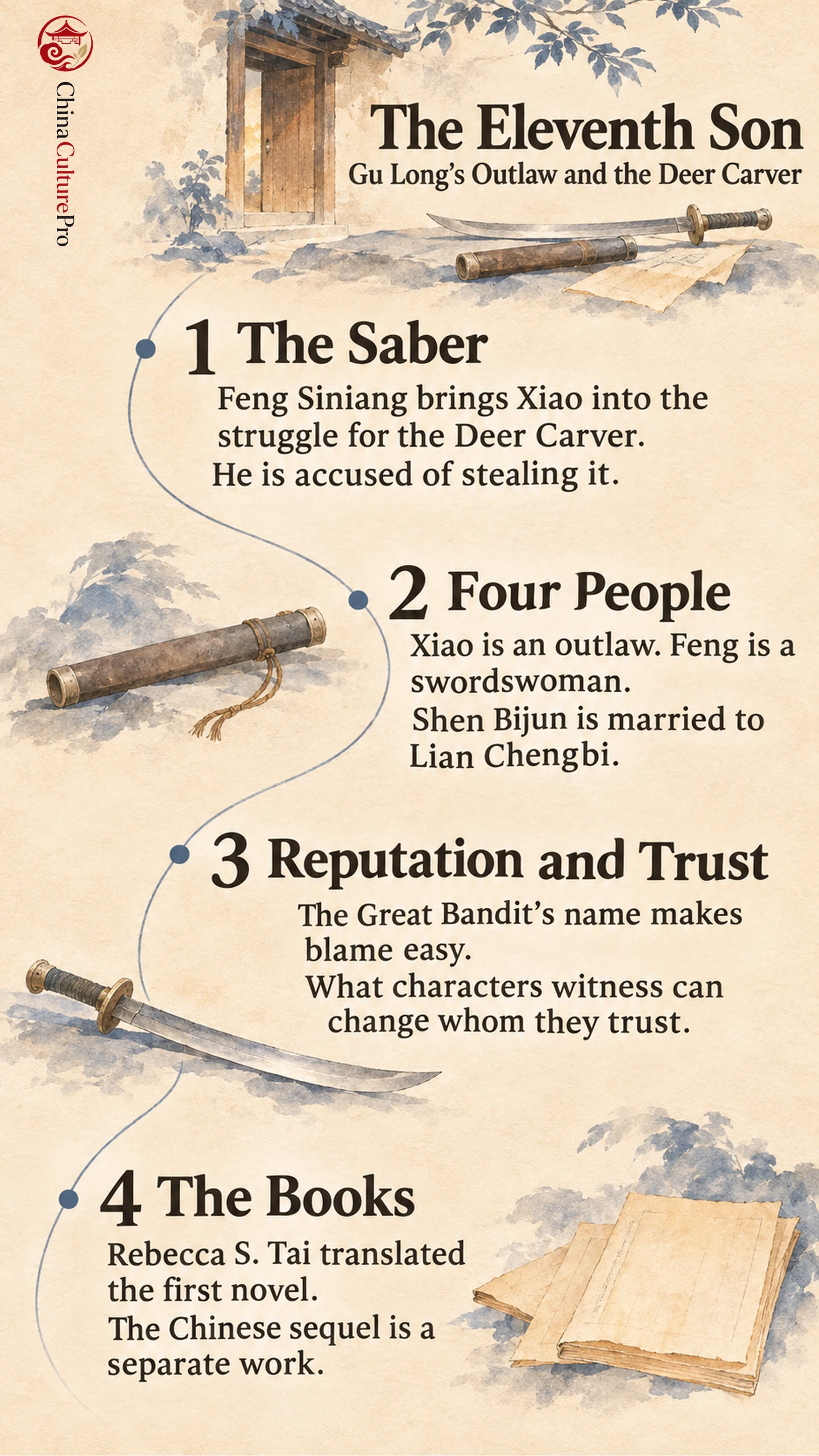
Xiao’s reputation supplies an accusation before anyone has shown what he did. When a famous saber draws attention and people begin looking for someone to blame, an outlaw’s name already suggests an answer. Xiao has to deal with what other people think they know about him while deciding how far to go for someone who has good reason to distrust him.
The Deer Carver and the Accusation
The weapon enters the story through a proposal. Feng Siniang (风四娘, Fēng Sìniáng), a swordswoman who knows Xiao, brings him into the conversation about taking the saber. Gu Long starts with a recognizable wuxia situation, several skilled people with designs on an exceptional weapon. Feng describes a newly forged weapon whose cutting ability rivals celebrated older blades. [3][7]
The ensuing accusation turns the struggle over it into a mystery about how the characters decide whom to believe.
Xiao is accused of stealing the Deer Carver. [1]
The danger lies in how well the story fits the name Great Bandit. Someone who already assumes Xiao is a thief can accept the accusation without knowing who took the weapon. The reader can follow the distinction between the physical object, what a character actually sees and what the people around that character are prepared to believe.
The saber appears in Chinese as 割鹿刀 in one text and 刈鹿刀 in another. Both names point to the fictional weapon Tai calls the Deer Carver. [1][3][7]
The Four People at the Center of the Story
The main relationships are easier to follow if you start with what each person can safely show in public and what they have to decide in private.
| Character | Early position in the story | A question to follow |
|---|---|---|
| Xiao Shiyilang | An outlaw accused in the struggle for the Deer Carver | When does his reputation make an accusation sound more convincing than its evidence? [1] |
| Shen Bijun (沈璧君, Shěn Bìjūn) | A married woman whom Xiao repeatedly helps | What does she learn about Xiao by dealing with him herself? [2] |
| Feng Siniang | A swordswoman whose proposal brings Xiao toward the saber | What does she want apart from Xiao’s affection? [2][3] |
| Lian Chengbi (连城璧, Lián Chéngbì) | Shen’s husband and a respected martial artist | How does public standing shape what others expect of the marriage? [2][3] |
The relationship between Xiao and Shen carries more than the immediate danger of a rescue. She has prior obligations and a public identity of her own. Gu Long can let her change her judgment about a person before she knows what to do about the consequences. Feng, meanwhile, enters with a plan of her own. The novel introduces her as someone who can set events in motion, which gives her interest in Xiao another dimension.
How Reputation Shapes the Mystery
Xiao’s name gives other characters a simple version of him. A person who has spoken with him, needed his help or watched him take a risk has more information, and may still struggle to make that information count in public. The story gets much of its tension from the gap between what can be experienced privately and what can be made credible to others.
Keep this distinction in view when a character makes a claim about another person. What have they witnessed themselves? Whom are they trusting to supply the rest? A rescue gives one person a reason to trust Xiao. Anyone hearing about it secondhand can still give more weight to his reputation.
This combination of chivalric action and a question about trust is one route into Gu Long’s fiction. His work ranges across different protagonists and settings, so readers looking for another mystery-centered story can try The Legend of Chu Liuxiang or The Legend of Lu Xiaofeng. Both follow other protagonists and need no knowledge of Xiao’s story. [5]
The English Translation and the Chinese Sequel
The novel dates to 1970. Gu Long had conceived the story for fiction and completed a film script before writing the novel. That history helps explain why a screen work and a book can be associated with the same title even when a scene or character receives different treatment. Use the novel when a discussion concerns its narration or specific chapters. [3][5]
The English title is The Eleventh Son: A Novel of Martial Arts and Tangled Love. The Homa & Sekey paperback is listed under ISBN 9781931907163, and library records credit Rebecca S. Tai. The publisher lists 2004 for the paperback, and the library record for the same ISBN gives 2005. [1][6] The title, translator and ISBN are stronger search cues than either year alone.
The Chinese sequel is Huobing Xiao Shiyilang (火并萧十一郎, Huǒbìng Xiāo Shíyīláng). A Chinese collection can put the two works under a shared cover title while giving each a separate entry in the contents. The English volume discussed here is the translation of the first novel. [2][4]
FAQs About The Eleventh Son
Is The Eleventh Son the same story as Xiao Shiyilang?
Yes. Xiao Shiyilang names both Gu Long’s Chinese novel and its main character. The Eleventh Son is the title of Rebecca S. Tai’s English translation.
Does the English book include the sequel?
The Homa & Sekey edition discussed here is the first novel. In a Chinese collected edition, look for a separate contents entry for Huobing Xiao Shiyilang.
What is the Deer Carver?
It is a fictional saber coveted by several characters. The dispute over who took it sets an accusation against Xiao in motion.
Sources
[1] Homa & Sekey Books. The Eleventh Son: A Novel of Martial Arts and Tangled Love
[2] OCLC WorldCat. The Eleventh Son: First American Edition
[3] Chen Mo, via Sina. Gu Long’s Appeal and Value: The Eleventh Son as an Example
[4] CiNii Books. Xiao Shiyilang: Two-Work Chinese Edition
[5] Gu Long official works site. Gu Long’s Works and Chronology
[6] The Anton Library of Chinese Studies. The Eleventh Son: English Paperback Record
[7] Gu Long, Gu Long Wuxia Archive. The Eleventh Son: Chapter Four, The Deer Carver