

Quick Answer: What Is Sea Cucumber in Chinese Food?
Sea cucumber, called hai shen (海参, hǎi shēn) in Mandarin, is a marine animal eaten for its soft, springy texture and its place in celebratory Chinese dining.[1][2][5]
- Flavor: mild; stocks and braising sauces supply much of the seasoning.
- Types: spiny and smooth-bodied products have different textures.
- Forms: dried, already soaked and frozen products require different handling.
- Cooking: dried sea cucumber needs rehydration before it joins a finished dish.[3][6]
It is seafood, despite its vegetable-like English name. A frozen pack is not automatically ready to eat.[1][3]

The first decision is whether to order a finished dish or prepare a dried ingredient. They offer very different introductions to this food.
Why Sea Cucumber Has a Place at the Banquet Table
Sea cucumber belongs to a long-established dried-seafood tradition. The dried product, also called bêche-de-mer, is rehydrated for eating and has a documented association with festive meals in Chinese communities.[2]
A seafood braise served at Chinese New Year can express hospitality and abundance through a collection of prized ingredients; these are cultural associations, rather than promised outcomes.[5]
Types, Flavor and Texture: What to Expect
Its mild taste leaves room for stock and sauce. A cooked piece can be springy, softly gelatinous or more yielding, depending on variety and preparation.[3][5]
| Market description | What it describes | Texture cue |
|---|---|---|
| Spiny or prickly sea cucumber | An elongated sea cucumber with soft surface projections | Often prized for a firmer, springy bite |
| Smooth or bald sea cucumber | A smoother-bodied market category | Generally softer, with a thick body wall |
| White teat sea cucumber | Sea cucumber with pale markings | Ask about the particular product’s expected texture |
These are market descriptions, not interchangeable grades or a complete species list.[3]
Dried, Soaked and Frozen Forms
Processing state is a separate question from type:
- Dried: a hard preserved product that must be softened, cleaned and prepared before cooking.
- Already soaked: rehydration has been done, but check whether further cleaning or cooking is required.
- Frozen: may be a soaked product; freezing alone does not state whether it is cooked or ready to eat.[3][6]
Ask what preparation remains. Dried weight and rehydrated weight are not interchangeable in recipes.
Three Chinese Ways to Serve Sea Cucumber
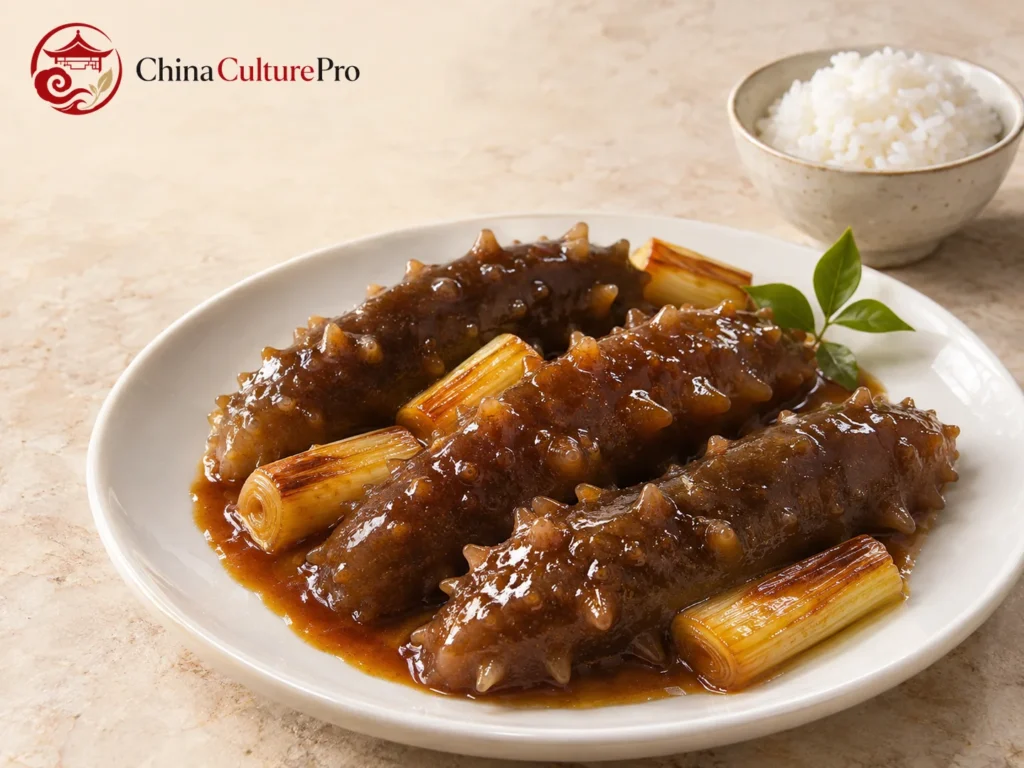
- Scallion braise: cong shao hai shen (葱烧海参, cōng shāo hǎi shēn) pairs sea cucumber with deeply fragrant cooked scallions and a glossy sauce. The dish is a representative of Shandong cuisine, with a soft yet elastic bite and a rich scallion aroma.[4]
- Mixed seafood braise: combine prepared sea cucumber with abalone, fish maw, dried scallops and shiitake mushrooms in a savory sauce. These ingredients provide contrasting textures as well as a festive presentation.[5]
- Soup or stew: prepared sea cucumber joins broth-based dishes with dried scallops, mushrooms or vegetables. Its texture complements the other ingredients.[9]
How Dried Sea Cucumber Becomes Ready to Cook
Preparation can take several days. The following is an overview of the jobs involved, not a universal schedule; use instructions for the actual species and product.[6]
- Rehydrate: rinse and immerse the dried product in clean water in a clean, oil-free container. Keep soaking sea cucumber refrigerated and change the water regularly.[7]
- Soften and clean: follow the product’s heating sequence, then open the softened underside and remove internal organs and grit. Some products need repeated softening stages.[6]
- Rinse and finish soaking: wash thoroughly in clean water and discard soaking water before cooking. Continue the specified refrigerated soaking until the required softness is reached.[7][8]
- Cook or freeze: use the prepared sea cucumber in the selected dish. If saving it, pack and freeze it; thaw it in the refrigerator before cooking.[6]
Do not substitute an overnight countertop soak for refrigerated soaking. Dry size, variety and prior processing can change the work required.[6][7]
Buying and Storing Sea Cucumber
Buy from a reliable supplier and ask for the product’s identity, processing state and preparation directions.[8] An already prepared product avoids the full dried-seafood process. Compare like processing states and weights when choosing between packs.
Keep dried stock protected from moisture in a cool, dry place. Follow the package’s storage instructions for chilled or frozen products. Prepared sea cucumber that will not be cooked promptly can be frozen; do not treat it as a pantry ingredient simply because it began as dried seafood.[3][6]
FAQs About Sea Cucumber
Is sea cucumber a vegetable or a fish?
Neither. It is an echinoderm, a marine animal related to sea stars and sea urchins, and is eaten as seafood.[1]
Can dried sea cucumber go straight into soup?
No. Rehydrate, soften and clean it first. The preparation can take several days, so a dried purchase is not a last-minute soup ingredient.[6]
Does frozen sea cucumber mean ready to eat?
No. Ask whether it is raw, rehydrated, cooked or explicitly ready to eat, and follow that product’s directions. “Frozen” describes storage, not the entire preparation history.
Is sea cucumber the same as fish maw?
No. Fish maw is a fish’s swim bladder; sea cucumber is a separate marine animal. Both may appear in the same braise, but they are different ingredients.[1][5]
Sources
[1] NOAA. Are sea cucumbers vegetables?
[2] FAO. Sea cucumber culture: potential and prospects — Introduction
[3] Michelin Guide. Cooking for Chinese New Year: All About Sea Cucumber
[4] Fushan District Culture and Tourism Bureau. Scallion-braised sea cucumber selected for Shandong’s heritage foods list
[5] Huang Kitchen. Chinese Braised Abalone with Sea Cucumber and Fish Maw
[6] Wing Joo Loong. Easy Guide to Prepare Dried Sea Cucumber for Cooking
[7] On Hing Dry Seafood. How to soak and store sea cucumbers
[8] Hong Kong Centre for Food Safety. Use of Caustic Soda in Sea Cucumber
[9] Confucius Was a Foodie. Sea Cucumber