


Quick Answer: What Is My Old Home About?
*My Old Home* (故乡, Gùxiāng) is a short story by Lu Xun (鲁迅, Lǔ Xùn). A man returns after more than twenty years to help his family leave its old house. He meets Runtu (闰土, Rùntǔ), a childhood friend, and finds that they can no longer speak to each other with the ease he remembers.[1][2]
- The return: The family has sold the house, so the trip is also a farewell.
- The reunion: Runtu addresses his old friend with the formality expected between people of different standing.
- The ending: The narrator wonders whether the next generation might make a different kind of life.
The road image at the end grows out of a specific friendship, and out of what the narrator cannot recover from it.[1]
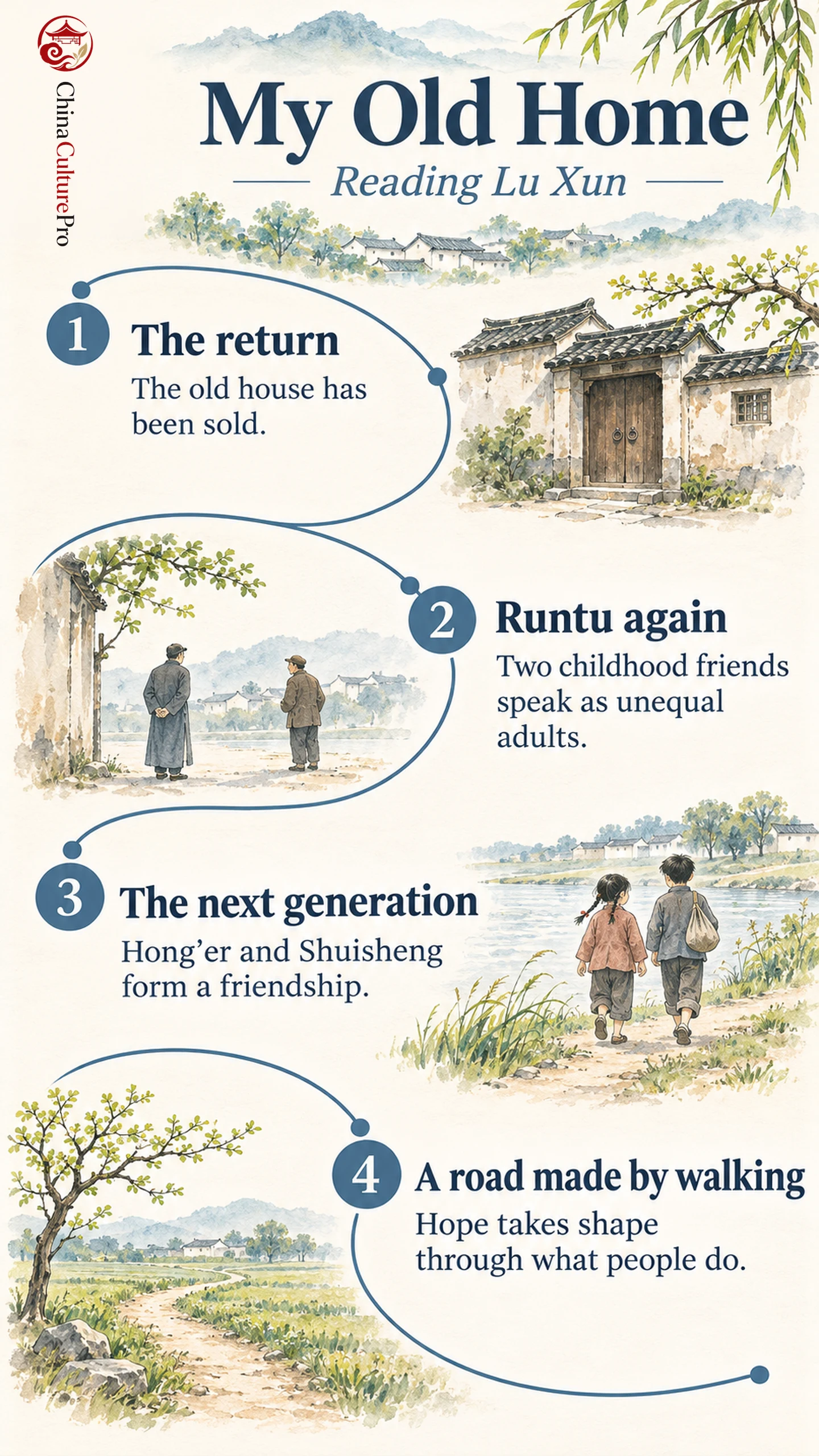
The narrator comes home in winter. What he sees from the boat makes him question whether he has remembered the place clearly at all.
Why the Narrator Returns to His Hometown
The old house has been sold and must be handed over before the new year. The narrator plans to help his mother move to the place where he earns his living. He expects to recognize the landscape. The villages look bleak to him, but he cannot bring a more beautiful version clearly to mind. He considers whether his mood has changed what he sees.[1]
The story sets up a difference between a place, the events he remembers there and the feeling he wants to recover. Mention of Runtu brings back a much clearer image than the buildings do. His mother says Runtu would like to see him. Before the two men meet, the reader has already seen how much the narrator wants that name to bring back.[1][2]
What Changes When He Meets Runtu Again
As a boy, Runtu tells the narrator about things the narrator has never done. He knows how to trap birds and talks about shells at the shore and animals that raid the watermelon fields. The memory makes the boy seem at home in a larger world than the one the narrator knows. Their different family positions matter even then. Runtu comes because his father works for the narrator’s household.[1][2]
The adult Runtu looks worn from years of hard living. The narrator starts to speak as he might have spoken to the boy in his memory. Runtu calls him *lǎoye* (老爷), a respectful form of address that can mean “master.” It makes a difference in social position audible. The narrator’s mother encourages the older familiarity, but Runtu treats it as a freedom they had when they were children.[1][2]
Runtu names concrete burdens when asked about his life, including mouths to feed, poor harvests and payments that eat into what he earns. The man who once brought news of the shore still has things to tell his old friend. Now their conversation has to make room for hardship the narrator did not share.[1][2]
Why Hong’er and Shuisheng Matter
Hong’er (宏儿, Hóng’ér) is the narrator’s nephew. Shuisheng (水生, Shuǐshēng) is Runtu’s son. The two boys spend time together during the visit. As the family leaves, Hong’er is already thinking about seeing his new friend again. That concern gives the narrator something more concrete than an abstract wish that people should treat one another differently.[1]
He can imagine the boys remaining friends. His reunion with Runtu also shows him how adult expectations can interrupt that closeness. He wants them to have a life distinct from the hardships he sees in his own circumstances and in Runtu’s. The future he imagines starts with two children who still want to meet.[1]
What the Road at the End Means
Before the narrator pictures a road, he wonders whether hope itself is like an idol he has made. He remembers his private amusement when Runtu wanted an incense burner and candlesticks. Runtu’s wish concerns something close to hand. The narrator’s hope for the children reaches further into an uncertain future. Comparing the two makes him more cautious about treating his own hope as something that already exists.[1]
He ends by imagining a path made by people walking on ground where no path existed before. The image gives the work of making a future to many people. The boys’ closeness is still uncertain. The road gives the narrator a way to think about what could make it last. In Kong Yiji, Lu Xun uses a different social division, made visible by who sits and who stands at a tavern.[1]
FAQs About My Old Home
Is Hometown another title for My Old Home?
Yes. Both are English renderings of *Guxiang*. *My Old Home* is the title used in the English excerpt from the Yang Hsien-yi and Gladys Yang edition hosted by Columbia University.[2]
When was My Old Home first published?
The Chinese story appeared in *New Youth* in May 1921 and was later collected in *Call to Arms*. The January date at the end of the Chinese text is its composition date.[1][3]
Sources
[1] Lu Xun. My Old Home, original Chinese short story
[2] Columbia University Asia for Educators. My Old Home, English excerpts and historical context
[3] Educational Wisdom. My Old Home, Chinese text and publication note