
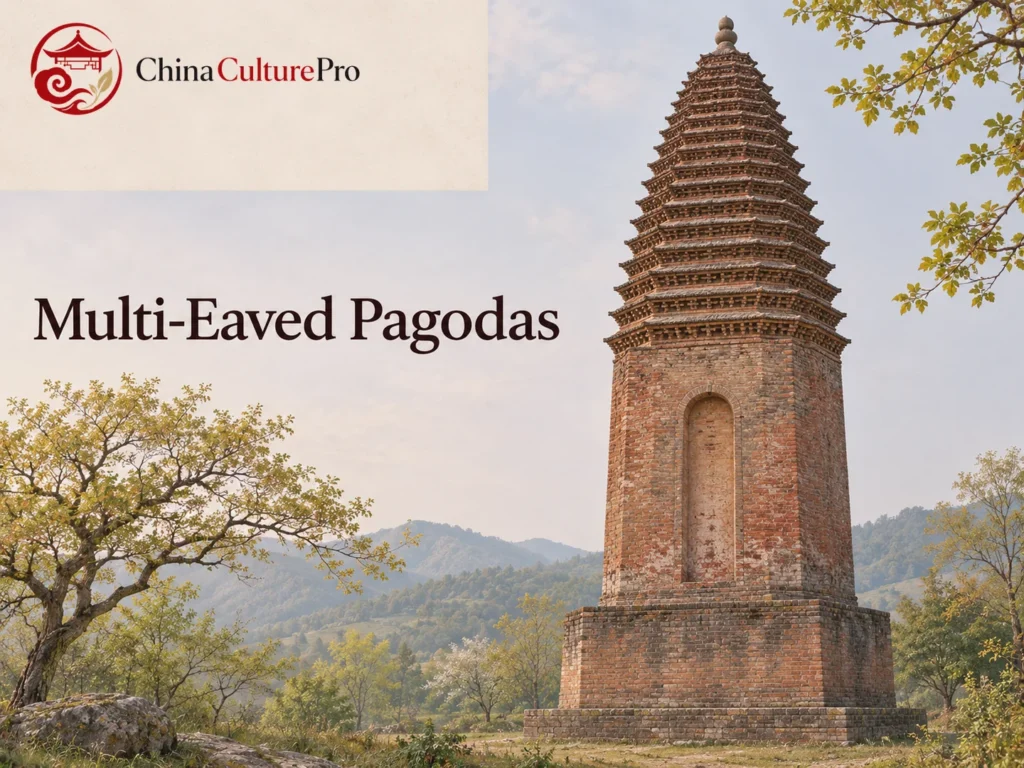

Quick Answer: What Is a Multi-Eaved Pagoda?
A multi-eaved pagoda (密檐式塔, mìyánshì tǎ) is a Buddhist tower with closely spaced projecting eaves above a taller lower body. The upper eaves often shrink in width as they rise. Count the bands to describe the outside, then consult the building record for its interior layout.[1][2][3]
- Start low: A tall first stage stands below the dense stack.[1][3]
- Look up: Short wall sections separate the upper eaves.[1][2]
- Check the plan: Examples have different outlines, including square, octagonal and twelve-sided forms.[1][3][4]
The number of eaves describes an exterior pattern. The interior can have a different arrangement.[2][3]

Seen from a distance, the eaves pull the eye toward the narrower top. Close up, the wall between those lines can carry brick reliefs or false openings.[1][2][3]
How the Eaves Shape the Tower
The lower body often has room for a tall door or carved imagery. Above it, shallow projecting eaves divide a much smaller amount of wall into repeated bands. From below, the undersides of the eaves cast lines of shadow that make the taper easier to see.[1][2][3]
At Songyue Temple in Henan, the brick pagoda is dated to 523. It has a twelve-sided lower body and fifteen close-set eaves. The World Heritage documentation describes many ornamental openings in its upper wall. On the upper stage, arched recesses and small lattice designs repeat around the tower. The openings and recesses add scale to the narrow space between each pair of eaves.[1][2]
Why Eaves and Interior Floors Can Differ
A pavilion-style pagoda (楼阁式塔, lóugéshì tǎ) organizes its outside in more widely separated levels. The tight upper bands of a multi-eaved tower can outnumber its interior divisions. At Songyue, the nomination dossier records fifteen projecting eaves above the first level outside and ten subdivisions in the upper part of the chamber.[2][3]
Some examples are solid above the base. The Tianning Temple Pagoda in Beijing has a solid octagonal brick body and thirteen closely spaced eaves over a tall lower stage. Recesses, false doors or modeled windows on a pagoda face can belong to the decorative design of traditional Chinese architecture. A section or conservation survey reveals what is behind them.[2][3]
Reading the Surviving Tiers at Small Wild Goose Pagoda
Xi’an’s Small Wild Goose Pagoda is a square brick tower from the Tang dynasty. Thirteen of its original fifteen levels survive, leaving the top truncated. The building is one of the Chinese components of the Chang’an–Tianshan Silk Roads World Heritage property.[4][5][6]
An engineering study describes the tower’s hollow interior and thick brick walls. That makes it useful alongside the solid Tianning example. Their similar eave profiles conceal different interiors. At Small Wild Goose Pagoda, arched openings pierce the north and south sides. At Tianning, the tall lower stage carries carved architectural and religious detail on the face of a solid tower.[3][4]
The silhouette persisted across dynasties. Beijing’s Cishou Temple Pagoda, built in 1576, also uses thirteen close-set eaves above a tall base. Dated building records are needed to place individual examples in that long history.[1][3]
FAQs About Multi-Eaved Pagodas
Do multi-eaved pagodas always have the same plan?
The form describes closely spaced eaves. Songyue has twelve sides at its base, Tianning is octagonal, and Small Wild Goose is square.[1][3][4]
Does every opening lead inside?
Some openings are ornamental. Compare the façade with a survey to tell which openings communicate with the interior.[2][3]
Why do historical and present tier counts sometimes differ?
Upper tiers can be lost. Small Wild Goose Pagoda was built with fifteen levels and has thirteen surviving levels.[4][5]
Sources
[1] Nancy Shatzman Steinhardt. Chinese Architecture: A History, Chapter 5
[2] UNESCO World Heritage Centre. Dengfeng Historic Monuments Nomination Dossier
[3] Academy of Chinese Studies. Features of Multi-Eaved Pagodas
[4] Journal of Vibration, Measurement and Diagnosis. Study of a Multi-Eaved Brick Pagoda
[5] China Internet Information Center. Xi’an Museum and Small Wild Goose Pagoda
[6] UNESCO World Heritage Centre. Silk Roads Component List