


Quick Answer: What Is Love in a Fallen City About?
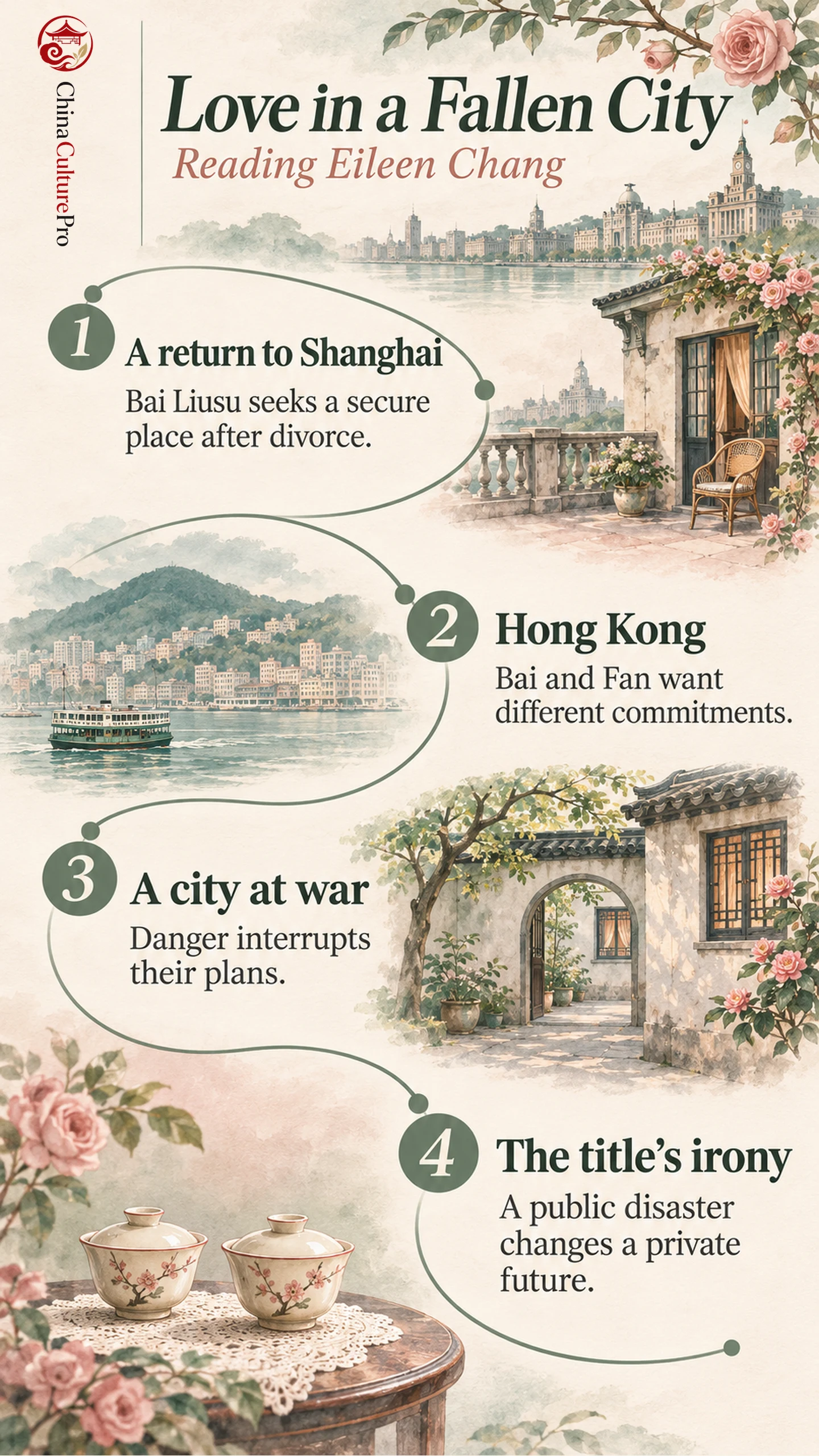
*Love in a Fallen City* (倾城之恋, Qīngchéng zhī Liàn) is a 1943 novella by Eileen Chang (张爱玲, Zhāng Àilíng). Bai Liusu (白流苏, Bái Liúsū), a divorcée trying to leave an uncomfortable family situation in Shanghai, sees a chance for a second marriage with Fan Liuyuan (范柳原, Fàn Liǔyuán). In Hong Kong, they have different ideas about commitment until wartime danger changes how much they need each other.[1][3][4]
- In Shanghai: Bai depends on relatives who regard her return as a burden.
- In Hong Kong: Fan can offer attention and a place to stay without giving Bai the security she seeks.
- During the war: An event much larger than either character changes what their relationship can be.
The private outcome and the public disaster give the title its uneasy force.[1][5]
Bai and Fan can say a great deal to one another without making a promise. The story takes them to a point where what they can offer each other matters more than how cleverly they can talk.
Why Bai Liusu Wants to Leave Shanghai
Bai returns to her mother’s house after a divorce. The extended family’s resources are limited, and relatives treat her presence as a problem they would prefer to solve on their own terms. A second marriage would change her position in a concrete way. It could give her a household where she has more security and fewer reasons to depend on the family’s goodwill.[1]
Chang makes it possible to see both the calculation and the feeling in Bai’s interest in Fan. Wanting stability shapes what she listens for when Fan talks about what he wants from their relationship. Her family’s impatience makes the question urgent even when Fan is content to leave it open.
What Bai and Fan Want in Hong Kong
Fan enters Bai’s circle as a potential match for her sister. His interest turns to Bai. He has spent much of his life abroad, has money and can move between places with options she does not have. Hong Kong gives the two some distance from her relatives. The Repulse Bay Hotel is one of the settings in which they can spend time together and still postpone a decision.[1][3][4]
Bai wants a recognized marriage. Fan’s teasing and attentions can keep her close without giving her that commitment. A house where he is willing to support her would offer shelter, but it would leave her position dependent on him. The novel can make that option look tempting because the alternative in Shanghai is to return to the same relatives and the same arguments.[1] Pay attention to when a witty remark lets one person change the subject. Their exchanges can sound equal in style while the consequences of going home alone are different for each.
How the Fall of Hong Kong Changes the Story
This section discusses the outcome. The Japanese attack on Hong Kong interrupts Fan’s plans to leave. He and Bai end up together again during the fighting. The danger changes the things they have reason to ask of each other. Getting through the next day matters more immediately than the balance of advantage they tried to preserve while they were courting.[1][4]
They marry. The story makes the security Bai sought at the start possible, but through a disaster neither could have planned. It never makes the fall of the city a reward they earned by understanding one another. The public and private events remain out of proportion. Chang lets the couple’s dependence become more direct while keeping the scale of what is happening outside their home in view.[1][5]
What the Title’s Irony Adds to the Ending
The Chinese expression in the title can evoke a beauty capable of overturning a city. Here a city actually falls, and its fall makes Bai’s marriage possible. A familiar phrase about a woman’s beauty ends up naming a reversal in what gives her power. The marriage settles an urgent problem for Bai. It is still a small outcome beside what the city’s residents have endured.[1][5]
In Half a Lifelong Romance, Chang lets the years apart change what a reunion can accomplish. Red Rose White Rose offers a different view of attachment and respectability through a man trying to separate desire from the life he thinks he ought to lead.[3]
FAQs About Love in a Fallen City
When did Love in a Fallen City first appear?
Chang published the Chinese novella in 1943. Its action takes place in wartime Shanghai and Hong Kong, with the fall of Hong Kong central to the last part.[1][3][4]
Is Love in a Fallen City a novella or a collection?
It is both a novella’s title and the title of an English collection of Chang’s short fiction. The NYRB Classics book includes the novella. The collection credits Karen S. Kingsbury and Eileen Chang as translators.[2]
Sources
[1] Washington University Libraries. Love in a Fallen City, literary exhibit and synopsis
[2] New York Review Books. Love in a Fallen City, the NYRB Classics collection
[3] Oxford Academic. Romancing Returnee Men, on two stories by Eileen Chang
[4] Hong Kong Public Libraries. Eileen Chang, Love in a Fallen City and the Repulse Bay Hotel
[5] University of Tübingen. The City, the Self and the Essayistic, a study of Eileen Chang and Virginia Woolf