


Quick Answer: What Is a Jiangxi Tianjing House?
A tianjing (天井, tiānjǐng), or skywell, is a small open court set within a house. In traditional examples from Jiangxi (江西, Jiāngxī), it gives surrounding rooms a place to receive daylight and air. Roofs can direct water toward the opening, where the floor drains or collects it.[1][2]
- Light: The roof opening lets daylight reach rooms set away from the street.[1][3]
- Air: Halls, doors and corridors around the opening help determine how the house ventilates.[3]
- Water: Inward-facing eaves lead rain to the skywell floor. Some floors drain the water and others contain a basin.[2]
The skywell is one feature of Jiangxi’s regional building traditions. Its size and position vary from house to house.[3][4]
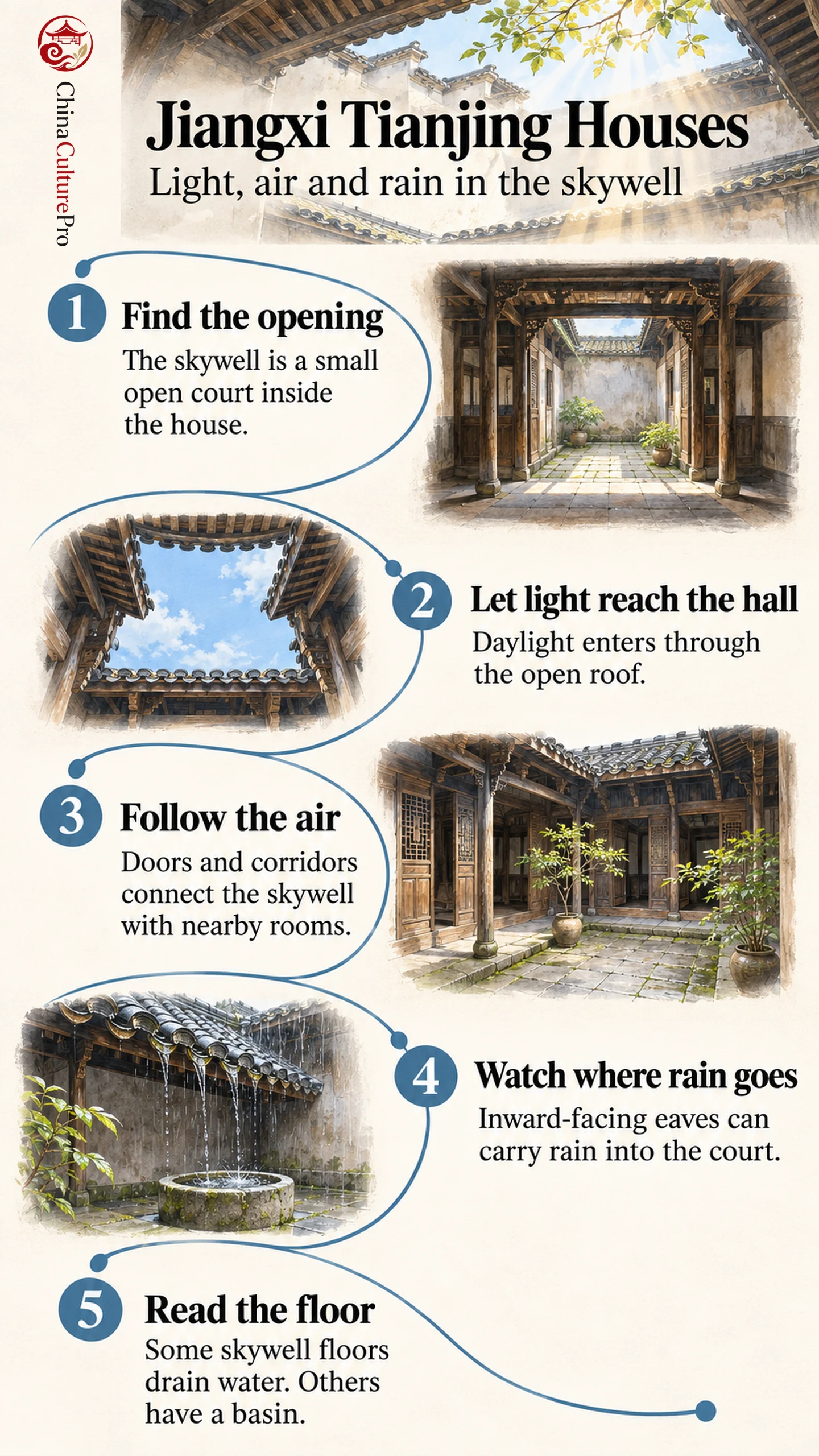
From the hall, look for the place where the roof stops and the paving continues into daylight. The skywell sits within the domestic layout. A single opening can bring light into the hall and give runoff a place to reach the ground.
How the Skywell Brings Light and Air Inside
In Hukou (湖口, Húkǒu) County, a local heritage account describes the skywell as the opening within a connected roof system. The roof frames of the main and side rooms meet around it. The opening gives these interior-facing rooms daylight and a path to the outside air.[1]
Researchers studying houses in Tianbao (天宝, Tiānbǎo) Village recorded conditions in Jinshidi (进士第, Jìnshìdì), a residence begun in the late Ming period and later enlarged. The team took measurements at the skywell, hall and corridor, then used them to check a computer model. In the model, air could pass from the entrance through the skywell and along the corridors.[3]
Where the Roof Water Goes
The phrase si shui gui tang (四水归堂, sì shuǐ guī táng) describes the way eaves around the court can direct roof water inward. Those eaves can meet at different heights. At floor level, the treatment also varies. A draining floor carries water away, while a sunken basin holds some of it. Look for the point where roof water reaches the ground and where it can leave. A recessed basin changes how the water sits within the court.[2]
Variation Across Jiangxi
Hukou lies near the border with southern Anhui. Its heritage account notes the relationship to Huizhou courtyard houses and the local use of grey brick and tiles.[1] In southern Jiangxi, the fortified Hakka enclosed compounds are a different regional tradition, while central Jiangxi has historic villages with groups of skywell houses.[4]
FAQs About Jiangxi Tianjing Houses
Is a Tianjing Covered by a Roof?
In the traditional type described here, the well itself opens to the sky. Roofs shelter the halls and side rooms around it.[1]
Is the Skywell the Same as a Courtyard?
It is a kind of court, usually compact and integrated into the surrounding rooms. Some properties have both skywells and larger open courts elsewhere on the plot.[3]
Do All Jiangxi Houses Have a Tianjing?
Jiangxi has multiple regional house types. Even within skywell traditions, the number and shape of the openings can vary.[3][4]
Sources
[1] Hukou County Bureau of Culture, Broadcasting and Tourism. A Guide to Historic Houses in Hukou
[2] China World Cultural Heritage Monitoring and Early Warning Platform. Jiangyou Gan-Style Skywell Houses
[3] Buildings. Study on Adaptive Techniques of Traditional Skywell Dwellings in Jiangxi and Hunan
[4] Jiangxi News. An Overview of Jiangxi’s Historic Towns and Villages