


Quick Answer: What Is an Ice-Ray Lattice?
An ice-ray pattern (冰裂纹, bīngliè wén) is an arrangement of straight bars that divide a window or screen into irregular openings. The bars meet at varying angles, like cracks across ice. A lattice may use the geometry on its own or add a motif such as a plum blossom.[1][2]
- Find the bars: Shorter lines meet longer ones at angles that change across the panel.[1][3]
- Compare the openings: Adjacent shapes vary in size and outline.[1][3]
- Notice the flowers: Some garden windows set plum blossoms within the angular pattern.[2]
The ice is a visual comparison. The pattern is built into the window frame.[1][2]
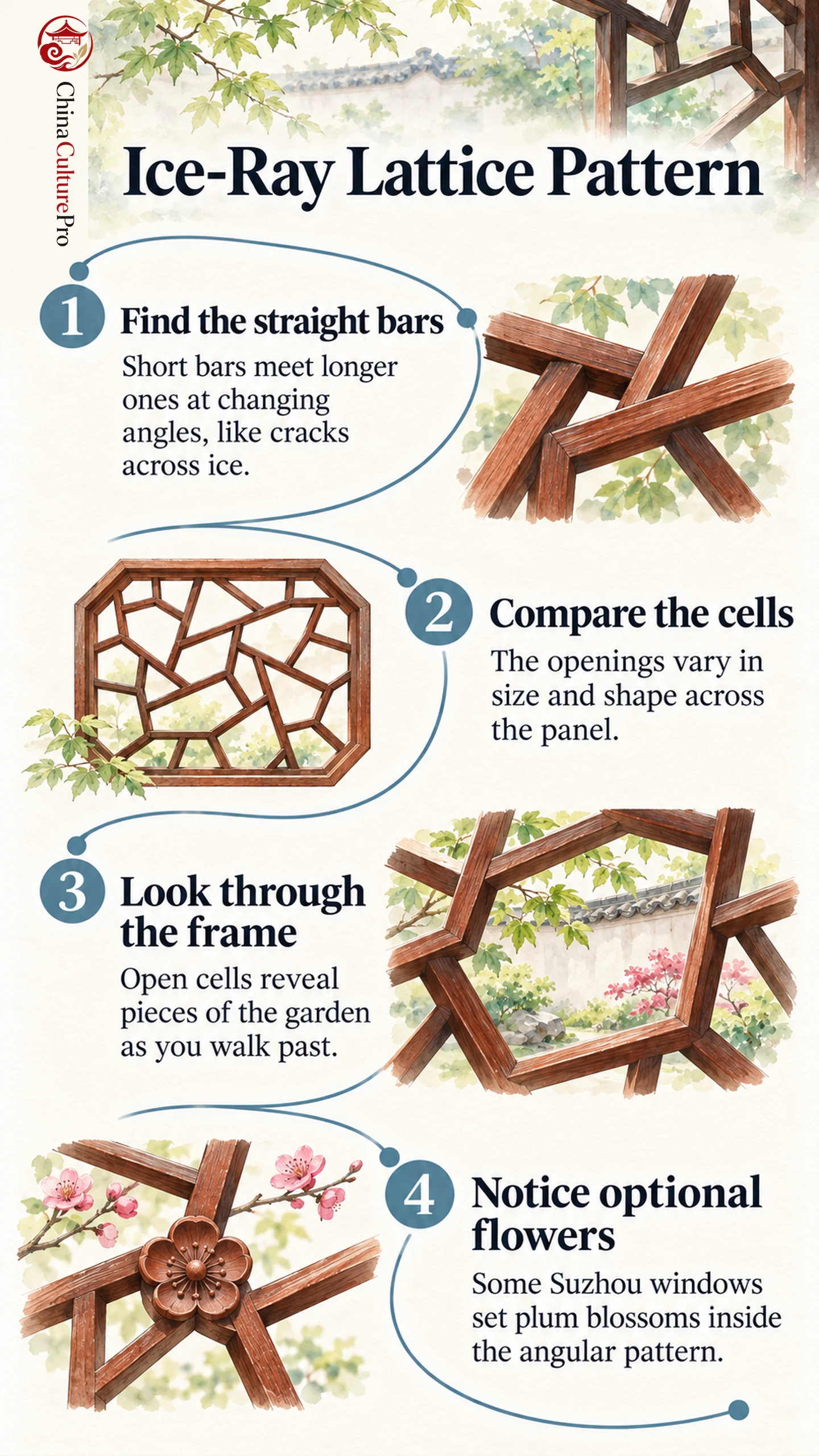
A window can be framed by a plain rectangle and still feel loose and varied inside. The difference comes from the way the bars break the view into unequal pieces.[1][2]
How the Cracked-Ice Pattern Works
Look at a single opening. Its sides are generally straight, but its corners need not meet at right angles. Look at the next opening and the proportions change. George Stiny distinguished ice-ray lattices from patterns made by repeating a small geometric unit at regular intervals.[1]
Stiny used a mathematical model that divides a region into smaller shapes. Iasef Md Rian later explored models that generate several kinds of ice-ray pattern. These studies explain how a simple operation can make a varied composition. The models explain the visible geometry. They leave open how carpenters laid out and assembled a particular surviving window.[1][3]
How the Openings Frame a Garden
The bars partly interrupt the view without hiding it. When you move along a covered walk, a branch or a fragment of a wall can slide in and out of view between them. The lines stay fixed while the view behind them changes. At a distance, the window can read as an overall pattern. Closer up, each opening frames a small piece of the scene. This is one way windows contribute to Chinese garden design.[1][2]
The Suzhou gardens bureau describes versions with plum blossoms set into the angular lattice. It links the flower with the plum’s ability to withstand the cold. The blossom gives a panel a second visual clue alongside the ice-like geometry.[2]
Where to Find Documented Examples
The Suzhou gardens bureau illustrates ice-pattern windows at the Small Square Hall in Lion Grove Garden and at Yiliang Pavilion in the Humble Administrator’s Garden. The hall and pavilion examples show the pattern at two building scales. Compare how much of the opening it occupies and how the woodwork sits within the larger frame.[2]
In Beijing, the Palace Museum records ice-crack lattice on upper windows and transoms at Meiwu, a western side building of the Hall of Mental Cultivation added in 1774. Its entry describes glass windows beneath the patterned openings. Look at the different levels of the opening to see how the lattice occupies part of a larger window arrangement.[4]
FAQs About Ice-Ray Lattice
Are ice-ray and cracked-ice lattice the same pattern?
Both English names describe the irregular bar layout associated with cracked ice.[1][2]
Does the pattern require cracked glass?
The pattern comes from the arrangement of the bars. Glass can be a separate element of the same window assembly.[2][4]
Does every ice-ray window have plum blossoms?
A plum blossom can be added to the pattern. The irregular geometry works on its own.[1][2]
Sources
[1] George Stiny. Ice-Ray: A Note on the Generation of Chinese Lattice Designs
[2] Suzhou Municipal Bureau of Gardens and Landscaping. Craft and Design of Wooden Windows
[3] Iasef Md Rian. Fractal-Based Algorithmic Design of Chinese Ice-Ray Lattices
[4] The Palace Museum. Meiwu and Its Ice-Crack Lattice Windows