

Quick Answer: What Is Hunan Stir-Fried Pork?
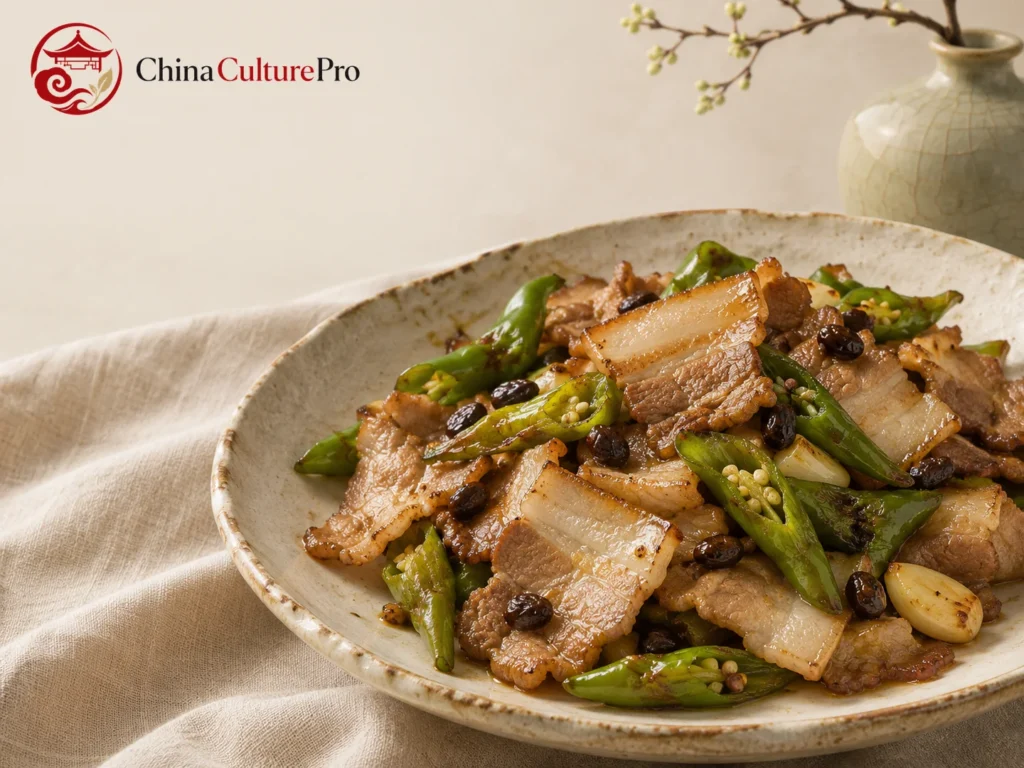
Hunan stir-fried pork (小炒肉, xiǎochǎo ròu) combines fresh pork with fresh peppers in a savory wok-cooked dish. Pork belly and green chilies are a familiar pairing.[1]
- Meat: Fresh pork, with the cut varying by preparation.
- Peppers: A substantial vegetable ingredient, rather than just a garnish.
- Seasoning: Garlic, soy sauce and other additions shape the flavor.
- Serving: A shared meat-and-vegetable dish suited to rice.
The name does not impose one pork cut, pepper variety or sauce consistency.[2][3][4]
Within Chinese food, this dish makes a useful introduction to fresh chilies: their texture and aroma matter alongside their heat.
Names, Pork Cuts and Fresh Peppers
Menus may use nongjia xiaochao rou (农家小炒肉, nóngjiā xiǎochǎo ròu), roughly farmhouse-style stir-fried pork, or lajiao chao rou (辣椒炒肉, làjiāo chǎo ròu), pork stir-fried with peppers. These names help identify the combination, but do not guarantee identical ingredients across restaurants.[3][4]
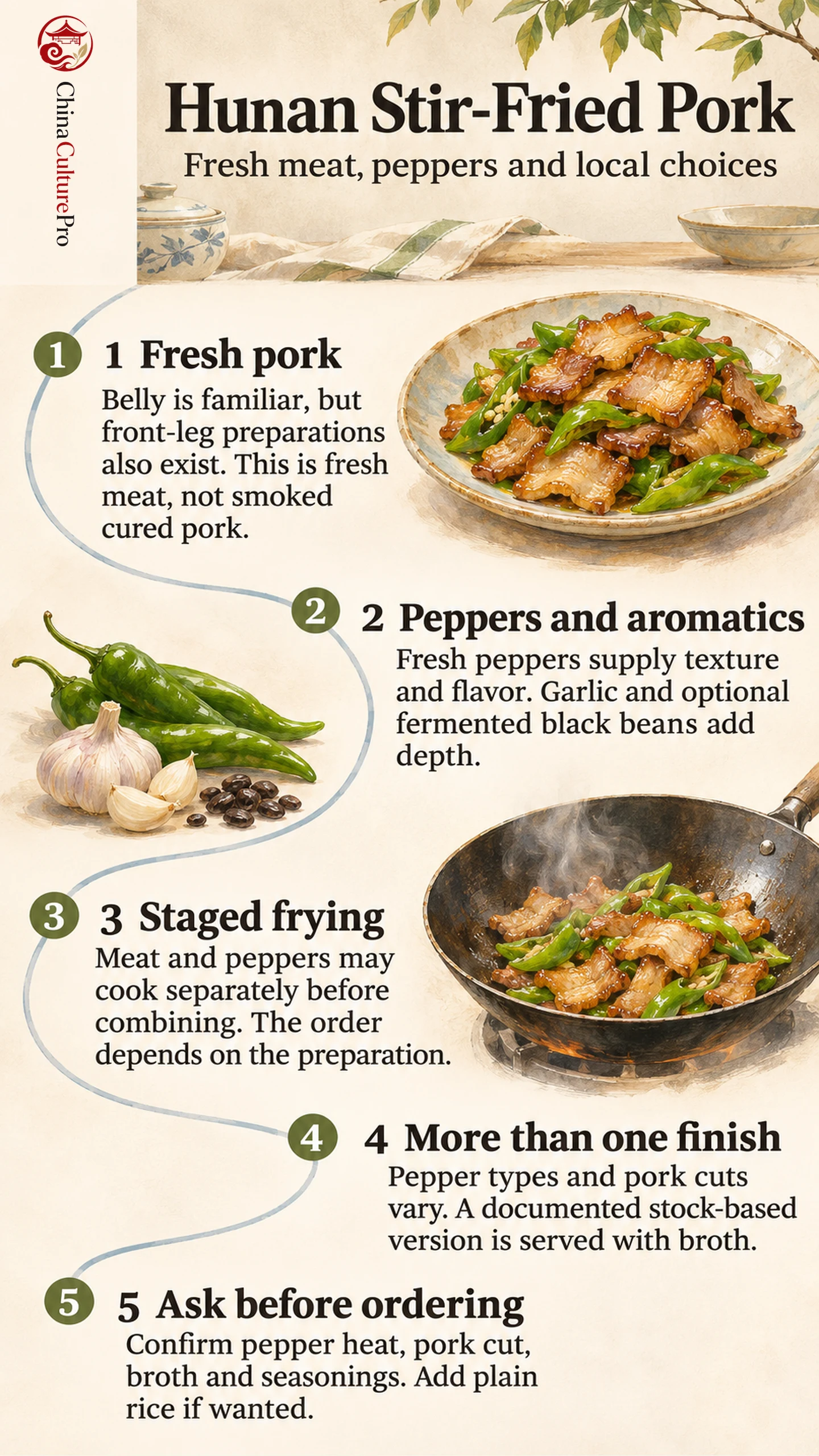
Belly brings alternating fat and lean layers; a documented front-leg version separates the fatty and lean portions before cooking. Both use fresh meat. That distinguishes this dish from Hunan smoked pork with garlic shoots, where cured meat supplies a different starting flavor.[2][4]
Fresh peppers contribute fleshy texture and a green aroma. Published versions range from bullhorn chilies to mild green capsicum, while contemporary Hunan cooking demonstrations feature multiple pepper varieties. There is no reason to identify the dish by one cultivar alone.[2][5]
Douchi (豆豉, dòuchǐ), fermented black soybeans, can add salty fermented depth. They are optional in one published farmhouse-style preparation, so their absence does not by itself identify a different dish.[3]
How the Ingredients Are Stir-Fried
The useful principle is controlling the meat and peppers separately before combining their flavors. One documented approach follows this sequence:[2]
- Cook the fresh peppers until softened and lightly marked by the pan, then set them aside.
- Fry the sliced pork so its fat begins to render.
- Add ginger, garlic, dried chili and fermented beans where the chosen preparation uses them.
- Return the peppers, add the remaining seasonings and toss everything together.
This is one example of Chinese wok cooking, rather than a compulsory order. Another preparation cooks the pork with aromatics first, sets it aside, cooks the peppers, then reunites them. The meat and peppers therefore need not enter the wok together.[3]
Documented Variations within the Dish
Differences extend beyond heat level. These published approaches show why a menu name alone cannot settle every detail:
| Approach | Meat and peppers | Distinguishing detail |
|---|---|---|
| Pork-belly version | Thin belly slices with bullhorn chilies or green capsicum | Uses a seasoned marinade that includes potato starch.[2] |
| Farmhouse-style version | Sliced or shredded meat with green peppers and chopped chili | Fermented black beans are an optional addition.[3] |
| Stock-based front-leg version | Fatty and lean portions prepared separately | Stock is added; the dish can arrive in a heated pot with broth.[4] |
These are concrete preparations, not three official regional schools. Together they show that neither a starch-free marinade nor a completely dry finish defines every version. Hunan descriptions also place the belly-and-green-pepper combination in everyday home cooking, alongside its restaurant presence.[1]
Ordering and Eating Hunan Stir-Fried Pork
Start with the pepper choice. Ask whether the kitchen uses hot chilies or a milder pepper, and whether dried or chopped chilies are added separately. Choosing a mild vegetable does not automatically remove every source of heat.[2][3]
Next ask about the pork cut and whether the dish is relatively dry or served with stock. Belly suits readers who enjoy a richer fatty texture; a front-leg preparation may combine distinct lean and fatty pieces. Order rice alongside if you want a plain accompaniment for the seasoned pork and peppers.[2][4]
For ingredient restrictions, check the actual seasonings. Soy sauce and fermented soybeans matter for soy avoidance; wheat content depends on the sauces used. Cooking wine, optional seasoning powders and any stock also need checking when relevant. A restaurant may not be able to change a prepared marinade or broth.[2][3][4]
FAQs About Hunan Stir-Fried Pork
Must It Be Made with Pork Belly?
No. Belly is familiar, but a published Hunan chef’s version uses front-leg pork and handles its lean and fatty parts separately.[4]
Can It Be Made with Mild Peppers?
Yes. Green capsicum appears as an alternative in a published preparation. Ask about additional chilies too, since changing the fresh pepper may not remove all heat.[2]
Are Fermented Black Beans Essential?
No. They add fermented savory flavor, but at least one farmhouse-style recipe explicitly treats them as optional.[3]
Should the Finished Dish Always Be Dry?
No. A stock-based preparation served in a heated pot is also documented. A little broth is therefore not sufficient reason to dismiss the dish.[4]
Sources
[1] Hunan Provincial Government. Here Comes the “Spicy”
[2] Adam Liaw, SBS Food. Hunan-style fried pork and peppers
[3] Lee Kum Kee. Farmhouse-style stir-fried pork
[4] Xiao Shuai, Daxiang Cuisine News. A chef’s pepper-and-pork dish served with broth
[5] Peng Kexin, Lu Qinke and Zhang Tianai, New Hunan. Changsha pepper-and-pork cooking event