

Quick Answer: What Are Hubei Pearl Meatballs?
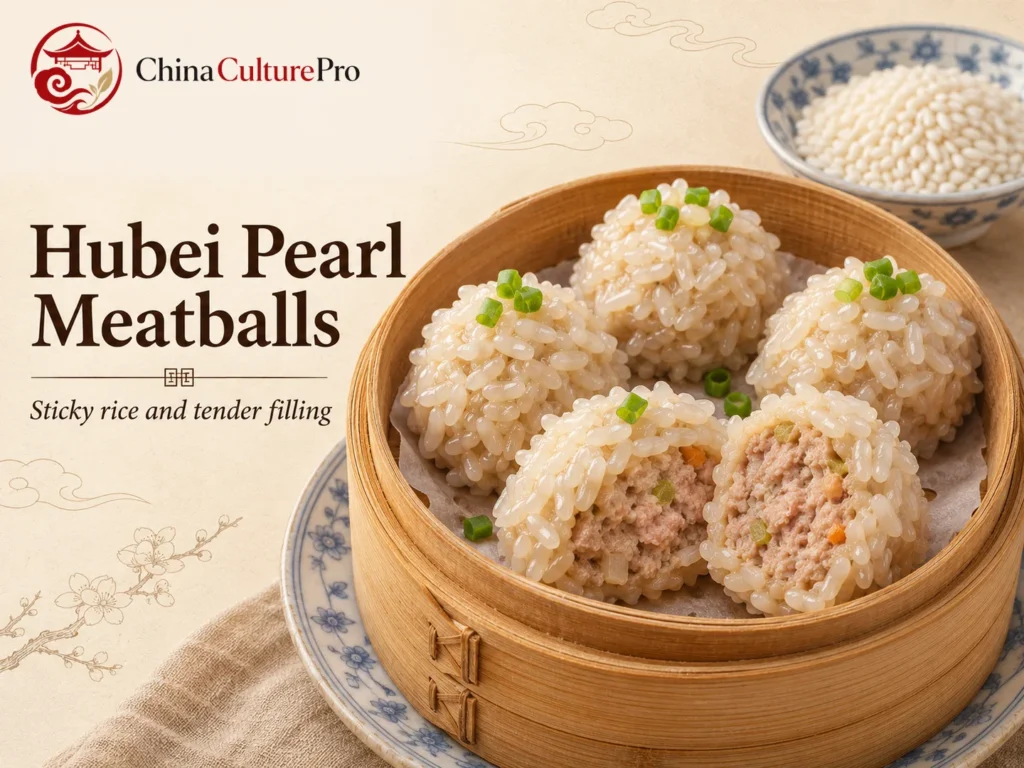
Hubei pearl meatballs (珍珠丸子, zhēnzhū wánzi) are savory meatballs coated in whole glutinous rice (糯米, nuòmǐ) and steamed. The grains become glossy and bead the surface, giving the dish its “pearl” appearance. The rice is a coating, not a flour-based wrapper. [1][2]
- Center: Seasoned minced pork is familiar; some versions also contain fish.
- Outside: Soaked rice grains cling to the shaped meatball.
- Cooking: The rice and filling cook together in steam.
- Serving: A savory shared dish, often associated with celebrations.
A pale rice coating does not reveal the filling’s full ingredients.

Their appearance is delicate, but pearl meatballs are a substantial meat dish. Understanding the grain layer, filling and steaming process makes the menu easier to read—and explains why two plates can look similar while containing quite different ingredients.
Whole Rice Outside, Seasoned Meat Inside
The outer layer uses intact sticky rice. Individual grains remain visible after steaming, creating a chewy surface around the tender center. This differs from kneading rice flour into a smooth skin or wrapping meat in a sheet. [2][3]
The filling begins with finely chopped or minced meat mixed with seasonings. Ginger, scallions and pepper are familiar choices. Water chestnuts can add a small crisp contrast; mushrooms are another documented household addition. Egg or starch may help the mixture hold together, depending on the recipe. [1][3]
A Hubei culinary-institute preparation combines pork with grass carp, water chestnut, egg and starch. That is a specific documented version, rather than proof that all pearl meatballs contain fish. Another family recipe uses pork and cabbage. [1][6]
How Pearl Meatballs Are Formed and Steamed
The essential order is filling first, grain coating second, steaming last. The rice is soaked and drained before coating; it is not normally cooked into a finished rice ball beforehand. [7]
- Soak the glutinous rice and drain it so the grains can coat the filling.
- Mix the minced meat, aromatics and selected additions until the filling holds its shape.
- Form individual meatballs and roll them in the prepared rice, pressing lightly to attach the grains.
- Arrange them on a suitable steamer liner or dish and steam until the filling and rice are cooked. [7]
The grains swell around the meat as both cook. A liner or prepared dish helps prevent the coating from sticking to the steamer surface. The result belongs to Chinese steaming methods, rather than the browned crust and reduced sauce of a fried or braised meatball. [2]
Hubei Traditions and Filling Variations
Pearl meatballs are associated with the Mianyang Sanzheng (沔阳三蒸, Miǎnyáng sānzhēng) tradition around present-day Xiantao in Hubei. “Three steams” can describe three broad ingredient groups—water products, meat and vegetables—rather than one compulsory set of three dishes. Pearl meatballs belong to its meat preparations. [4]
That regional association and the filling recipe are separate questions. These documented examples illustrate how the dish changes between kitchens:
| Documented version | Filling distinction | What it demonstrates |
|---|---|---|
| Hubei culinary-institute preparation | Pork, fish, water chestnut, egg and starch. | A familiar meatball can contain fish as well as pork. |
| Mushroom household version | Pork with mushrooms, egg and aromatics. | Vegetable additions can change flavor and texture. |
| Cabbage household version | Pork with finely minced cabbage. | There is no single mandatory vegetable filling. |
Celebratory family meals give the dish a place in Chinese food culture beyond everyday meatballs. This does not mean a festival, a particular steamer or an elaborate banquet is required to serve it. [3]
Ordering, Serving and Ingredient Checks
Ask what is inside before choosing a portion: pork only, a pork-and-fish mixture, or another preparation. If you avoid fish or egg, the white rice exterior cannot tell you whether either is present. Likewise, a vegetable ingredient in the center does not make the meatball vegetarian.
Check soy sauce, sesame oil and any separate dipping sauce as well as the meat mixture. One commercially packaged product includes chicken, pork, wheat flour, soy protein and sesame oil. Its ingredient list demonstrates why a product label matters; it does not establish a standard formula for Hubei cooking. [5]
Serve the meatballs as part of a shared meal and take a whole piece carefully so the rice coating stays attached. Their character comes from the combination of chewy grains and tender filling, rather than a heavy sauce. Any accompanying dip is a separate choice.
FAQs About Hubei Pearl Meatballs
Why Are They Called Pearl Meatballs?
The name refers to the visible rice grains, which become glossy around the cooked meatball. It does not mean that pearls or pearl powder are ingredients.
Is the Rice Cooked Before Coating?
The usual sequence coats the filling with soaked, drained grains. The rice then cooks together with the meat during steaming.
Does Glutinous Rice Contain Gluten?
“Glutinous” describes sticky rice, not wheat gluten. The finished dish still needs a separate ingredient check because sauces, binders or commercial mixtures may contain wheat. [3][5]
Can Pearl Meatballs Be Vegetarian?
Vegetarian adaptations are possible, but the pork-based dish described here is not vegetarian. Confirm the entire filling and seasoning when a menu offers a meat-free version.
Sources
[1] Hubei Chu Cuisine Research Institute. 珍珠圆子
[2] Judy / The Woks of Life. Chinese Pearl Meatballs with Sticky Rice
[3] Amy L. Hubei Pearl Meatballs
[4] Changjiang Network / Hubei Department of Culture and Tourism. 这道菜传承600年魅力日盛见证非遗文化生命力
[5] Chen Hsiang Food. Pearl Meat Ball 750g
[6] Frankie Gaw. Grandma’s Pearl Meatballs
[7] Cookery teaching handout. 珍珠丸子