

Quick Answer: Who Is Huang Feihu?
Huang Feihu (黄飞虎, Huáng Fēihǔ) is a Shang military commander in Investiture of the Gods (封神演义, Fēngshén Yǎnyì). He holds the title King Wucheng (武成王, Wǔchéng Wáng) and changes allegiance to Zhou after a tragedy at the Shang court. Near the end of the novel he receives a new office, the god of Mount Tai, the Eastern Peak (东岳, Dōngyuè).[1][4][5]
- Chapter 30 explains the deaths in his family and his break with the ruler.[1]
- Chapters 31 through 34 follow the escape and his arrival on the Zhou side.[2][3][4]
- Chapter 99 names him head of the gods of the Five Sacred Peaks.[5]
The story links a military figure in a dynastic war to a mountain with an older religious history.[6]

At the Shang court, Huang Feihu has a title, a family connection to the palace and a record of service. As he leaves, those ties make the journey harder. He must escape with relatives whose safety is bound up with his own decision.
Why Huang Feihu Leaves Shang
In Chapter 30, Lady Jia (贾氏, Jiǎ Shì), Huang Feihu’s wife, goes to the palace. Daji brings her into the ruler’s presence, and Lady Jia dies after throwing herself from the tower. Huang Feihu’s sister, one of the ruler’s consorts, confronts him and dies as well. Zhou Ji presses Huang Feihu to act after the two deaths. The chapter makes his break with Shang a dispute about the ruler’s conduct toward his own household.[1]
The Journey to Zhou
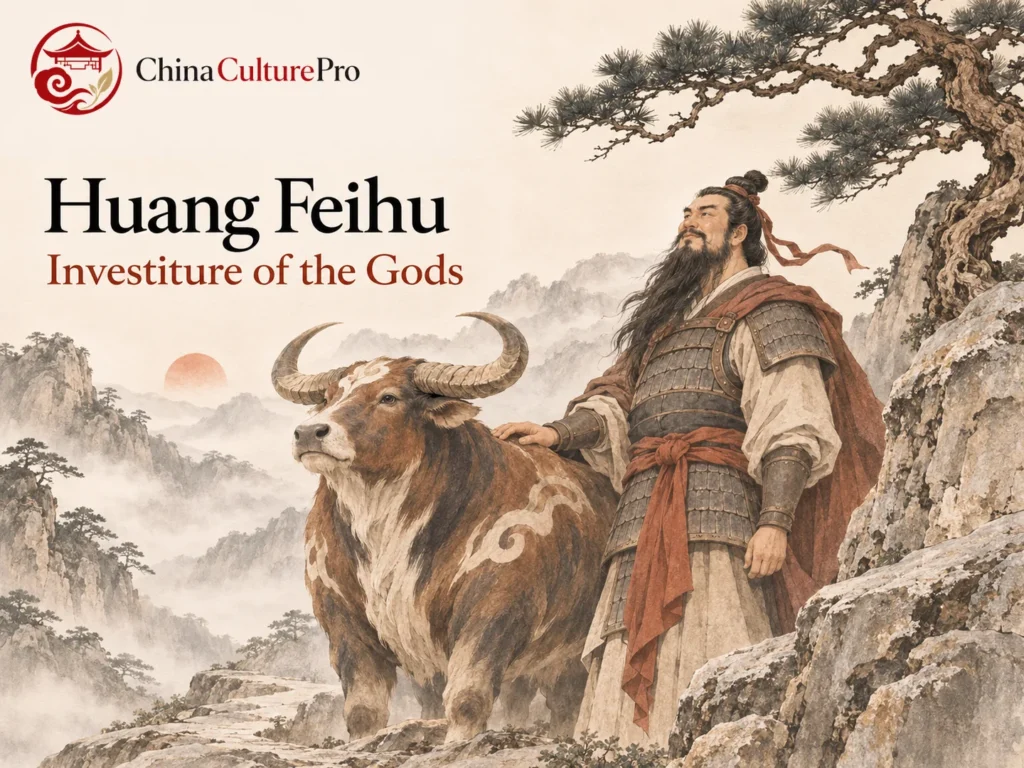
At the passes, the military commander is also a figure of supernatural fiction. Chapter 31 puts him on a five-colored divine ox (五色神牛, wǔsè shénniú) as he approaches a garrison. Wen Zhong is among the pursuers, and an immortal intervenes to conceal the fleeing family.[2]
At Tong Pass, his son Huang Tianhua (黄天化, Huáng Tiānhuà) comes to his aid. Chapter 34 brings the general to Jiang Ziya (姜子牙, Jiāng Zǐyá) in the west, where he explains his departure from Shang and seeks a place with Zhou.[3][4]
How Mount Tai Enters His Story
In Chapter 99, Jiang Ziya gives Huang Feihu the office of the Great Emperor of the Eastern Peak at Mount Tai. The appointment places him at the head of the five peak gods and gives him responsibilities over passage through the underworld. This is one of several divine appointments in the closing chapters. The same ceremony assigns Zhao Gongming a different office.[5]
Mount Tai was already a place of imperial and popular worship centuries before the novel. The mountain god’s association with the judgment of the dead is attested by the Tang, and records from the Song document worship at the mountain and in temples farther away. The novel gives a name and a backstory to an office that readers could recognize from an older tradition.[6][7]
FAQs About Huang Feihu
What animal does Huang Feihu ride?
He rides a five-colored divine ox. It appears during his flight from the Shang court.[2]
Who is Huang Tianhua?
He is Huang Feihu’s son. Chapter 32 brings them together at Tong Pass after the father is struck down.[3]
Did the novel originate worship of Mount Tai?
Mount Tai had a long history of worship before the novel. The story makes Huang Feihu the holder of an established divine office.[5][6]
Sources
[1] Investiture of the Gods. Chapter 30, Chinese text
[2] Investiture of the Gods. Chapter 31, Chinese text
[3] Investiture of the Gods. Chapter 32, Chinese text
[4] Investiture of the Gods. Chapter 34, Chinese text
[5] Investiture of the Gods. Chapter 99, Chinese text
[6] Lifeng Han. Communicating Civilization Through Rituals: Mount Tai Pilgrimages in Song China, 960–1279
[7] UNESCO World Heritage Centre. Mount Taishan