
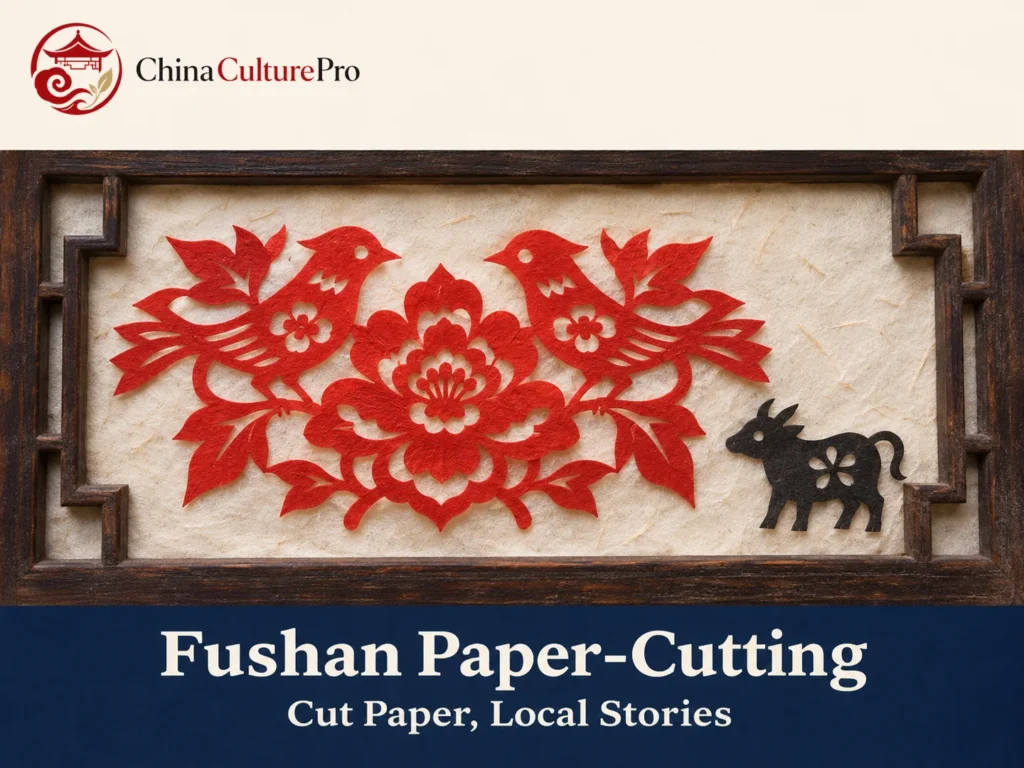

Quick Answer: What Is Fushan Paper-Cutting?
Fushan paper-cutting (浮山剪纸, Fúshān jiǎnzhǐ) is a folk art from Fushan County in southern Shanxi. Makers cut patterns into paper for uses such as decorating windows, covering wedding gifts and providing patterns for embroidery. A local birthday custom used a series of red cutouts called bridge flowers. [1][2][3][4]
- Openwork: The paper left between the openings holds a picture together.
- Folds: A fold helps create paired designs such as facing birds or blossoms.
- Use: A cut can decorate a window, carry a wish at a celebration or guide stitches on cloth. [2][3][4]
Look at how the lines join and where the finished piece was placed. A window cut and a wedding cut can make different use of the same flower.

A Fushan cut can fit in a window pane, span a basin on a wedding day or tell a story with many figures on one sheet. The opening around each figure belongs to the design. That balance between what stays and what is removed changes with the size and purpose of the piece.
How a Cut Sheet Holds Together
The Shanxi Arts and Crafts Group describes the use of scissors and knives as well as some torn-paper work. In an openwork design, bridges of paper connect different parts of the pattern. When the sheet is lifted, an isolated shape would fall away. A thin link at the base of a leaf can keep it attached and double as the leaf’s stem. With folded paper, a cut through both layers produces a matching shape on either side. [2]
A Fushan story picture can put people, objects and buildings side by side so viewers can see them all. The local profile describes scenes arranged to show several viewpoints. It also cites Mice Stealing Oil for its exaggerated way of telling a story. A viewer can follow the scene through the arrangement of the figures rather than through one fixed viewpoint. [2][3]
Window Flowers, Wedding Pairs and Bridge Flowers
Window flowers are among the Chinese New Year decorations documented in Fushan. The county tradition also includes cuts placed on clothing or accessories to guide embroidery. A flat paper flower could supply the plan for stitches on a pillow or a shoe. [2][4]
Paired motifs had a place at weddings. One local account describes designs covering items in a bride’s dowry, including basins. It records fish and lotus designs on these covers. Folding can make one half of a pattern answer the other, a fit for images of two birds or paired flowers. [2][3]
A Fushan customs account describes a celebration at age twelve. In one documented version, the family joined twelve red paper cuts on yellow paper to form a symbolic bridge. These pieces, called qiáohuā (桥花), could include a peony or a figure connected with a wish for the child’s welfare. The account describes the child passing under the paper bridge during the observance. The strips of paper became one object for that occasion. [2][3]
Qiao Qin’s Work and the Local Record
Qiao Qin learned paper-cutting in his family and worked with Shanxi artist Zheng Hong’e after returning home in 2011. His piece Spring brings drummers, stilt walkers and lion dancers into the shape of the Chinese character for spring. Nearly sixty figures connect in a symmetrical arrangement. A close view reveals individual performers, while the entire sheet reads as one character. [4]
People’s Daily also reported that Qiao contacted the families of older Fushan artists and assembled albums for eight of them. In 2024, the same report showed Qiao using a zodiac theme for sixteen dragon designs. He varied the posture from resting to airborne to make a different outline for each. [4]
How the Craft Is Taught Today
At the Fushan Paper-Cutting Museum, Qiao taught children a local rhyme about subjects including the moon and fish. In May 2026, Shanxi Evening News reported that Zhang Ning helped children make window flowers at an event in Zhaigeta. Story designs on display included The Mouse Wedding. The museum class uses a rhyme to remember subjects. At Zhaigeta, children began by making something for a window. Both give people a way into Chinese paper-cutting in Fushan. [4][5]
FAQs About Fushan Paper-Cutting
Is Fushan paper-cutting always red?
Red appears in window decorations and the local bridge-flower account. Black also appears in Fushan work. Qiao Qin has used black with dyed colors for a series of sports-themed paper cuts. [2][3][4][5]
What are Fushan bridge flowers?
Bridge flowers are paper cuts called qiáohuā (桥花). A local account describes twelve red cuts joined into a symbolic bridge for an observance at age twelve. [3]
How is Fushan paper-cutting listed as heritage?
Shanxi added Fushan paper-cutting to its provincial list in 2009 as an extension of its paper-cutting entry, with the Fushan County Cultural Center named in the notice. UNESCO’s 2009 inscription is for the broader Chinese paper-cutting tradition. [1][6]
Sources
[1] Shanxi Provincial People’s Government via Xinzhou Intangible Cultural Heritage Protection Center. Notice on the Second Provincial Intangible Cultural Heritage List
[2] Shanxi Arts and Crafts Group. Traditional Crafts of Shanxi: Fushan Paper-Cutting
[3] Qiao Xiaoguang Studio. Fushan Customs and Paper-Cutting
[4] People’s Daily, Shanxi edition. Qiao Qin and Fushan Paper-Cutting
[5] Shanxi Evening News. Fushan Paper-Cutting at Zhaigeta
[6] China Intangible Cultural Heritage Network. Chinese Paper-Cutting