


Quick Answer: Should You Choose Fresh or Dried Rice Noodles?
Choose fresh rice noodles when you want a tender, slippery texture and can use them promptly. Choose dried rice noodles for pantry convenience and a reliable alternative when good fresh noodles are unavailable. Both can work in Chinese soups and stir-fries; shape and preparation still matter.[1][2][3]
- Fresh does not mean wide: moisture level and noodle shape are separate classifications.[1]
- Dried does not mean ready for the wok: hydrate or cook the noodles as directed for the dish.
- Fresh does not always mean cooked: some refrigerated products still require cooking; read the directions.[4]
Treat fresh and hydrated noodles as perishable ingredients. Keeping them soft on the counter is not a substitute for safe refrigerated storage.[5][6]
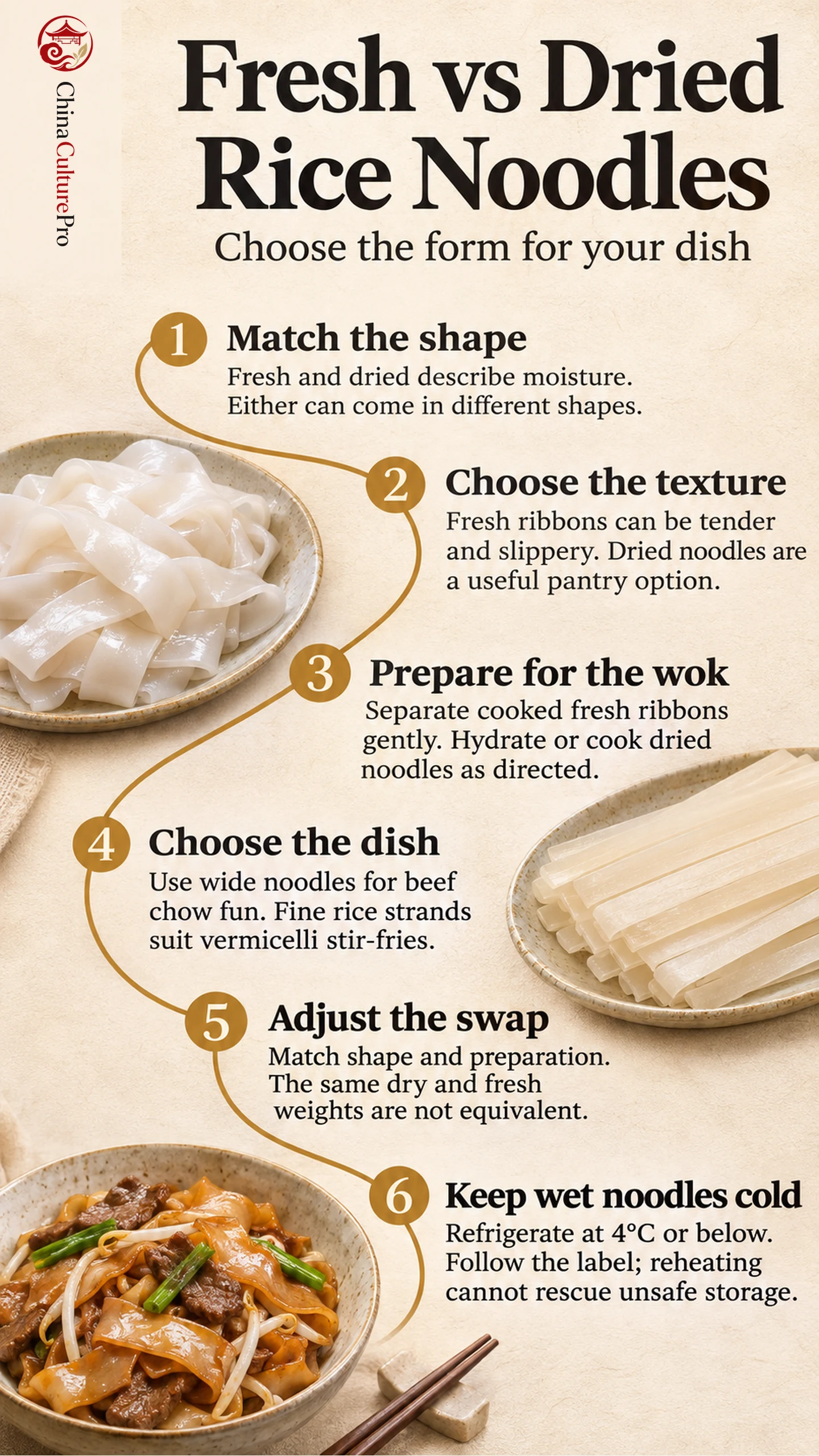
A successful substitution starts with the noodle’s shape and state, not just the words “rice noodles” on the front of the packet. A wide ribbon, a thin strand and a round noodle bring different textures to the same sauce.
Shape and Moisture Are Separate Choices
Chinese rice noodles can be classified by how they are formed—such as cutting steamed sheets or extruding strands—and by whether they are fresh or dehydrated. Drying extends storage life; it does not define a single noodle shape.[1]
Ho fun (河粉, hé fěn) is the Cantonese name commonly used for fresh wide rice noodles. Thin rice vermicelli may be labeled mei fun or mi fen (米粉, mǐ fěn), although regional names and English labels are not perfectly standardized. Compare the visible width and shape alongside the ingredient list.[2]
For a wider view of rice and wheat noodle families, see our guide to Chinese noodles. Here, the practical comparison is between moisture states within a suitable rice-noodle style.
Compare Texture, Preparation and Storage
| Form | Texture | Preparation before a stir-fry | Storage priority |
|---|---|---|---|
| Fresh rice noodles | Often tender and slippery; chilled sheets can become firm and stuck together.[2][3] | Separate cooked ribbons gently; follow cooking directions for other fresh types. | Refrigerate and follow the use-by label. |
| Dried rice noodles | Brittle in the packet; texture after cooking varies with thickness and formulation. | Rehydrate or cook according to the product and recipe. | Keep unopened dry noodles protected from moisture; refrigerate after hydration. |
Both forms have a mild rice flavor; texture is the more useful comparison. Freshness and formulation also matter.[1] Dried wide noodles can give good results in a stir-fry when the available fresh noodles are stiff or difficult to separate.[3]
Prepare Each Form for the Wok
Read the packet and recipe together. A method designed for a thin dried strand should not automatically be applied to a thick ribbon.
- Check the starting state: identify fresh or dried, width, and whether a fresh product is already cooked.
- Prepare fresh noodles: gently peel apart soft cooked ribbons. If chilled sheets are rigid, use the product’s suitable brief warming or blanching method to loosen them rather than pulling them apart by force.[3][4]
- Prepare dried noodles: soak or cook to the recipe’s required flexibility. Allow for further cooking in the wok rather than softening them completely first.[4]
- Drain and finish gently: have the other ingredients ready, drain the noodles, and lift or fold them through the pan without overcrowding.[4]
There is no universal soaking time. Thickness, formulation, water temperature and the next cooking stage all change the result. Check the noodles themselves as well as the clock.
Choose Noodles for the Chinese Dish
- Beef chow fun (干炒牛河, gān chǎo niú hé): wide rice noodles are central to this beef-and-bean-sprout stir-fry in Cantonese cuisine. Fresh ribbons or properly prepared dried wide noodles can work.[3]
- Thin vermicelli stir-fries: choose fine rice strands when the recipe is built around that light texture; replacing them with broad ribbons changes the dish.[2]
- Rice-noodle soups: round strands and flat noodles are both possible. Select the requested style and prepare it before adding it to the soup as the recipe directs.[2]
Substituting Without Losing the Dish
Match shape first, then adjust preparation and quantity. Dried noodles gain water during hydration, so the same dry weight is not a like-for-like replacement for a weight of fresh noodles. Use a recipe’s tested alternative amount or the packet’s portion guidance rather than assuming a universal conversion ratio.[1]
Cooked fresh ribbons may only need heating and coating; prepared dried noodles may need more cooking. Adjust liquid and doneness together.[4]
Keeping Fresh and Soaked Noodles Safe
Store fresh rice noodles at 4°C or below and follow the packet’s storage and use-by instructions. Keep hydrated noodles refrigerated if they are not being cooked immediately. A fresh packet’s short preparation time should not be confused with a long safe keeping time.[5][6]
Wet rice noodles held too long at room temperature can develop hazardous heat-stable toxins. Reheating cannot be relied on to rescue improperly stored noodles, and normal appearance alone does not establish safety. Keep time out of refrigeration brief rather than leaving noodles out for prolonged softening.[5]
FAQs About Fresh and Dried Rice Noodles
Are all fresh rice noodles already cooked?
No. Steamed sheets are cooked; other refrigerated products may still need cooking. Check the packet rather than their soft appearance.[4]
Should dried rice noodles always be boiled?
No. Some methods use soaking followed by cooking in the wok; others use boiling or blanching. Follow the product and dish instructions, not a blanket rule for all rice noodles.[2][4]
Can I replace fresh noodles with the same dry weight?
Do not assume so. Fresh noodles already contain water, while dried noodles take up water during preparation. Check a tested substitution or portion recommendation.[1]
Are fresh rice noodles always better?
No. Good fresh noodles offer a tender texture, but quality varies. Dried wide noodles can be a useful, consistent option for beef chow fun when good fresh noodles are unavailable.[3]
Sources
[1] Li Y. et al. Traditional Chinese Rice Noodles: History, Classification, and Processing Methods
[2] The Woks of Life. Chinese Noodles and Wrappers
[3] The Woks of Life. Beef Chow Fun
[4] Hot Thai Kitchen. How to Cook Rice Noodles Properly
[5] Centre for Food Safety. Food Safety Express, September 2024: Bongkrekic Acid
[6] Centre for Food Safety. Bacillus cereus in Poon Choi