

Quick Answer: What Is Flowers in the Mirror About?
*Flowers in the Mirror* (镜花缘, Jìnghuā Yuán) is an early nineteenth-century Chinese novel by Li Ruzhen (李汝珍, Lǐ Rúzhēn). It takes place in a fantastic version of the age of Wu Zetian (武则天, Wǔ Zétiān). Flower spirits descend to the human world, travelers visit imaginary kingdoms, and women compete in examinations that let their learning come into public view.[1][2]
- The voyage: The travelers find societies whose customs make their own seem less inevitable.
- The best-known reversal: In the Kingdom of Women (女儿国, Nǚ’ér Guó), a male visitor is subjected to footbinding.
- The later story: An examination for women brings together characters whose lives began in the opening flower story.
The two halves ask different questions about what a society expects people to be able to do.[1][4]
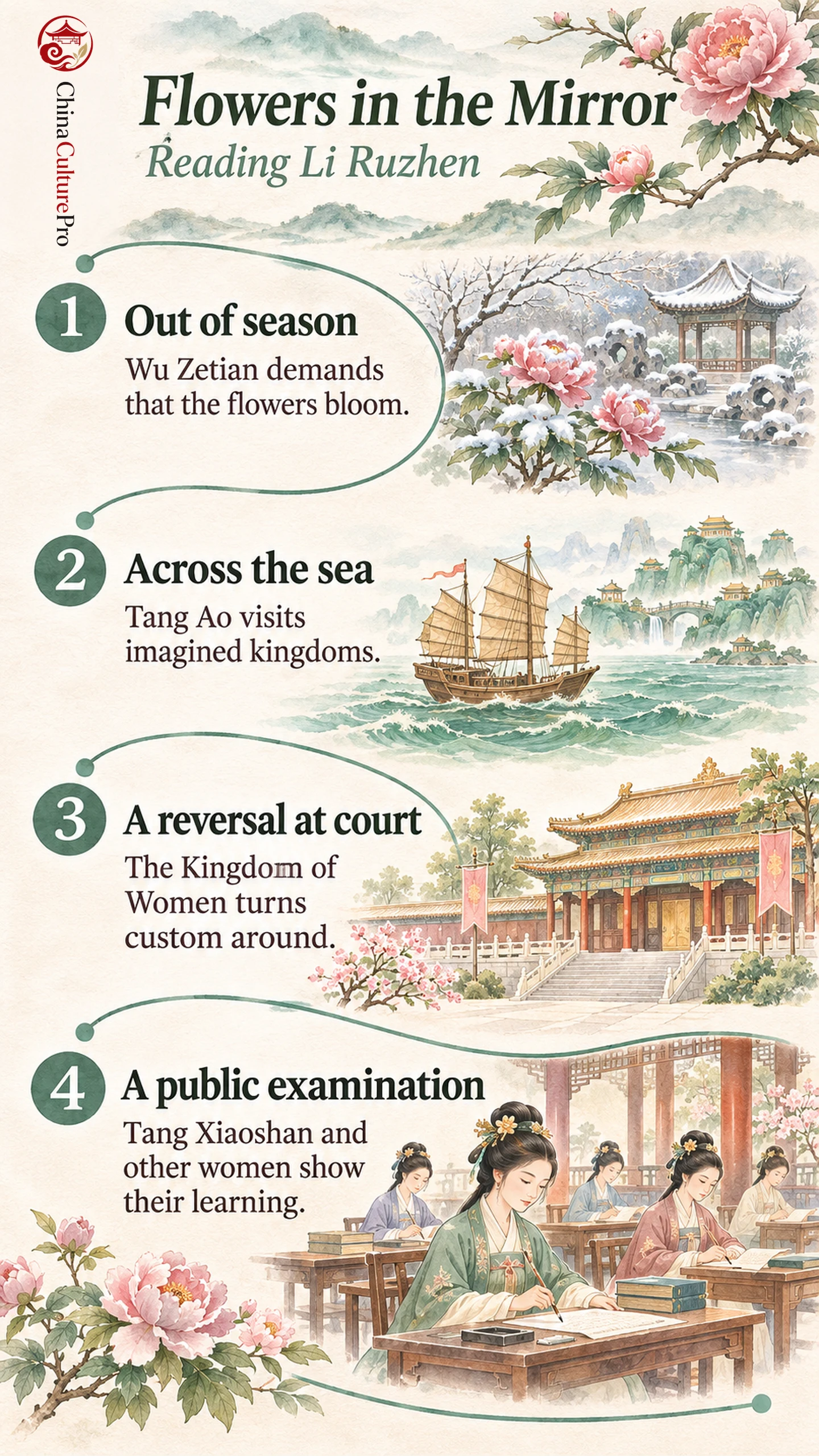
The novel begins by making flowers bloom against the season. It goes on to change rules that people have learned to take for granted.
How the Flowers and the Voyage Are Connected
In the opening chapters, Wu Zetian wants the flowers to bloom out of season. Their early flowering upsets the order the flower spirits are expected to keep, and they are sent into the human world. The incident gives the later story of talented women a fantastic origin. It also introduces a ruler whose wishes can change the conditions under which others have to act.[1][2]
Tang Ao (唐敖, Táng Áo) goes to sea after his prospects in the examination system are frustrated. In lands far from the court, he and his companions encounter practices that depart from what they know. When a habit is turned around, the travelers have to explain to themselves why their own rules had seemed natural to them. The journey also opens a route that Tang Ao’s daughter will have a reason to follow.[1][2]
What Happens in the Kingdom of Women?
In the Kingdom of Women, women hold the public authority the male travelers expect men to have. The ruler chooses the visiting merchant Lin Zhiyang (林之洋, Lín Zhīyáng) for a place in the palace. His feet are bound to prepare him for the role. The pain and humiliation are experienced directly by a man who would be spared the practice at home.[2][3]
The reversal works because the court takes its expectations for granted. A person’s discomfort can seem irrelevant to the people who have the power to enforce what they consider proper. The episode invites readers to apply Lin’s response to familiar practices. Scholars have also pointed out that the book’s interest in women’s situation sits alongside ideals of good order and learned conduct from its own time.[4][5]
How Tang Xiaoshan Changes the Story
Tang Xiaoshan (唐小山, Táng Xiǎoshān) is Tang Ao’s daughter and the earthly incarnation of the chief flower spirit. She leaves home to look for her father. Her voyage picks up the route of the earlier chapters, but it gives the journey a different purpose. In later chapters she is known as Tang Guichen. The name change is worth noting if you read the Chinese chapter headings or switch between editions. The focus shifts from whether she can find her father to what she can do with other learned women.[2][1][2]
Wu Zetian establishes an examination for women in the fictional court. The candidates show what they can do when there is a public occasion to judge their learning. The examination gives women from different parts of the story a reason to meet. The gatherings that follow let them speak at length about the things they have studied. Readers who want historical context for the separate examination system can turn to the guide to imperial examination halls.[1][2]
How to Read the Novel’s Two Halves
The Chinese novel has one hundred chapters. For a first reading, keep track of three changes of scene: the flower spirits enter human life, the travelers set sail, and the women enter the examination. For the best-known reversal, chapter 33 is the place to start. Then look at a scene after the examination to see how the book gives the women room to show what they know. The itinerary of unfamiliar countries changes often. In the later chapters, learned conversation and games can take up space that a modern novel might give to a faster-moving plot.[2][4]
That change is part of the book’s design. The voyage asks what would happen if social rules were different somewhere else. The examination brings a different set of rules into the court the reader already knows. For another Chinese novel that shows social habits through a succession of telling encounters, see Strange Happenings over Two Decades.
Readers who enjoy following a large cast through journeys that eventually converge can compare Demi-Gods and Semi-Devils. Jin Yong gives his travelers different allegiances and brings their paths together in a martial world.
FAQs About Flowers in the Mirror
Is Flowers in the Mirror a Tang or Qing novel?
Li Ruzhen wrote it in the Qing period. Its imagined story looks back to the earlier age of Wu Zetian. The overseas kingdoms and the women’s examination belong to the novel’s fictional world.[1][2]
Is there an English translation of Flowers in the Mirror?
Yes. The University of California Press issued Lin Tai-yi’s English version in 1965. It covers the arc of the work and summarizes some passages, so readers comparing individual scenes with the Chinese should expect differences in detail.[4][6]
Sources
[1] Huaxia Publishing House. Flowers in the Mirror, the Chinese novel and its two narrative strands
[2] Li Ruzhen. Flowers in the Mirror, the full Chinese chapter list and text
[3] Shidianguji. Flowers in the Mirror, chapter 33
[4] The Journal of Asian Studies. Women in the Ching-hua yüan and the novel’s English translation
[5] National Taiwan University. Revisiting the Kingdom of Daughters
[6] CiNii Books. Flowers in the Mirror, Lin Tai-yi’s 1965 English edition