
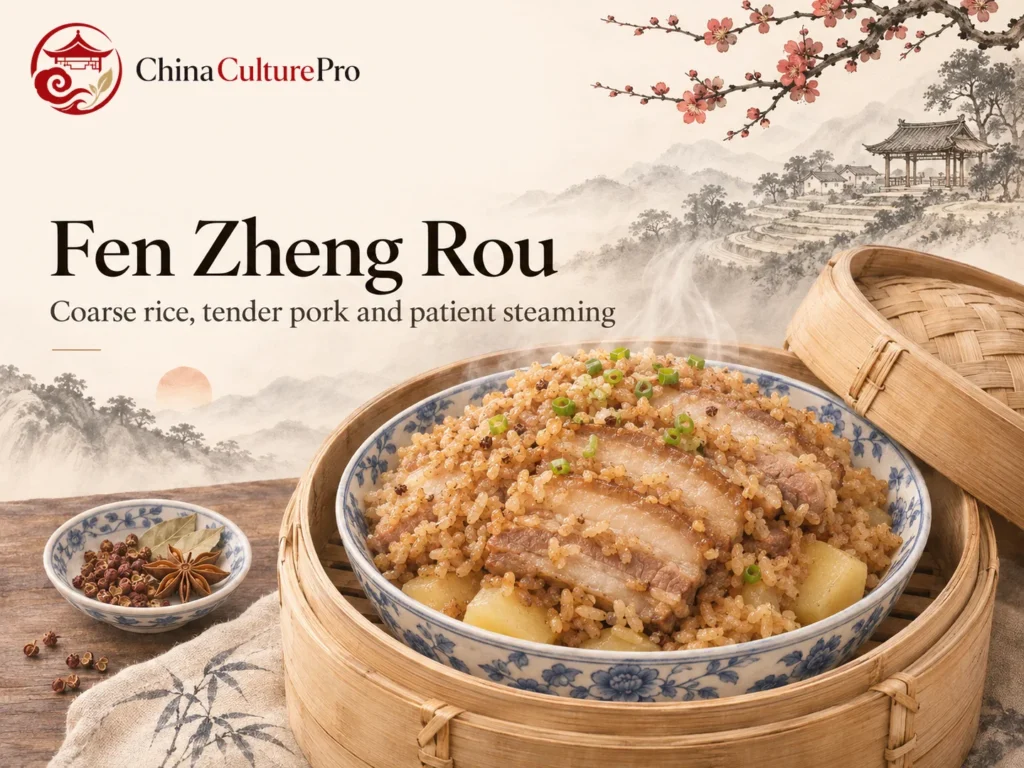

Quick Answer: What Is Fen Zheng Rou?
Fen zheng rou (粉蒸肉, fěnzhēng ròu) is pork steamed with a coating of toasted, coarsely ground rice. The coating softens around the meat and takes up its seasoning and rendered fat.[3]
- Pork belly supplies alternating lean and fatty layers.[3]
- The rice coating should retain a little grain texture; it is not a crisp fried crust.[3]
- Seasonings and vegetables vary, including spicy Sichuan versions and milder preparations.[2]
The recipe below uses one wet rice-paste method with pork belly and potato; other versions coat the meat more directly.

Choose the seasoning direction first, then prepare the coating and steamer. The following version gives one complete set of quantities, so you can cook the dish without combining incompatible formulas.
Regional Styles and an Older Jiangxi Record
There is no need to assign every version to one province. Two documented examples show how the same basic idea accommodates different seasonings:
- Older Jiangxi description: Yuan Mei’s Suiyuan Shidan (随园食单, Suíyuán Shídān) describes half-lean, half-fat pork, toasted rice powder and mianjiang (面酱, miànjiàng) paste, steamed over cabbage. Its association with Jiangxi cooking is explicit. That is a historical association, not proof of one inventor or one modern recipe.[4]
- Contemporary Sichuan direction: A spicy version uses doubanjiang (豆瓣酱, dòubànjiàng) chili bean paste and Sichuan peppercorns (花椒, huājiāo). Mild versions also exist within the same cooking tradition, so Sichuan style need not mean the maximum possible heat.[2]
What Kind of Rice Powder Does It Need?
Steaming rice powder (蒸肉粉, zhēngròu fěn) is a coarse preparation of toasted rice, often mixed with spices. Regular rice provides the base; adding glutinous rice (糯米, nuòmǐ), also called sticky rice, changes the coating toward a softer, chewier texture.[2]
Use a short pulse or a mortar to leave small grains. Smooth rice flour sold for baking is not the same preparation. Toasting adds aroma, but does not replace the later steaming needed to cook the coating.[3]
Ingredients for Pork and Potato Fen Zheng Rou
Use a heatproof bowl that fits inside your covered steamer and leaves room for the rice to expand.[1]
- Meat and vegetables: 450 g pork belly; 450 g peeled potato; 1 chopped scallion.
- Marinade: 1 teaspoon minced ginger; 2 teaspoons Shaoxing wine (绍兴酒, Shàoxīng jiǔ); 1 cube fermented bean curd (腐乳, fǔrǔ), white or red; 1 tablespoon doubanjiang; 1 teaspoon five-spice powder (五香粉, wǔxiāng fěn); ½ teaspoon sugar.
- Rice coating: 6 tablespoons uncooked long-grain rice; 3 tablespoons uncooked glutinous rice; ¼ teaspoon Sichuan peppercorns; ¼ of a star anise; 120 ml water; 2 teaspoons light soy sauce (生抽, shēngchōu).[1]
How to Coat and Steam the Pork
- Marinate the pork. Slice belly about 6 mm thick; mix with all marinade ingredients. Cover and refrigerate for about 1 hour.[1]
- Toast and grind the rice. Stir both rices with peppercorns and star anise in a dry pan over medium-low heat, until lightly golden. Cool, then grind coarsely.[2]
- Make the coating and assemble. Cut potato into pieces similar in size to the pork. Mix ground rice with the 120 ml water, then combine with pork, potato and light soy sauce. Transfer to the bowl without packing tightly.[1]
- Steam until tender. Set the bowl above the water, cover and maintain steady steam for roughly 70–90 minutes. Check and replenish the steamer water as needed. The rice coating and potato should soften, and the pork should be tender. Garnish with scallion before serving.[1]
- Check before serving. Pork must reach at least 145°F/63°C and rest 3 minutes before eating. This safety minimum does not establish that the rice or potato is tender; continue steaming if either remains hard.[5]
For equipment choices, the Chinese cooking methods guide explains steaming alongside other common techniques.
FAQs About Fen Zheng Rou
Can I use a packet of steaming powder?
Yes, if it is intended for this dish. Check its ingredients and seasoning: some commercial mixtures already contain salt or chili. Follow its quantity and liquid instructions rather than automatically adding the full homemade rice mixture as well.[3]
Why is the rice coating still gritty?
It may need more steaming, moisture or a less crowded arrangement. Keep the steamer supplied with water and avoid compressing the meat into a dense block. The aim is tender rice granules, not merely a browned-looking coating.[2]
Can I replace the potato or pork belly?
Sweet potato, pumpkin and taro appear in other versions. Beef and ribs are also used, but their seasoning, moisture and cooking time need separate adjustment. Lean meat will not supply the same rendered fat as belly.[2][3]
How should I store and reheat leftovers?
Divide into shallow containers and refrigerate within 2 hours, or 1 hour above 90°F/32°C. Keep at 40°F/4°C or colder for 3–4 days. Reheat leftovers to 165°F/74°C.[6]
Sources
[1] Judy Leung. Steamed Pork with Rice Powder (Fen Zheng Rou)
[2] Elaine. Steamed Pork with Rice Flour
[3] Yun Zhang John. Steamed Pork Belly with Rice Powder
[4] Yuan Mei; Chinese passage and translation presented by Sean J.S. Chen. Pork 19: Fen-Zheng Pork
[5] U.S. Department of Agriculture. What Is a Safe Internal Temperature for Cooking Meat and Poultry?
[6] U.S. Department of Agriculture. How Do I Handle Leftovers Safely?