

Quick Answer: What Is Chronicle of a Blood Merchant About?
*Chronicle of a Blood Merchant* (许三观卖血记, Xǔ Sānguān Mài Xuè Jì) is a novel by Yu Hua (余华, Yú Huá) about Xu Sanguan (许三观, Xǔ Sānguān), a silk-mill worker who sells blood to meet expenses his wages cannot cover. Over the years, the sales become a way to handle family crises. His hardest choices concern a boy he has raised as his son.[1][2][3]
- The pattern: An urgent need takes Xu to the blood buyer, and a familiar restaurant meal follows.
- The cost: Each sale can solve one financial problem and leave Xu at risk from repeated sales.
- The family: An argument about who belongs in the household tests what Xu is prepared to give.
The same act means something different each time Xu has to repeat it.[1]
Yu Hua gives his novel a rhythm readers can recognize before Xu does. The familiar trip to sell blood becomes more troubling as the reasons for making it change.
Why Xu Sanguan Sells His Blood
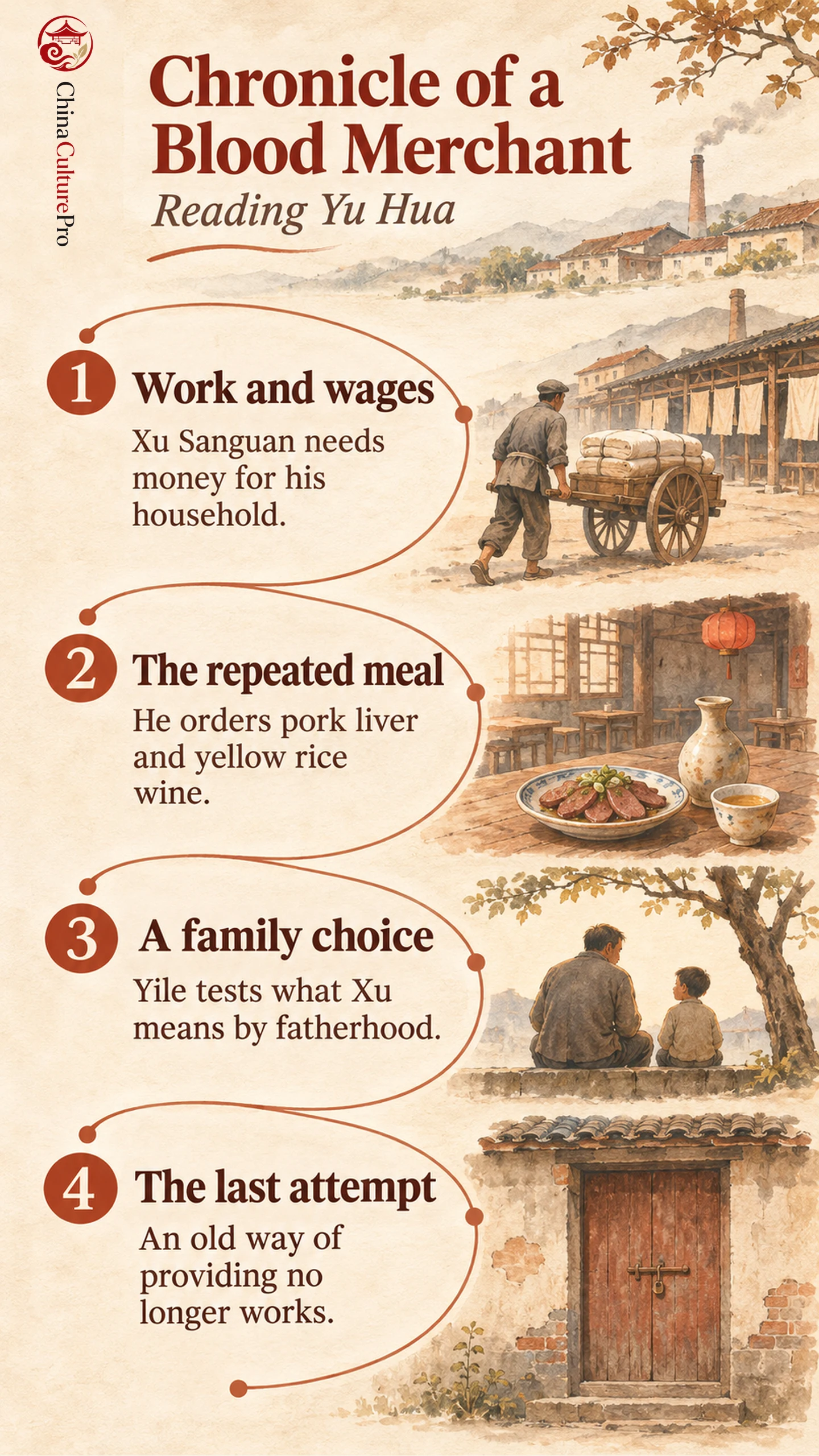
Xu pushes carts at a silk mill. His wages have to stretch across his household with his wife, Xu Yulan (许玉兰, Xǔ Yùlán), and three sons. The money he receives for blood can cover an expense sooner than his job can. That gives him a form of power when money is scarce, but the book also shows how little stands between a family problem and a demand on his body.[1][2]
Large events change what the household can eat and how its members are treated. During a famine, the children need food and the household makes do with thin gruel. During the Cultural Revolution, Xu Yulan is subjected to public humiliation. Both episodes bring pressures from outside into the room where the family has to live together. They also change what it means for Xu to think of himself as a provider.[1]
What the Meal at the Victory Restaurant Does
After selling blood, Xu often goes to the Victory Restaurant for fried pork liver and warmed yellow rice wine. The meal marks a return to familiar ground after the transaction. The repeated order gives very different visits the same ending. The reader can follow the differences by noticing how urgently Xu needed money, how often he has had to go back and what he can still afford.[1][2]
Yu Hua also lets hunger appear through words. The family can talk about the pleasures of a meal even when it has very little to eat. The repeated food images are comic at times, with people’s attention fixed on tiny details. Those details make the lack of an actual meal easier to feel. A restaurant order sounds simple beside the effort it takes to put a meal on the family table.
How Yile Changes the Meaning of Blood Ties
This section discusses a family secret and later events. Yile (一乐, Yīlè), the eldest boy, turns out to be the biological son of another man. Xu feels humiliated and starts to draw a line between him and the other boys. When he treats the family to a meal, he leaves Yile out. The decision turns a question about parentage into one about who gets to eat with the family.[1][2]
Later, when Yile is ill, Xu risks his own health to raise money for his care. The change does not undo the earlier exclusion. It gives the reader another way to judge their relationship, through what the man who raised him is prepared to do. Blood has a price in one part of the story and a claim on loyalty in another. Xu’s actions make those meanings collide.[1][3]
Why the Last Attempt to Sell Blood Matters
The last part of the novel returns to the sale. When an older Xu tries again, the buyer turns him away. The refusal takes away a means of acting that Xu has counted on through much of his life. It also puts the familiar meal and the family’s ability to care for him in a different light. The man who kept finding a way to pay has to face the possibility that someone else can pay for him.[1][4]
For another Yu Hua novel about family loyalty changing under economic pressure, read Brothers. To Live follows a different household and gives survival a different measure.
FAQs About Chronicle of a Blood Merchant
What does the Chinese title mean?
It means roughly “The record of Xu Sanguan selling blood.” The Chinese title names the man. The English title describes him through the activity the novel follows.
When was the novel published, and who translated it?
The Chinese novel appeared in the literary journal *Harvest* in 1995, and a Chinese book edition followed in 1996. Andrew F. Jones translated it into English. Pantheon published that edition in 2003.[1][2][3][4][5]
Sources
[1] Pantheon Books. Chronicle of a Blood Merchant, English edition and publisher description
[2] University of Leeds. Chronicle of a Blood Merchant, Chinese writing reading guide
[3] Guangxi Minzu University Library. Chinese novel and reading notes
[4] Ningbo library catalogue. Chronicle of a Blood Merchant, 1996 book edition
[5] Chinese Literature Award. Chronicle of a Blood Merchant, first publication record