


Quick Answer: What Are Chinese Water-Powered Mills?
A water-powered mill (水磨, shuǐmò) uses flowing water to turn machinery for processing grain. The channel supplies the wheel, the shaft transmits its motion, and a moving millstone grinds grain against a fixed one. The building brings the water route and the working floor together.[1][2][3]
- Find the channel: It brings water to the mill at a usable height.[1][4]
- Follow the shaft: A wheel below the floor can turn a stone above it.[1][2]
- Look inside: A hopper feeds grain to the grinding surfaces.[1]
The large vertical wheel familiar from some mills is one possible form. A horizontal wheel can sit low in the water under the workshop.[1][3]
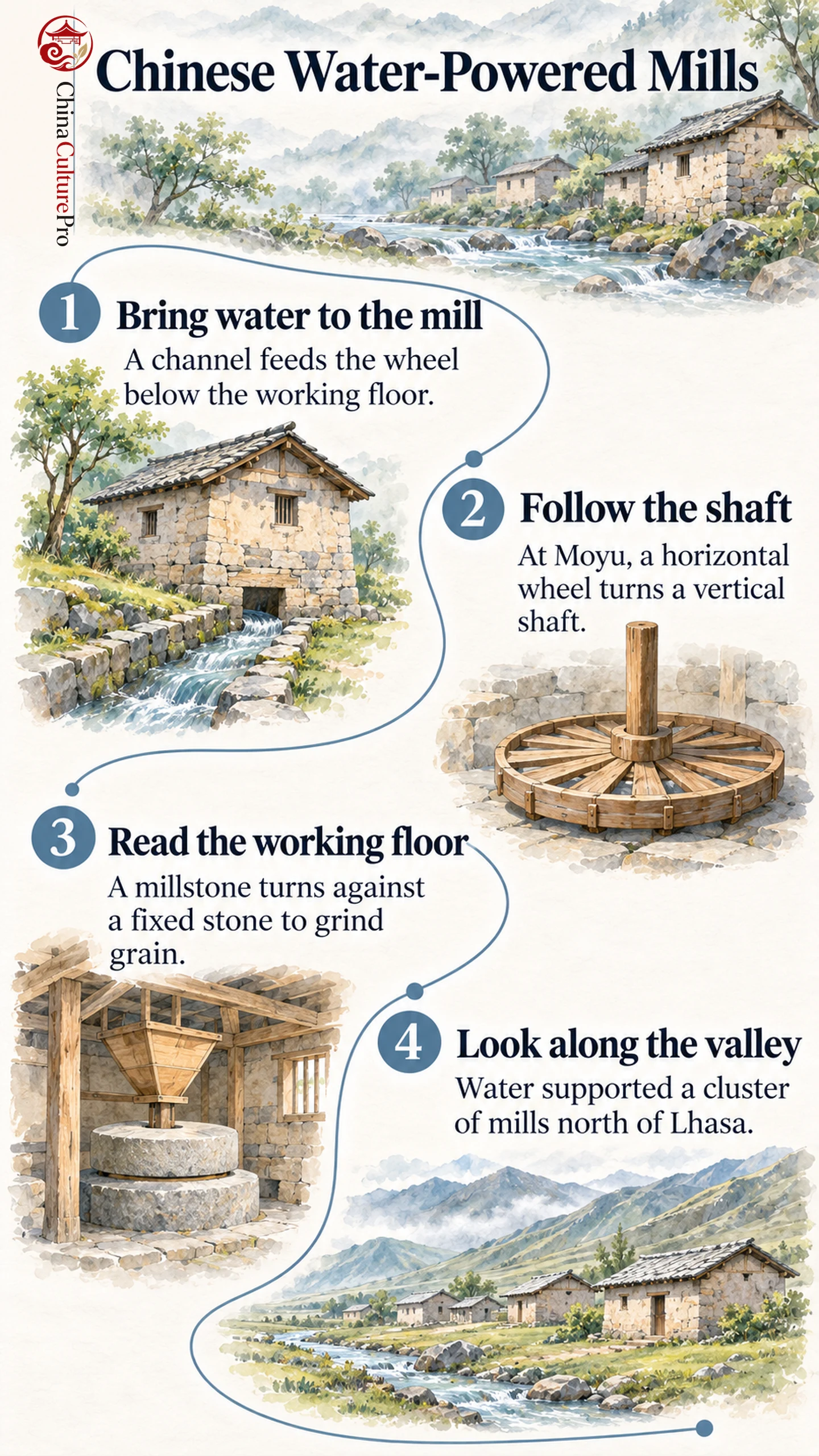
A mill starts with the terrain. Follow the inlet and the drop to understand how a building could turn the movement of water into work.[1][4]
How Water Turned a Millstone at Moyu
The county government in Moyu, Xinjiang, records 28 old milling units along a main canal through the county seat. In the type documented there, a horizontal wheel sits in the water. Its vertical shaft turns the upper millstone. A wooden hopper above the stones feeds wheat or maize into the mill while the wheel turns below.[1]
This places the water and the working surface at different levels. It also explains why the wheel may be hard to see from the bank. The county record describes the surviving series of mills and leaves their exact construction date open.[1]
A Shaft Could Drive One Stone or Work Through Gears
A historical study describes a type in which the wheel directly turns the vertical axis and upper stone. Wang Zhen’s agricultural treatise of 1313 also illustrates a geared mill. In that drawing, one waterwheel transmits motion through several gears.[2][3]
A direct-drive arrangement can place the stones immediately above the wheel. A geared arrangement can carry power farther inside the building. Those different paths for the motion change where the machinery and working areas fit.[1][2][3]
At Gumo in Yunnan, stone-walled workshops with stone-slab roofs stand along the river. The documented mill craft brings together masonry for the water inlet and building, carpentry for the shaft and paddles, and stone cutting for the millstones. Much of the structure of the workshop makes sense when read in that order.[6][7]
Mills, Valley Water and Tsampa Near Lhasa
China’s intangible heritage catalogue places the Jiami mill in the Nyangre valley north of Lhasa and dates its origins to about the seventeenth century. The valley’s water supply supported a cluster of mills that processed grain, including barley for tsampa. The catalogue records the mill’s priority in using water and an arrangement for other mill operators to help repair it if it was damaged.[4]
The Tibet regional culture department also records a more recent mill project at Weiba, built on an existing cultural site in the nearby Duodi valley. The workshop and its water route are the two parts to look for when reading either site as Chinese architecture.[4][5]
FAQs About Chinese Water-Powered Mills
Does a grain mill lift irrigation water?
Its wheel provides power for processing grain. An irrigation lifting wheel moves water to a higher level.[1][2]
Was the wheel always outside the mill?
A horizontal wheel can sit below the working floor, as the Moyu example shows.[1]
What did the mills near Lhasa make?
They processed grain for foods such as tsampa, a flour made from roasted barley, as well as other products such as animal feed.[4][5]
Sources
[1] Moyu County Government. The Twenty-Eight Water Mills
[2] Bulletin of the School of Oriental and African Studies. The Monasteries and China’s Economy in Medieval Times
[3] UC Davis History-Social Science Project. Wang Zhen’s Watermill Drawing in Sites of Encounter: Quanzhou
[4] China Intangible Cultural Heritage Digital Museum. The Craft of the Jiami Watermill in Lhasa
[5] Tibet Autonomous Region Department of Culture and Tourism. Milling and Cultural Heritage in Weiba Village
[6] Fengqing County Bureau of Culture and Tourism. Gumo Village and Its Watermill Craft
[7] Kunming Information Hub. The Stone Watermills of Gumo Village