

Quick Answer: How Do You Cook Tea Tree Mushrooms?
Tea tree mushrooms (茶树菇, cháshùgū) are long-stemmed edible mushrooms used in Chinese stir-fries and simmered dishes. Their stems are part of the meal, rather than something automatically discarded.[2]
- Fresh: Choose them for a recipe written around fresh mushrooms and their texture.[7]
- Dried: Soften them before cooking; use refrigerated soaking if more than two hours is needed.[5]
- Cooking: Soups and a spicy mushroom-and-pork dry-pot (干锅, gānguō) show different sides of the ingredient.[2][3]
Buy from reliable food retailers. A picture of cultivated mushrooms is not a safe way to identify a wild find.[6]

The useful choice at the grocery store is not simply which bag looks biggest. Decide whether you want mushrooms to simmer in broth or hold their own in a wok dish, then check whether the recipe expects fresh or dried ones. Texture is a central part of this ingredient’s place in Chinese food culture.
What the Names on the Package Mean
Chaxingu (茶薪菇, cháxīnggū) is another Chinese name used for tea tree mushrooms.[2] English labels may also say poplar mushroom; that is the English title of China’s national tea tree mushroom product standard.[8]
Latin labels require more care. Chinese cultivated tea tree mushrooms are discussed in current research as Cyclocybe chaxingu, while trade names such as Agrocybe cylindracea have been used collectively for related mushrooms. These names should not be treated as proof that every commercially labeled product is the same biological species.[1]
Choose Fresh or Dried for the Dish
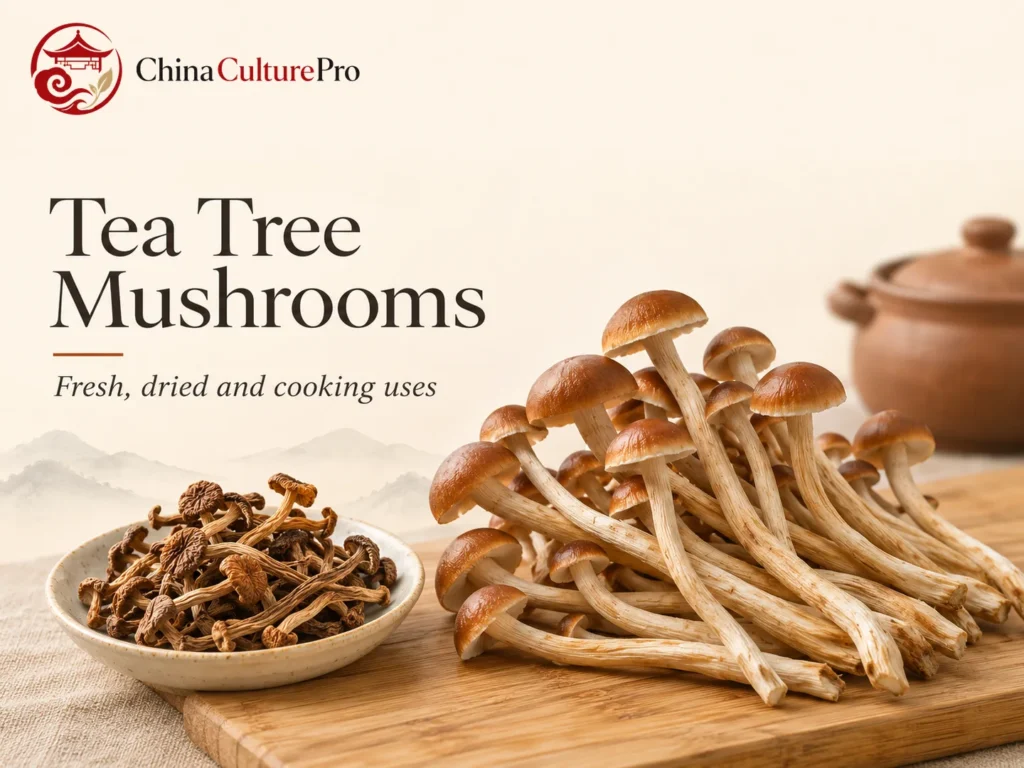
Choose fresh mushrooms with mostly closed or partly opened brown caps; fully opened caps indicate greater maturity.[2] Freshness and an appropriate recipe matter more than treating every long stem as waste.
- Fresh mushrooms: A dry-fried preparation can blanch them, remove excess water and then cook them until the edges become golden and chewy. A recipe written for this form controls moisture before the final seasoning.[7]
- Dried mushrooms: Prepare them as a rehydrated ingredient, with soaking built into the cooking plan. Do not leave them soaking unattended on the counter for a long period.[5]
Choose the form first, then a recipe written for it, rather than improvising a weight-for-weight swap.
Three Ways Chinese Cooks Use Their Texture
Use the finished dish to choose the preparation:
| Cooking approach | What the mushrooms contribute | Preparation to notice |
|---|---|---|
| Soup or stew | Edible caps and stems within a simmered dish | Dried mushrooms need soaking before cooking.[2][5] |
| Fresh mushroom stir-fry | A substantial, chewy mushroom component | Follow the recipe’s draining and cooking method.[7] |
| Dry-pot with pork | A firm-textured ingredient alongside rich meat and hot seasonings | Cook the mushrooms with the dish’s seasonings; a heated serving vessel may finish the presentation.[3] |
One dry-pot version pairs them with pork belly, red chilies, fermented black beans and chili bean paste. The seasonings connect it with the flavors of Sichuan cuisine, although the cited local dish comes from Pingli in Shaanxi.[3]
Prepare Dried Mushrooms Without a Long Countertop Soak
- Rinse the dried mushrooms under clean running water.[5]
- Put only the quantity you need in a clean container with water for soaking.[5]
- If soaking will take more than two hours, keep the mushrooms in the refrigerator instead of at room temperature.[5]
- Use soaked mushrooms promptly. Discard them if they develop slime or an abnormal smell.[5]
After soaking, follow the recipe for trimming and cutting, and cook the mushrooms thoroughly.[6] Use the product directions and softened condition to judge readiness for preparation, while observing the safe-soaking limit.
Choose Sound Mushrooms and Store Them Properly
Look for intact fresh mushrooms with a natural smell and a resilient feel. Tea tree mushroom bunches should be reasonably uniform; reject products with mold, insect damage or an abnormal odor.[4]
For dried mushrooms, choose sound, evenly sized pieces without mold or insects. Keep them cool, dry and protected from light, and use opened packages promptly rather than letting them absorb moisture.[2][4] Refrigerate fresh mushrooms soon after purchase.[9] Follow the supplier’s storage directions for the form purchased.
Use cultivated mushrooms from reliable shops. Edible and poisonous wild mushrooms can look similar, and cooking does not reliably destroy mushroom toxins.[6] The shopping cues here concern condition, not species identification.
FAQs About Chinese Tea Tree Mushrooms
Are tea tree mushrooms the same as matsutake?
No. An alternative name sometimes translated as willow matsutake does not make tea tree mushrooms the same mushroom as matsutake.[2]
Can I eat the stems?
Yes. Suitable stems are eaten along with the caps; trim tough bases as the recipe directs rather than discarding every stem.[2][7]
Can dried mushrooms replace fresh ones directly?
No. They need rehydration and behave differently in a fresh-mushroom recipe. Choose a method written for the form you have.[7]
Can I soak dried tea tree mushrooms overnight?
If overnight soaking is needed, keep them in the refrigerator. Do not use a long room-temperature soak.[6]
Sources
[1] Yi et al., IMA Fungus. Assessing Genetic and Phenotypic Diversity to Advance Multi-Trait Selection in Cyclocybe chaxingu
[2] China Science and Technology Museum, interview with an edible-fungi engineer. Tea Tree Mushrooms with Unopened Caps
[3] Pingli County Government. Dry-Pot Tea Tree Mushrooms
[4] Shanghai Agriculture and Rural Affairs Commission. How to Choose Edible Mushroom Products
[5] Hong Kong Centre for Food Safety. Soaking Mushrooms and Food Safety
[6] Hong Kong Centre for Food Safety. Wild Mushrooms: Numerous Species and Numerous Toxins
[7] Savory China. Dry-Fried Tea Tree Mushrooms with Cured Pork
[8] National Public Service Platform for Standards Information. GB/T 37749-2019: Poplar Mushroom
[9] Hong Kong Centre for Food Safety. Proper Handling of Fresh Mushrooms