
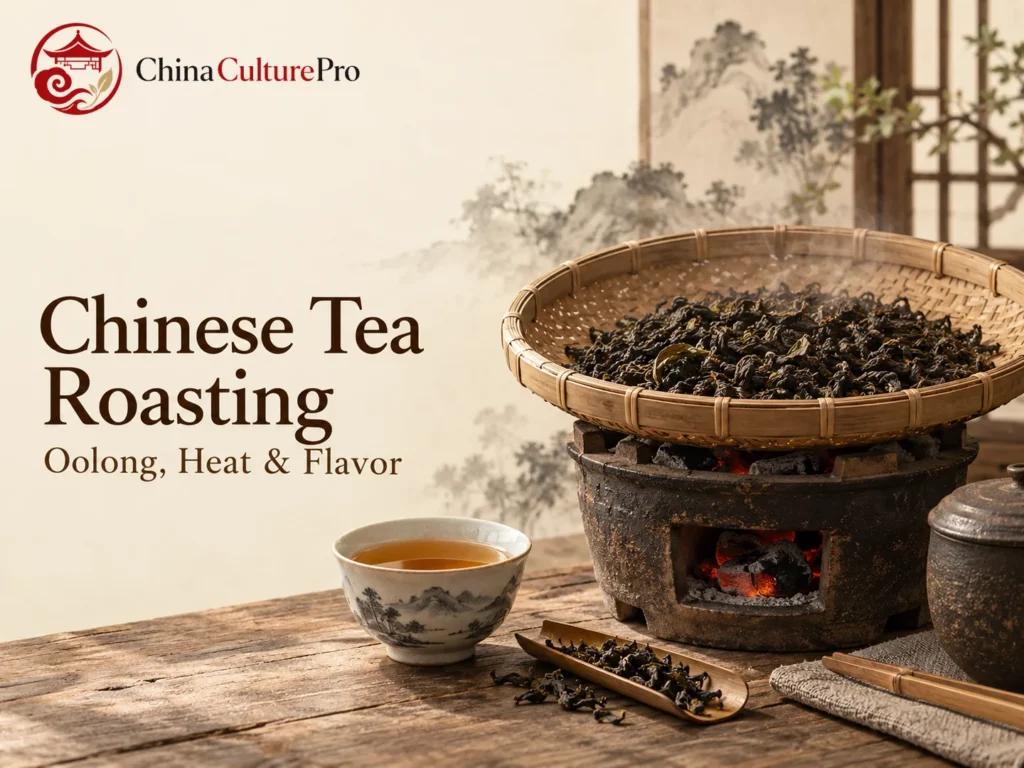

Quick Answer: Why Is Chinese Tea Roasted?
Chinese tea roasting (焙火, bèihuǒ) uses controlled heat to shape a tea’s aroma, taste and moisture. It is important in many oolong traditions, but is not the same process as oxidation.
- Purpose: Roasting can further dry tea and develop a chosen sensory character.
- Style: Light and deeper roasts offer different expressions, not automatic quality grades.
- Judgment: Starting material, earlier processing, heat control and storage all matter.
A powerful toasted smell alone does not prove a better tea or a traditional heat source.
Two oolongs can share a variety name while tasting strikingly different. One emphasizes floral fragrance; another suggests toasted grain or warm, nut-like notes. Roasting helps explain that contrast, but it works with the leaf and its earlier processing rather than replacing them.
Roasting Is Different from Oxidation and Other Heat Steps
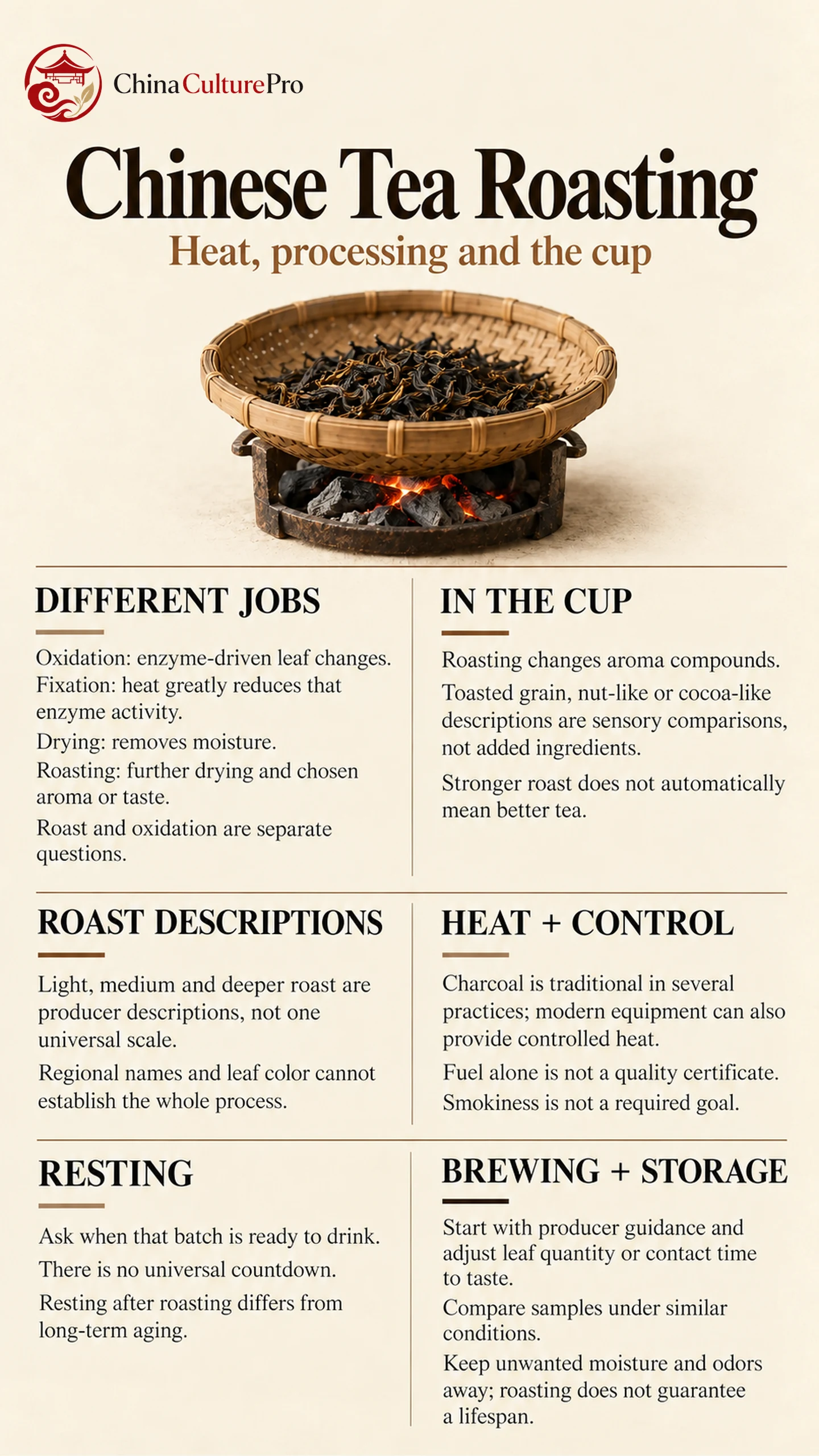
Fixation (杀青, shāqīng) is the heating stage that greatly reduces the enzyme activity responsible for continued enzymatic oxidation. Drying removes moisture, while roasting can further dry the leaf and develop a particular flavor. These jobs can overlap in practice; English “firing” is sometimes used loosely for more than one operation.[1]
| Operation | Its main job in this discussion |
|---|---|
| Oxidation | Enzyme-driven changes in the leaf before those reactions are curtailed. |
| Fixation | Heating that greatly reduces the relevant enzyme activity. |
| Drying | Removing moisture from processed leaves. |
| Roasting | Controlled heating that can further dry tea and shape its aroma and taste. |
Roast and oxidation are separate questions. Substantially oxidized tea can receive a relatively light roast; another tea may be more noticeably roasted after different earlier processing. Neither the brownness of the leaf nor the word “dark” identifies the entire manufacturing history.
The distinction between oxidation and fermentation also matters. A roasted aroma does not mean microorganisms performed the roasting, and oxidation is not simply another name for heat treatment.
What Roasting Changes in the Cup
Roasting transforms compounds involved in aroma and taste. Research on one charcoal-roasted Wuyi cultivar measured changes in volatile compounds and their precursors during the process. That supports a chemical transformation, rather than the idea that tea merely absorbs a fire’s smell.[2]
Drinkers may describe toasted grain, nuts, cocoa-like warmth or a less overtly green character. These are sensory comparisons, not statements that nuts or cocoa were added. The result depends on the tea and the way heat was applied; a tasting word is not a manufacturing specification.
Maximum roast aroma is not necessarily the aim. A pronounced treatment may suit one tea while overwhelming another. Notice whether the tea retains a coherent aroma and satisfying taste beyond its initial toasted impression. Persistent burnt harshness should not be admired merely because it seems to indicate stronger fire.
Wuyi rock tea provides an important context for the craft. Its documented traditional sequence includes charcoal roasting alongside earlier leaf handling.[3] The roast is one contributor to its identity, not a complete explanation of the tea.
Reading Light, Medium and Deeper Roast Descriptions
Roast descriptions communicate a producer’s intended style, but do not form one universally calibrated scale. “Medium” from one producer may taste different from “medium” elsewhere. Ask what the label means for the particular tea rather than assuming a shared numerical threshold.
A lighter treatment may leave floral or fresh-leaf fragrance more prominent. A deeper treatment can shift the balance toward roasted notes. These are tendencies to explore, not a rule that light roast is delicate and superior or that heavy roast is necessarily more traditional.
Regional names are also insufficient. Taiwan high mountain tea is often discussed through fresh fragrance, but tea grown at elevation does not all receive identical finishing. The distinction between oolong and green tea likewise cannot be reduced to roasted versus unroasted: heat serves different jobs within their processing sequences.
When comparing samples, keep leaf quantity, water and brewing conditions reasonably consistent. A more concentrated infusion can otherwise be mistaken for evidence of a stronger roast.
Charcoal, Electric Heat and the Craft of Control
Charcoal belongs to several traditional roasting practices. Modern equipment can also provide controlled heat, and the development of automated tea-roasting machinery demonstrates that roasted aroma is not restricted to one fuel or historic tool.[4]
A charcoal-roasted label describes a production claim, not an independent quality certificate. Ask about the producer and batch rather than assuming that visible charcoal or an old basket establishes superiority. Smokiness is not a necessary goal of good charcoal roasting.
Temperature, time, airflow and leaf condition interact with the roaster’s decisions. An industrial experiment cannot be converted directly into a home-oven recipe because the equipment and starting material differ. Reheating unfamiliar tea can change it irreversibly and will not reliably recover the aroma lost through poor storage.
Resting, Brewing and Keeping the Tea
Freshly roasted tea can have an assertive roast impression that changes after keeping. Ask when the producer expects the batch to be ready to drink. There is no reliable countdown that tells every roasted oolong when to become enjoyable.
Resting after roasting is different from the broader traditions of aged tea. Longer storage histories involve additional questions about material and conditions, rather than simply waiting for a recent roast to settle.
Start brewing with the producer’s recommendation, then adjust leaf quantity or contact time to the cup. Do not automatically dilute every roasted tea until its character disappears. Notice how aroma and taste develop over successive infusions rather than judging only the smell of dry leaves.
Protect the character you want to retain with tea-appropriate storage. Keep unwanted moisture and odors away. Roasting does not make tea immune to poor keeping, and a deeper roast does not supply a guaranteed lifespan.
FAQs About Chinese Tea Roasting
Is all oolong tea heavily roasted?
No. Oolong includes a range of roast styles. Variety, earlier processing and the producer’s intended expression also influence the result.
Does a darker leaf prove a stronger roast?
No. Appearance reflects several factors, including processing and age. Use the brewed tea and its production description rather than color alone.
Can roasting make poor tea high quality?
Roasting can change a tea’s expression, but it cannot guarantee good starting material or reverse damaged storage. Intense toasted aroma is not a substitute for overall quality.
Sources
[1] Fujian Tea. Tea Processing by Category
[2] Duan Yue and colleagues. Dynamic Changes of Aroma Compounds and Their Precursors during the Roasting Process of Qidan Wuyi Rock Tea
[3] Fujian Provincial Government. Wuyishan Tea Fragrance Reaches the World
[4] Tea and Beverage Research Station. Automated Tea Roasting Equipment and Roasted Aroma