

Quick Answer: What Is Taiping Houkui Tea?
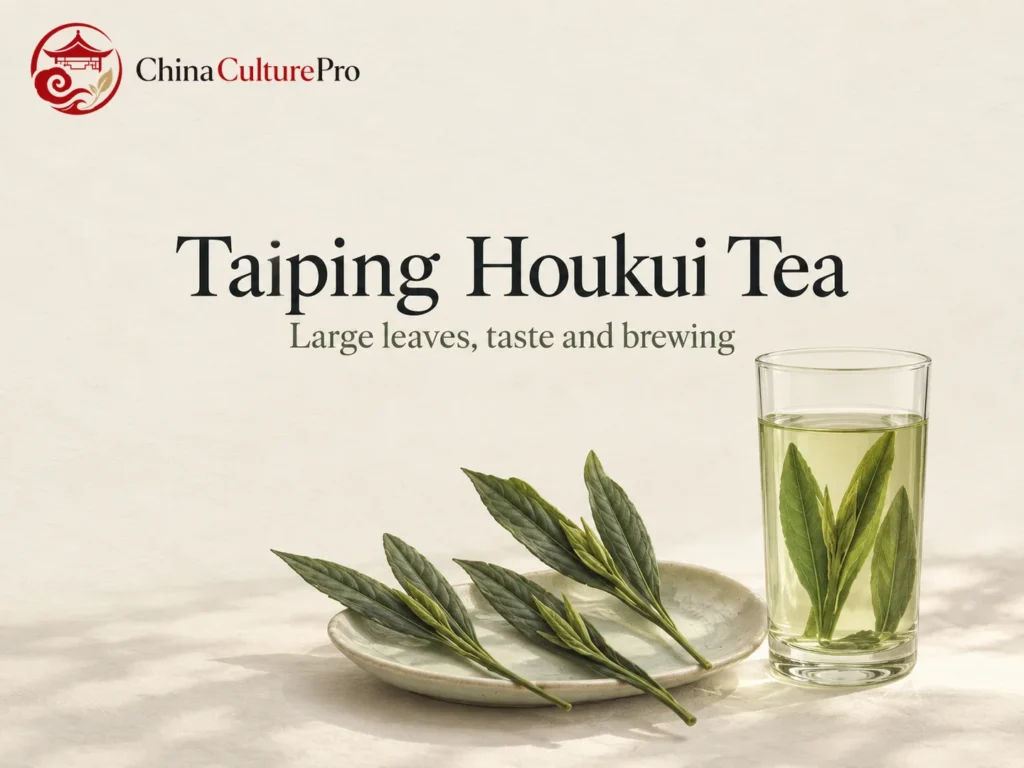
Taiping Houkui (太平猴魁, Tàipíng Hóukuí) is a green tea associated with Huangshan District in Anhui. Its finished sprigs commonly show two leaves surrounding a bud, flattened into an elongated form.
- Leaf: unusually long, broad and flat compared with many small-bud green teas.
- Processing: heating, arranging, flattening and drying give the finished tea its form.
- Drinking: a clear, gentle cup and an opening leaf that rewards a roomy vessel.
The green-tea making tradition was listed as a national intangible cultural heritage project in2008. That protects a craft tradition; it does not certify every packet using the name.[1]
Taiping Houkui (太平猴魁, Tàipíng Hóukuí) is immediately recognizable for its long, flat green leaves. Their size is only part of the story: plant material, careful shaping and enough room in the brewing vessel all help explain this distinctive Anhui tea.
Why the Leaves Are So Long and Flat
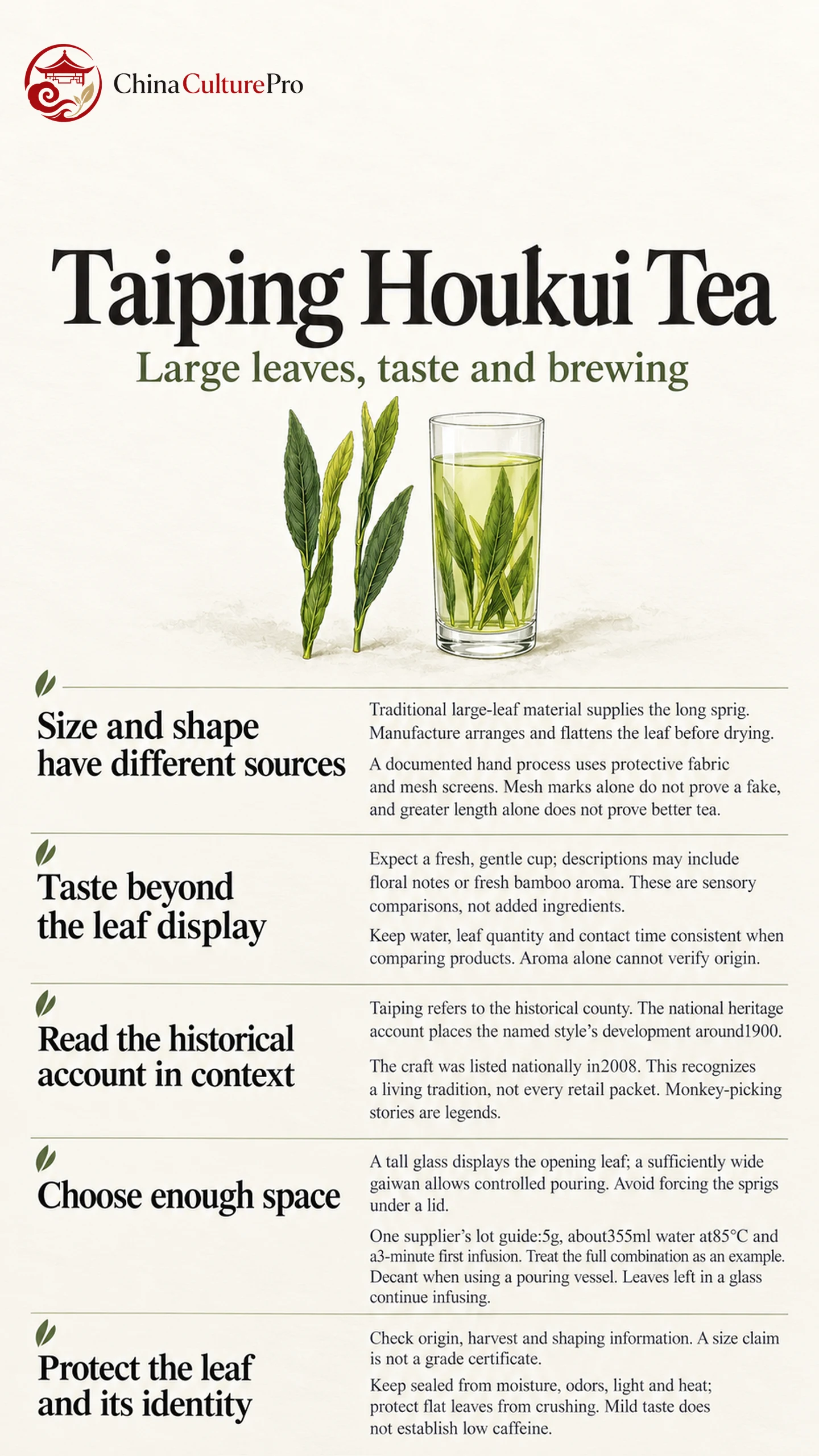
Shidacha (柿大茶, shìdàchá) is the large-leaf local tea material associated with the traditional style. A developed bud-and-leaf sprig can be large without being simply an old coarse leaf. This is one reason bud-only rules from other products do not transfer neatly to Houkui.[3]
Plant material supplies the potential size; manufacture supplies the distinctive flat form. In one documented maker’s process, heated leaves are individually arranged, protected between fabric layers and flattened with fine mesh screens before staged drying. The finished leaf can retain a patterned impression from that contact.[2]
A grid or mesh mark therefore cannot independently establish a fake. Nor does an exceptionally long leaf independently establish superior tea. Ask how the leaf was shaped and what the seller means by handmade. Hand arranging, hand pressing and wholly manual manufacture describe different claims.
What Taiping Houkui Tastes Like
The cup is usually appreciated for freshness, a soft body and a lingering floral impression. A documented lot is described with fresh bamboo aroma and a clean, gentle flavor; other descriptions emphasize orchid-like notes. Those are sensory comparisons, not added ingredients or a fixed chemical checklist.[2][4]
Taste the infusion rather than using leaf length as a substitute. Notice whether the aroma is clear, whether bitterness overwhelms the cup and whether the finish remains pleasant. Comparisons become more useful when water, dose and contact time stay consistent. An aroma description alone cannot verify geographic origin.
Anhui Roots and the Meaning of the Name
Taiping refers to the historical county name. The national heritage account places the development of the named style around1900 and associates it with Wang Kuicheng (王魁成, Wáng Kuíchéng) and carefully selected local sprigs. This is the published heritage account; monkey-picking stories belong to legend.[1]
Regional tea production is older than the named modern style. Keep those histories separate when a label uses ancient, imperial or famous. A region’s long relationship with tea does not establish that today’s leaf shape existed unchanged throughout that whole period. The heritage record identifies a living craft rather than one mandatory retail grade.
How to Brew Long Leaves Without Crushing Them
A tall glass gives long leaves room to open and makes their movement visible. A sufficiently wide gaiwan also works, provided the leaves fit without being snapped or forced under the lid. Pick a vessel for its actual usable dimensions.
- Measure by weight: Use a scale when possible: long leaves occupy a great deal of space, so a teaspoon is a poor comparison with compact tea. One supplier’s own lot guide starts with5g in12US fluid ounces, about355ml, of85°C water.
- Give the leaf space: Place the tea gently in a roomy vessel and add water without crushing the sprigs. The same supplier suggests a3-minute first infusion for its lot; this is a product example, not the only valid method.
- Taste and control contact: If using a pouring vessel, decant and taste. For a glass where leaves remain in the water, remember that contact continues while you drink. Adjust leaf quantity or drinking and refill pace if the cup grows too strong.
The example’s temperature, volume and time belong together. A concentrated short-infusion method needs a different contact time; changing only the vessel name does not preserve the same extraction.[2]
How to Judge a Packet and Store It
Read the named origin, harvest information and shaping description alongside the appearance. Specific information is more useful than a claim about having the largest leaves. Picking standards and tea grades operate within product traditions, not one universal bud-size ladder.
Protect the flat leaves from crushing and keep the tea sealed from damp, odors, light and heat. A rigid outer container can protect a sealed inner packet. Review storage guidance for different tea forms before vacuum packing or refrigerating delicate leaf. For intake questions, caffeine depends on the leaf and brewing rather than a large-leaf or mild-taste label.
FAQs About Taiping Houkui Tea
Are the biggest leaves always the best?
No. Length helps identify the style, but material, manufacture, freshness and the actual cup still matter. A size claim alone cannot establish grade or origin.
Do mesh marks mean the tea is fake?
No. Documented hand manufacture can involve fine mesh screens. A pattern is evidence of contact with a surface, not a complete authentication test.
Can I brew Taiping Houkui in a gaiwan?
Yes, if the vessel has enough room for the sprigs. Avoid forcing long leaves into a narrow bowl or trapping them under the lid when pouring.
Is Taiping Houkui a low-caffeine tea?
The name does not establish caffeine per serving. A gentle flavor and large leaves are not a caffeine measurement; preparation and the amount consumed also matter.
Sources
[1] China Intangible Cultural Heritage Network. 绿茶制作技艺(太平猴魁)
[2] Seven Cups, original maker documentation. Taiping Houkui (Monkey King)
[3] Seven Cups, original field account. Tai Ping Hou Kui
[4] iTeaworld, original tea guide. What Is Taiping Houkui Tea?