


Quick Answer: What Were Chinese Scholar Retreats?
Chinese scholar retreats were places set aside for reading, writing, painting or time away from public responsibilities. They could take the form of an estate in the hills or a studio beside a courtyard within a city residence. Such settings could express the ideal of reclusion (隐逸, yǐnyì).[1][2][3][4]
- In the hills: An estate could include several named landscape settings.[1][2]
- In the city: A small garden court could sit beside a room for study.[3][4]
- At the threshold: A pavilion or covered corridor could open views while providing shelter.[4][5]
The retreat was defined by how the place was used and imagined. Its architectural form varied with its setting.[1][3][4]
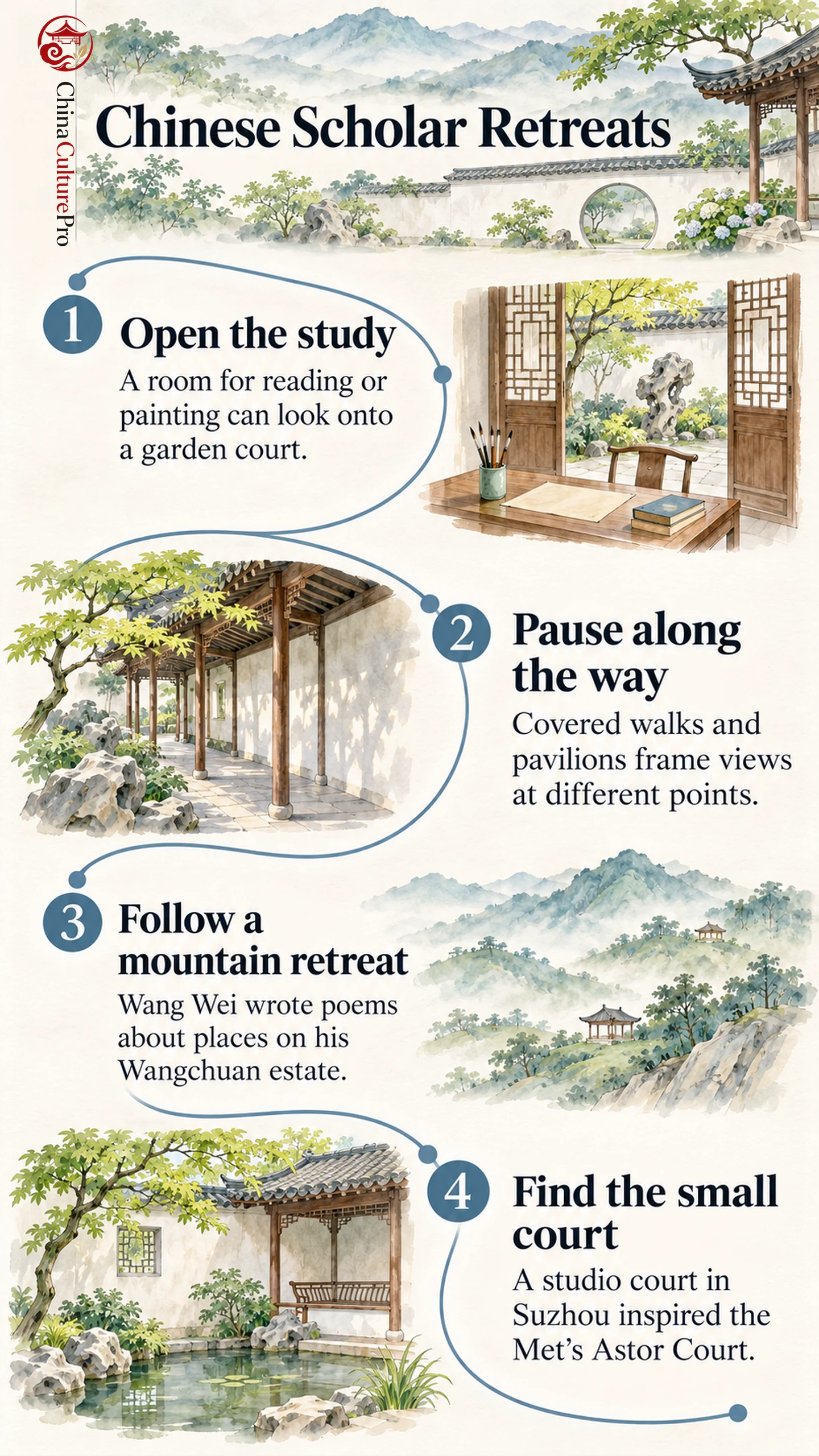
Start with where a person might sit or walk. The view from that place is part of the design, as are the walls and paths that bring it into sight.[4][5]
How a Study Opens onto a Garden
A study provides an interior for reading or painting. A nearby court extends what can be seen from the room and offers another place to pause. A wall can make the enclosure feel private while openings give selected views across it.[3][4][5]
A roofed corridor offers shelter as people move around the court. A pavilion gives them a place to stop and look. In this arrangement, the rock, plants and built openings can be experienced in stages as the viewer moves.[4][5]
Wangchuan Villa and the Mountain Retreat
The Tang poet and painter Wang Wei had an estate at Wangchuan in the hills outside Chang’an, near modern Xi’an. The Smithsonian dates his acquisition of the estate to about 740 and records twenty quatrains on its points of interest. The named places are part of how readers can understand the retreat as a series of encounters with a landscape.[1][2]
The estate was represented in paintings for centuries. Wang Yuanqi’s 1711 handscroll used the outline from a rubbing of a composition engraved in 1617 and drew on Wang Wei’s poetry. The scroll shows how a Qing artist imagined a celebrated Tang retreat.[1][2]
The Master-of-Nets Garden in Suzhou
Suzhou’s Master-of-Nets Garden traces its history to a Southern Song residence with a library and a garden known as the Fisherman’s Retreat. The city records a substantial redesign and rebuilding in the Qing. Today the residence lies east of the main garden, and a smaller court sits beside the Peony Studio in the west.[3][5]
The small court and studio inspired the Astor Court and Ming Room at the Metropolitan Museum of Art. In the museum court, the Cold Spring half-pavilion sits against the west wall, and a covered corridor runs along the east side. A small pool lies among rocks in the southwest corner. These features place a sheltered route, a seat and a view within the same enclosure in Chinese architecture.[3][4]
FAQs About Chinese Scholar Retreats
Did a scholar retreat have to be in the mountains?
It could be part of a city residence, as the studio court at the Master-of-Nets Garden shows.[3][4]
Is the Astor Court an original Suzhou garden?
The Astor Court was built at the Metropolitan Museum of Art in New York, modeled on a courtyard in Suzhou.[3][4]
Can a painting show how a retreat was laid out?
A painting can show relationships the artist wanted to emphasize. Later paintings of Wangchuan also reflect artistic choices made centuries after Wang Wei.[1][2]
Sources
[1] Smithsonian Institution. The Wangchuan Villa
[2] The Metropolitan Museum of Art. Wang Yuanqi: Wangchuan Villa
[3] Suzhou Municipal Government. The Master-of-Nets Garden
[4] The Metropolitan Museum of Art. Nature Within Walls: The Chinese Garden Court
[5] UNESCO World Heritage Centre. Classical Gardens of Suzhou