

Quick Answer: What Are Chinese Roof Ridge Beasts?
Chinese roof ridge beasts, broadly called jishou(脊兽,jǐshòu), are animal-shaped architectural ornaments associated with roof ridges and corners.
- Position: Large ridge-end creatures and small processional figures occupy different locations.
- Function: Decoration can combine with covering joints or protecting fastenings.
- Meaning: Particular palace arrangements express status, while mythical forms carry auspicious and protective associations.
The well-known Forbidden City examples do not supply a universal code for every Chinese building. Identify the component and architectural setting before using a creature’s name or a count to interpret it.
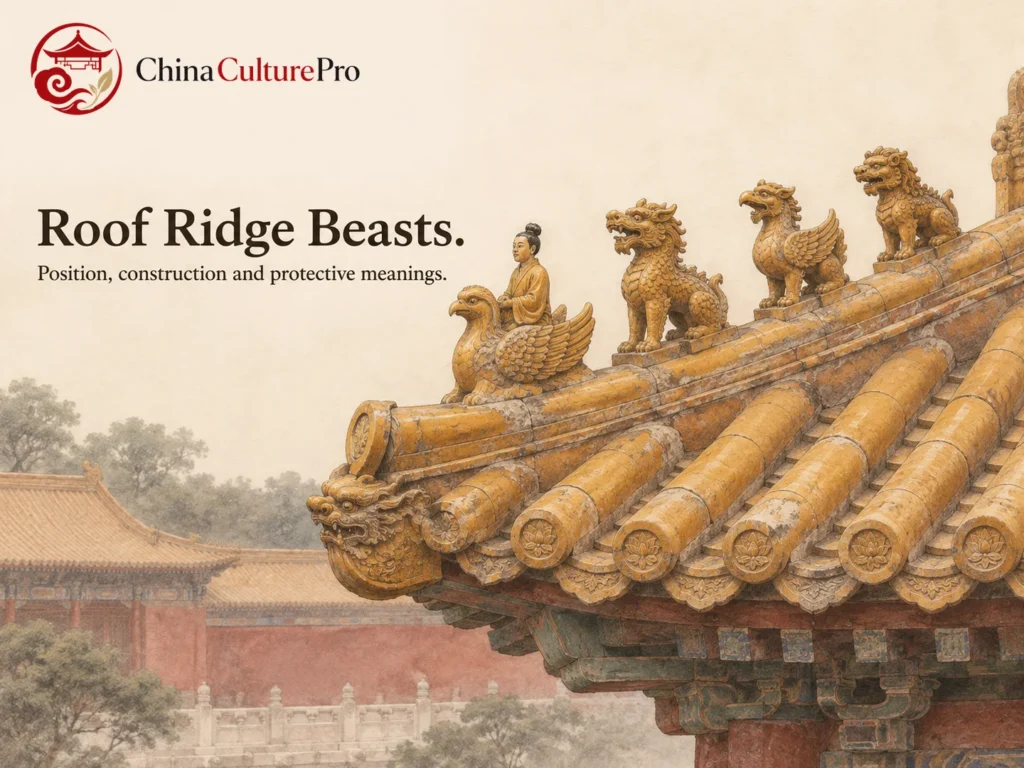
A line of small glazed creatures makes a palace roof corner look almost alive. Seen closely, however, the roof contains several kinds of ornament with different positions and jobs. Understanding those differences gives readers a firmer entry into Chinese architecture than memorizing a single list of mythical animals.
Locate the Creature before Naming It
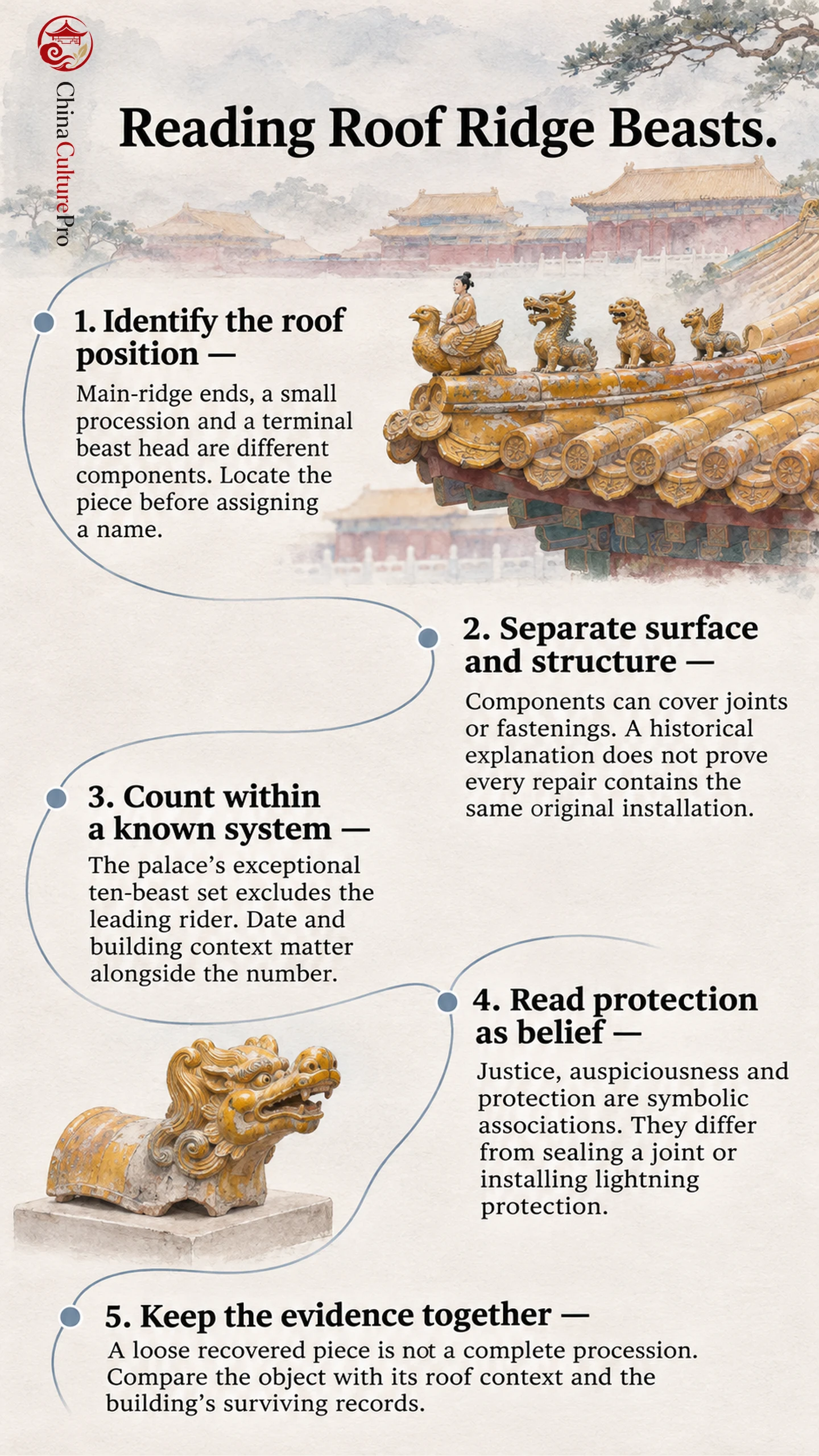
Prince Kung’s Palace Museum distinguishes the leading rider, the small processional animals, the following terminal beast and the large main-ridge ornaments. The small figures are often called zoushou(走兽,zǒushòu). A large chiwen(鸱吻,chīwěn)belongs to another part of the roof, while a chuishou(垂兽,chuíshòu)is a beast-head component behind the procession.[1]
For an initial comparison, position is more reliable than an assumed species. These typical distinctions apply to the northern architectural examples discussed here; terminology and roof arrangements require their own local context.
| Component | Typical position | Useful distinction |
|---|---|---|
| Small processional animals | Along a descending corner ridge | A row following the leading rider, rather than every creature on the roof.[1] |
| Large dragon-shaped ridge end | At the ends of the main ridge | A substantial architectural component sealing the ridge junction.[2] |
| Terminal beast head | Behind the smaller processional figures | A different component associated with securing the ridge, not another small member of the row.[1] |
Read the figures within the profile of the Chinese roof. A close-up that omits the ridge can make two quite different components look deceptively comparable.
Practical Functions beneath the Decoration
The Palace Museum’s architectural glossary explains a historical connection between the small ornaments and fastenings used where sloping roof elements meet. The decorative forms cover the visible fastening points. The same account notes that decorative figures continued after the fastening practice changed.[3]
The museum’s large glazed dragon-ridge component has another practical description: it closes the junction of roof slopes and helps prevent leakage. This is a local function at the roof surface, not a claim that the ornament alone supports the entire building.[2]
Keep the component, its material and its installation together. A museum explanation of an older construction method does not establish that every surviving figure, repair or modern reproduction contains the same original iron fastener.
Rank, Number and the Hall of Supreme Harmony
In the palace arrangements described by the Palace Museum, a larger procession is associated with higher standing. The Hall of Supreme Harmony has the exceptional set of ten small beasts; the leading figure riding a bird is additional to that count.[4]
Hangshi(行什,hángshí)is the tenth creature. Architectural researcher Huang Ximing examines the exception through rebuilding records and the dimensions of tile components. He proposes a connection with the Kangxi-period rebuilding and changes in tile sizes. This is a historical argument grounded in documents and construction analysis, not evidence that the arrangement remained unchanged from the building’s first foundation.[5]
The count is useful within an identified system. It is less useful when detached from date, roof type, building function or restoration history. Counting a cropped photograph cannot establish all of those conditions.
The Forbidden City’s architectural history is therefore part of the explanation, rather than optional background to a rank chart.
Auspicious Meanings and Protective Beliefs
The animal forms also carry symbolic associations. The Palace Museum’s educational account connects the single-horned xiezhi(獬豸,xièzhì)with justice and the ability to distinguish right from wrong. It presents other creatures through wishes for auspiciousness, rain and protection against disaster.[4]
Huang’s study discusses the winged, monkey-faced tenth figure in relation to thunder-deity imagery. The proposed connection helps explain protective symbolism; it should not turn the ceramic creature into a working lightning conductor.[5]
These meanings belong to cultural interpretation and belief. The wish to avert fire differs from the practical act of closing a roof joint. Both can matter to the same object without becoming the same kind of function. The rider’s legendary identity is a story about the image, not a documented account of its invention.
Beyond the Palace: Context and Surviving Evidence
Ridge beasts also occur in material evidence outside a palace hall. In a 2021 account of conservation archaeology at the Great Wall’s Yushi Tower, Beijing’s cultural heritage bureau reported recovered roof ornaments. An expert provisionally identified the larger piece as a terminal ridge beast, explaining its relationship to preventing tile movement.[6]
The finding establishes a specific architectural context. It does not reconstruct an entire missing procession or allow every original rank to be inferred from one loose component. The identification remains provisional.
When studying an example, bring together a full roof view, a close view of the component and any reliable building or excavation record. That combination supports better questions than counting alone: where did it sit, what survives, and what belongs to a later repair?
FAQs About Roof Ridge Beasts
Are all the creatures on a roof dragons?
No. Different components and processions include several mythical forms. Position helps identify what you are looking at.
Do ten beasts include the figure riding a bird?
In the Hall of Supreme Harmony example, the rider is separate from the ten small beasts.
Can you identify a building’s exact rank by counting?
A count needs an identified architectural system, date and context. It is not a universal decoder.
Did the beasts actually prevent lightning or fire?
Those are protective beliefs. Practical roof functions and modern fire or lightning protection are different matters.
Sources
[1] Prince Kung’s Palace Museum. The Small Beasts on the Palace Roof Ridges
[2] Palace Museum. Glazed Dragon Ridge-End Architectural Component
[3] Palace Museum. Architectural Glossary: Zoushou
[4] Palace Museum Youth. The Mysterious Beasts on the Roof Ridges
[5] Huang Ximing, Palace Museum Journal. Discussion of Hangshi at the Hall of Supreme Harmony
[6] Beijing Municipal Cultural Heritage Bureau. Roof Ridge Beasts Discovered during Yushi Tower Conservation Archaeology