

Quick Answer: How Do Chinese Number Gestures Work?
Number gestures (数字手势, shù zì shǒu shì) let a hand shape stand for a number. A familiar Chinese set represents one to ten using one hand, with special shapes above five. [3]
- One to five: Raised fingers show the smaller numbers.
- Six to ten: Symbolic shapes extend the set beyond five.
- Variation: The same shape may receive different readings.
- Confirmation: Use a written number and unit when the amount matters.
Learn the following set as a useful reference, rather than a universal rule.
A gesture can help when a room is noisy or a spoken number is unfamiliar. Its value comes from shared understanding. Before using a hand sign to confirm an order or amount, make sure the other person is reading the same number you intend.
Use the Signs as a Shared Convention
Showing a number and counting through a sequence are related tasks, but you should not assume that every person performs them identically. Research with Chinese university students included both one-hand and two-hand counters. A commonly taught convention is useful without describing everybody’s habits. [3]
Keep the hand shape and the spoken word together while learning. This guide supplies Mandarin readings; it does not imply that all Chinese-speaking communities pronounce the numbers alike. The broader guide to Chinese languages and dialects explains that distinction.
Read a Common One-to-Ten Gesture Set
The table follows a common teaching set. The named fingers describe the shape; a mirrored photograph should not change your finger identification. Numeral readings are Mandarin. [1][2]
| Number and Mandarin reading | Hand shape |
|---|---|
| 1: 一, yī | Raise the index finger. |
| 2: 二, èr | Raise the index and middle fingers. |
| 3: 三, sān | Raise the index, middle and ring fingers. |
| 4: 四, sì | Raise four fingers; keep the thumb folded. |
| 5: 五, wǔ | Open all five digits. |
| 6: 六, liù | Extend the thumb and little finger; fold the others. |
| 7: 七, qī | Bring the thumb and fingertips together into a point. |
| 8: 八, bā | Extend the thumb and index finger into an L shape. |
| 9: 九, jiǔ | Curve the index finger toward the thumb into a C shape. |
| 10: 十, shí | Close the fist; crossed fingers are another form. |
For ten, two index fingers can also cross at right angles. The one-hand crossed-index-and-middle-finger form is another taught alternative. A closed fist is especially dependent on context because it can also stand for zero. [1]
The written numerals and their broader uses belong to Chinese number reading; a gesture is an additional way to communicate the value.
Expect Differences Between Communities
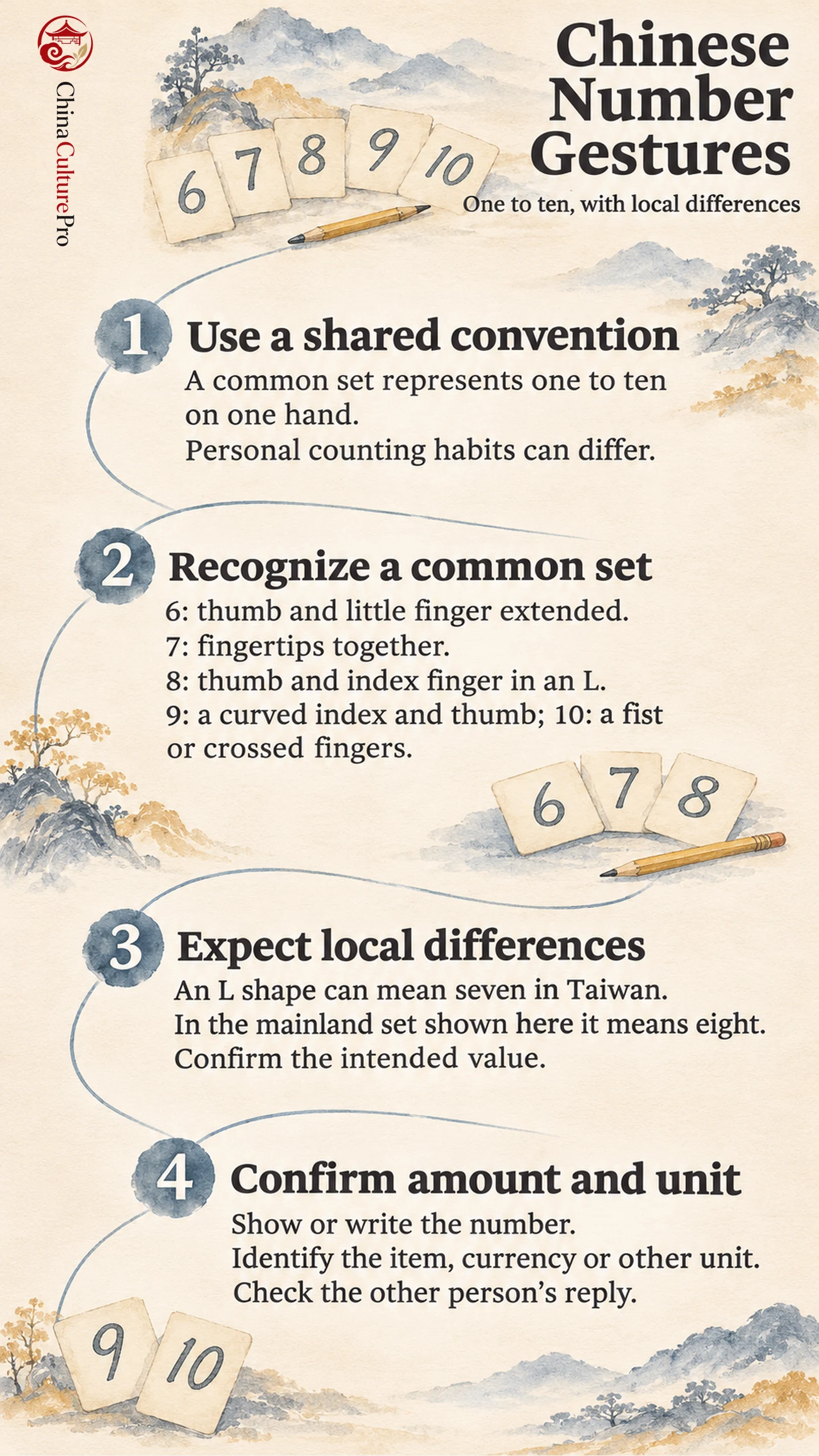
A documented Taiwan–mainland contrast concerns the L shape made by thumb and index finger: it can indicate seven in Taiwan while being understood as eight in the mainland set above. This is a concrete reason to verify a number rather than memorizing one supposedly universal chart. [4]
Confirm the intended value in the immediate conversation. Do not infer somebody’s origin from one gesture, and do not correct a local speaker simply because their form differs from your lesson. Individual habits and the surrounding task both matter.
Confirm the Number and Its Unit
A hand shape provides little information about scale by itself. In a price discussion, distinguish the numerical amount from its currency and whether it applies to one item or the entire order. The same care is useful when confirming a party size, quantity or time. [2]
- Show the amount: Use a clear gesture, or point to a written number.
- Say what it counts: Specify the item, people, price or other unit.
- Check the reply: Ask the other person to repeat or display the number before you act.
For example, if you intend eight items, display or write “8” and identify the item. A second person’s repeated number gives you something concrete to compare with your intention. If you are confirming a telephone number, use its written digits; the separate telephone-number pronunciation guide addresses spoken digit strings.
FAQs About Chinese Number Gestures
Does every Chinese speaker count the same way?
No. The research documents individual differences, including people who use two hands. A common one-hand system should not be treated as everybody’s personal counting habit. [3]
Can a closed fist mean zero instead of ten?
Yes. The teaching set includes both readings. Use speech, writing or a crossed-finger ten when you need to remove that ambiguity. [1]
Does one hand sign tell me the full price?
No. Confirm the written amount, currency and what the price covers. A gesture alone leaves those details unresolved. For written Chinese number forms, consult the numerals and financial numerals reference before copying them.
Sources
[1] The Open University, OpenLearn. Beginners’ Chinese: Basic numbers
[2] Li Chun Li, Confucius Institute for Business London, London School of Economics. Numbers-LCL
[3] Morrissey et al., Journal of Numerical Cognition. Cross-Cultural and Intra-Cultural Differences in Finger-Counting Habits and Number Magnitude Processing
[4] TVBS News. 數字手勢差很大!台陸日用法不同