
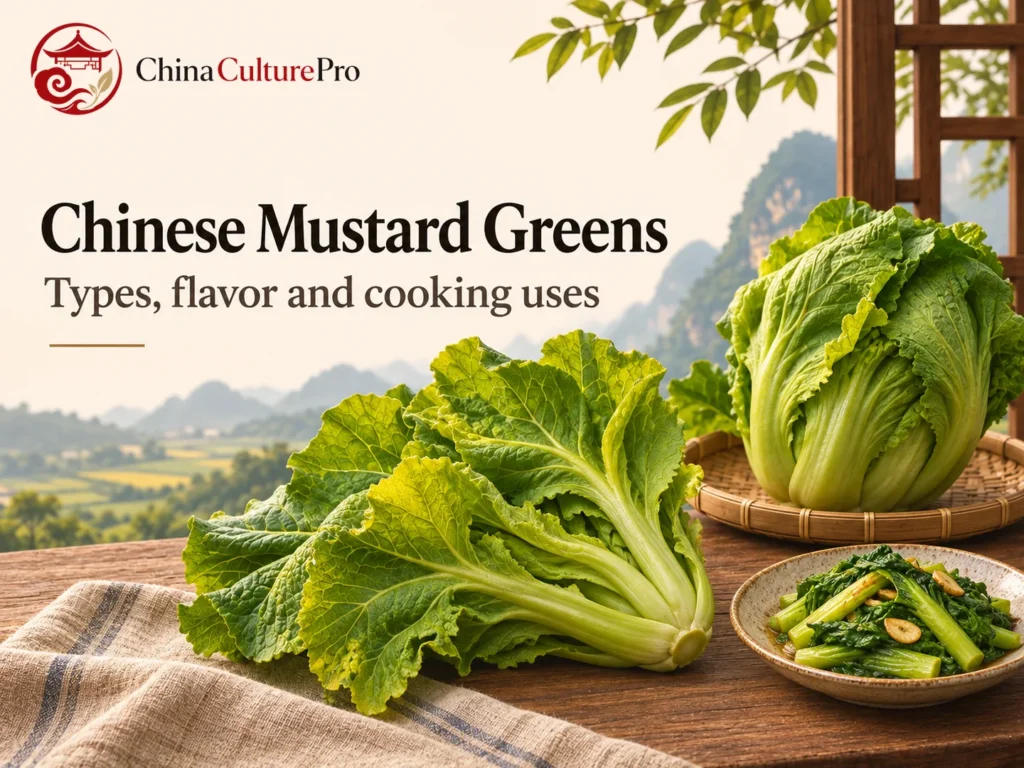

Quick Answer: What Are Chinese Mustard Greens?
Chinese mustard greens(芥菜,jiècài), often called gai choy on Cantonese menus and produce labels, include several cultivated mustard vegetables rather than one uniform bunch. Familiar leafy forms belong to Brassica juncea. [1][5]
- Leaf forms: Some have broad open leaves; others have thick bases gathered into a head.
- Flavor: Mustardy pungency and bitterness vary with the type and preparation.
- Fresh uses: Stir-fries, soups and stews are common.
- Preserved forms: Selected mustards also become salted, fermented or dried products. [2][5][7]
A fresh mustard vegetable and a packaged mustard pickle are different ingredients, even when they start from related plants.

A loose bunch of serrated leaves and a compact vegetable with broad, pale ribs can both be mustard greens. Their textures suggest different uses, from a quick vegetable dish to a preserved ingredient. Start with the plant part and the product’s condition before relying on its English name.
Four Mustard Forms You May Encounter
Leaf shape and the part grown for eating offer a clearer guide than a single supermarket label. This selection includes leafy vegetables and a related stem-grown form; it is not an exhaustive cultivar list. [1][2][3][4]
| Form | What distinguishes it |
|---|---|
| Broad-leaf mustard | Large leaves form an open rosette; the leafy portion is prominent. |
| Heading mustard | Thick leaf bases wrap together, producing a compact head rather than a loose bunch. |
| Xuelihong(雪里蕻/雪里红,xuělǐhóng) | A leafy mustard form with long green, serrated leaves; it can be bought as a fresh vegetable. |
| Swollen-stem mustard | Selected for an enlarged, sometimes knobbly stem, rather than simply for large leaf ribs. |
Broad-leaf and head-leaf mustards are recognized cultivated groups. Their different structures matter when comparing how much leaf, firm base and tender interior a purchase provides. [1][2]
The wider mustard crop also includes forms selected for roots, shoots or flower stalks. That diversity explains why not every mustard-derived product looks like a leafy green. An enlarged stem should not be confused with the thick base of a heading variety’s leaf. [4]
Seed catalogues also describe xuelihong as a fresh leafy crop. Check whether the name refers to fresh leaves or a preserved product. [3]
Peppery Leaves, Bitter Notes and Crisp Leaf Bases
Fresh mustard greens have a distinctive peppery edge, often accompanied by bitterness. That is different from chili heat. Aromatics and the overall seasoning can balance the flavor without turning mustard into a completely neutral green. [5]
Heading types have substantial, wrapped leaf bases as well as leaf blades. Both belong to the edible leafy vegetable. [2]
With a heading type, the wrapped leaf bases offer a firmer element alongside the leaf blades. Mature leaves can be cooked in stir-fries, soups or stews. Select the preparation for the structure in front of you rather than expecting every mustard to behave identically. [2]
How Fresh Mustard Greens Are Cooked
A fresh xuelihong stir-fry can feature garlic and dried chili, with seasoning adjusted to the greens’ bitter edge. One household version uses a little sugar for balance and sesame oil for aroma. Those are choices in that preparation, not requirements for all mustard dishes. [6]
Other leafy or heading forms suit soups and stews, where the leaves soften within the surrounding liquid. A vegetable grown for thick bases can provide both a tender leaf component and a firmer bite. [2]
Fresh cooking and preserving are parallel uses of the crop. Agricultural accounts describe mustard as a vegetable for stir-frying, boiling and soup as well as a raw material for processing. It does not have to become a pickle before it can be eaten as a cooked green. [7]
For a broader overview of heat and texture, see Chinese cooking methods. The important choice here is which treatment suits the leaves and bases, rather than following one universal mustard-green method.
Fresh Greens Are Not the Same as Preserved Mustard
Chinese preserved vegetables include several products made from mustard crops. Zha cai(榨菜,zhàcài)uses a swollen-stem type; the familiar preserved mustard stem is not merely chopped fresh mustard leaves. [4]
Mei gan cai(梅干菜,méigāncài)is a dried preserved vegetable. A regional agricultural account describes mustard-based production involving salting and drying, separately from its account of fermented sour mustard. Different processing gives the ingredients different moisture, seasoning and culinary roles. [7]
Salted mustard greens are another product to distinguish from a fresh bunch of xuelihong. Check the packaging and preparation directions. A preserved product’s concentrated saltiness or acidity cannot be inferred from the taste of fresh leaves. [5]
Likewise, mei gan cai belongs in the preserved-ingredient section of a recipe, not automatically in place of the same volume of fresh greens. Identify the product first.
Buying and Ordering the Form You Need
When shopping among Chinese vegetables, check whether you need loose leaves, a compact heading type or a packaged preserved ingredient. Use the actual structure and label together, because English translations and regional names can vary. [5]
For a fresh cooked dish, ask how the greens are prepared and whether the bases are included. For a preserved ingredient, confirm the specific product rather than requesting “mustard” alone.
Also ask about the seasoning. A published mustard-green stir-fry includes optional chicken bouillon alongside otherwise plant-based ingredients. The vegetable is a plant; the finished dish’s suitability depends on the complete preparation. [6]
FAQs About Chinese Mustard Greens
Are Mustard Leaves and Their Thick Bases Both Edible?
Yes, in commonly sold leafy and large-petiole forms, both can be eaten. Markets sometimes trim leaves heavily because the bases are especially useful, not because every mustard leaf must be discarded. [5]
Is Xuelihong Always Pickled?
No. It is also a fresh leafy mustard used in cooked dishes. Check whether a recipe or packet means the vegetable or a salted, preserved version. [3][6]
Can Another Leafy Green Replace Mustard Greens?
Sometimes, when the recipe needs a fresh cooked green. Expect a different flavor and texture. Fresh leaves cannot automatically replace the moisture and seasoning of a salted or dried mustard product. [5][7]
Sources
[1] National Parks Board, Singapore. Brassica juncea Broad-leaf Mustard Group
[2] National Parks Board, Singapore. Brassica juncea Head-leaf Mustard Group
[3] Tainong Seeds. Mustard and gai choy: original seed catalogue
[4] Taiwan Ministry of Agriculture. Mustard: crop introduction and useful plant parts
[5] The Woks of Life. Chinese Mustard Greens: original household ingredient guide
[6] Judy Leung. Stir-fried Chinese Mustard Greens: original xuelihong preparation
[7] Chen Mingzheng and Mao Xianzong, Tainan District Agricultural Research and Extension Station. Mustard production and processing in Dapi Township (1992)