


Quick Answer: How Is a Confucian Temple Laid Out?
A Confucius temple (孔庙, Kǒngmiào) usually organizes its principal ritual buildings along an axis. Gates and courtyards lead toward Dacheng Hall (大成殿, Dàchéng Diàn), the central hall for honoring Confucius. Side buildings can honor disciples, scholars or members of his family.[1][2][3]
- Approach: A Lingxing Gate (棂星门, Língxīng Mén) can mark an early threshold in the sequence.[1][3]
- Ritual center: The main hall and its front court or terrace give the ceremony a focus.[1][2]
- Variation: Qufu and Beijing share an axial approach. Their auxiliary spaces have different positions and purposes.[2][3][4][5]
Read the layout by following the principal gates and then checking what lies to the sides and behind the hall.[1][3][4]
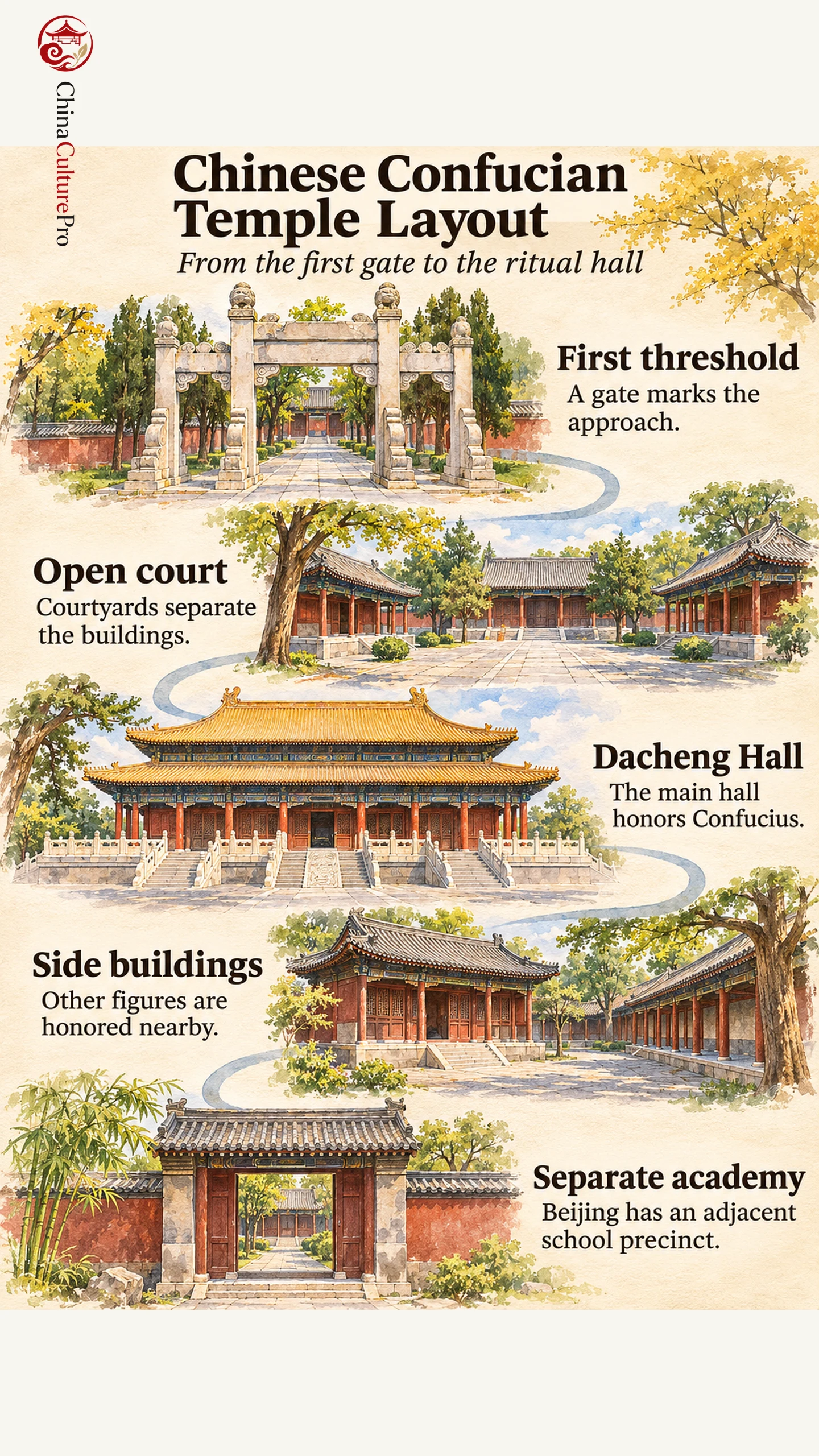
One gate opens onto another courtyard. The main hall is still ahead, and smaller buildings can appear along the edges before you reach it. This sequence gives each place a role in the larger ritual setting.[1][3][4]
The Courtyards and the Main Ritual Hall
On a temple plan, find Dacheng Hall and the court immediately in front of it. A front terrace can form part of the ceremonial space. The flanking galleries or halls may be devoted to disciples and scholars who were honored alongside Confucius. Their position makes them part of the same courtyard while distinguishing their role from that of the main hall.[1]
The approach can include a pan pond (泮池, pànchí). The China Confucius Temple Conservation Association describes the pond as associated with local official schools and records examples on different sides of the Lingxing Gate. Where it is present, the pond and its crossing can mark a distinct part of the approach. Its exact position should come from the plan of the site you are reading.[1]
Building names can offer additional clues. The words for a hall, gate or pavilion identify different spaces in the compound. Chinese hall names explains how those terms are used.[1][3]
Reading the Route Through Qufu’s Confucius Temple
In Qufu, the main sequence includes the Lingxing Gate, Kuiwen Pavilion and the court of imperial stele pavilions before the Dacheng Gate. Beyond that gate, the Apricot Altar (杏坛, Xìngtán) stands on the approach to Dacheng Hall. The sequence places the imperial inscriptions before the gateway to the main ritual court.[2][3]
There are also side routes. The eastern buildings include the Chongsheng Shrine (崇圣祠, Chóngshèng Cí) and spaces associated with ancestral rites. The western group includes buildings honoring Confucius’s parents. Following the principal line gives you the order of the major halls. Looking to either side tells you how the compound accommodates other forms of commemoration.[2][3]
UNESCO dates Qufu’s temple foundation to 478 BCE and records 104 buildings on a temple site of 14 hectares. The surviving buildings range from the Jin through Qing periods. The large site makes room for numerous thresholds and halls that smaller local temples may compress into fewer courts. Its World Heritage property includes the Temple, the Cemetery and the Kong Family Mansion. These have different purposes and locations. The regional history of Qilu provides context for the temple’s place in Shandong.[2]
Beijing’s Confucius Temple and the Imperial Academy
Beijing’s Confucius Temple also places the Dacheng Gate and Dacheng Hall on a south-to-north axis. In the documented Beijing sequence, a gate and the Chongsheng Shrine stand beyond the main hall. Qufu’s eastern ancestral route shows why one site’s arrangement should be checked against another’s actual plan.[3][4]
At Beijing, the Guozijian Imperial Academy lies beside the temple in its own compound. The heritage plan shows the two precincts next to each other. The temple’s principal hall served rites honoring Confucius, while the academy was a state educational institution. Their adjacent locations put the ritual and educational institutions side by side.[4][5]
FAQs About Confucian Temple Layout
What is Dacheng Hall used for?
Dacheng Hall is the main hall for honoring Confucius. Its position on the axis and its relationship with the front court identify the main ritual focus.[1][2]
Does every Confucius temple have an Apricot Altar?
Qufu’s Apricot Altar is a named feature on the approach to Dacheng Hall. Other sites have their own sequence of gates and courts, as the Beijing plan shows.[2][3][5]
Are the Confucius Temple and the Imperial Academy the same place?
In Beijing the temple and the academy are adjacent compounds. The temple was a place for rites and the academy was a place for state education.[4][5]
Sources
[1] China Confucius Temple Conservation Association. Architectural forms and functions of Confucian temples
[2] UNESCO World Heritage Centre. Temple and Cemetery of Confucius and the Kong Family Mansion in Qufu
[3] ChinaCulture.org. Qufu temple layout and the Kong Family Mansion
[4] Chang Shuo, Beijing Municipal Cultural Heritage Bureau. Confucian rites and the layout of Beijing’s Confucius Temple
[5] Beijing Municipal Cultural Heritage Bureau. Plan of the Beijing Confucius Temple and Imperial Academy