


Quick Answer: What Is a Chinese Bamboo Dragonfly?
A bamboo dragonfly (竹蜻蜓, zhú qīngtíng) is a traditional spinning toy with a small rotor on top of a light shaft. In a hand-spun version, the player rolls the shaft between the palms and releases it. When the angled blades turn fast enough, the rotor lifts the toy into the air. [1][4][5][6]
- Shape: A horizontal blade sits across an upright shaft.
- Motion: Angled blades move air down as they spin.
- Variants: Some documented toys use a pull cord instead of a hand-spun shaft. [1][3][4][5]
The simplest version has a small number of parts. Its flight still depends on how the blade is shaped and how it turns. [1][4][6]
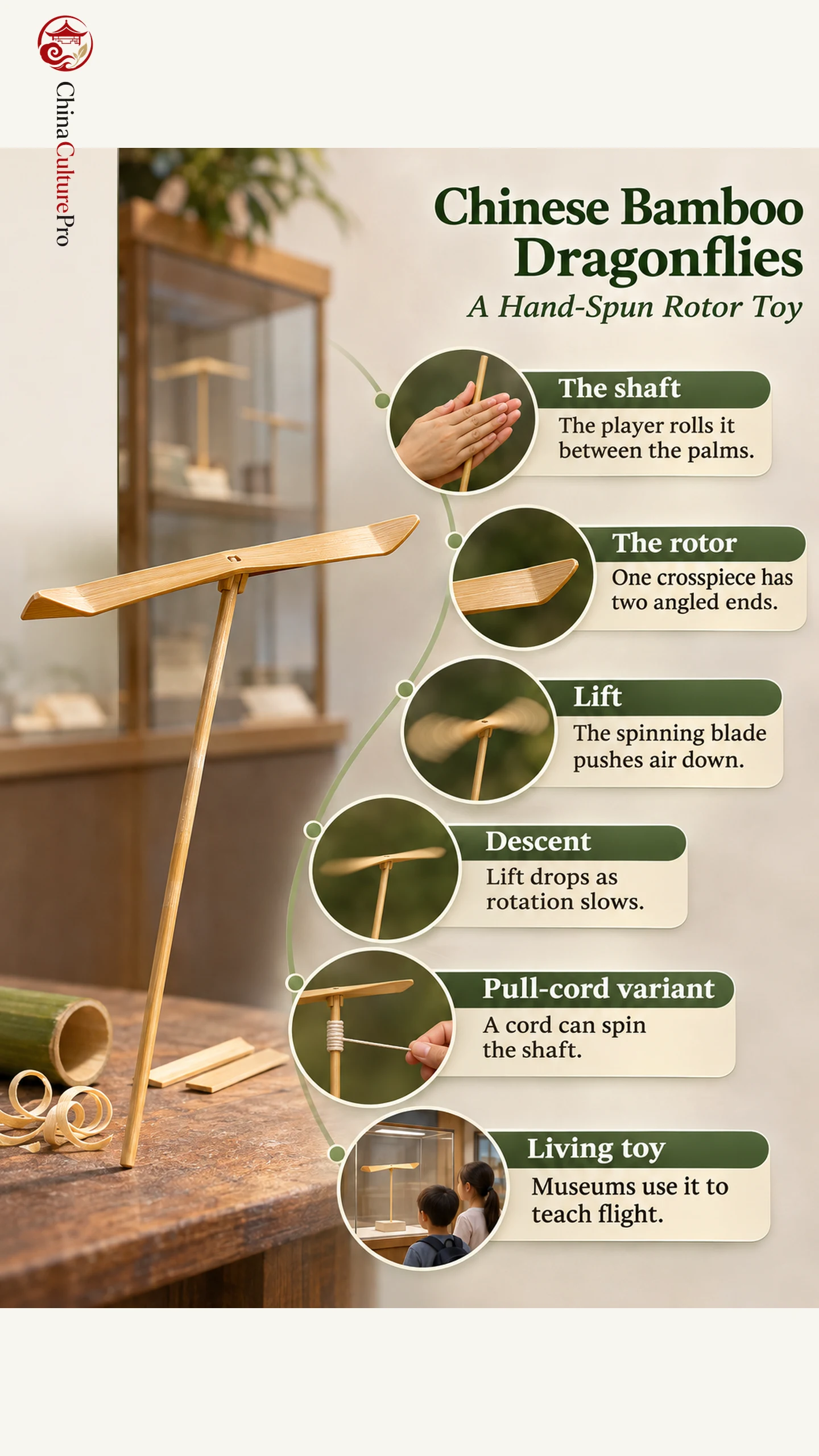
At rest, the toy looks like a light cross. In flight, the horizontal piece turns into a blur, and its angle to the air starts to matter more than its outline.
What the Maker Shapes in Bamboo
The long, thin shaft is the part held for a hand launch. The rotor spans both sides of its top. The two ends of the rotor are shaped so that, when they sweep around the shaft, both move air downward. The light shaft gives the blades less weight to lift. These choices distinguish it from other Chinese traditional toys that spin on a surface. [1][4][5][6]
A cultural collection records bamboo dragonflies made by Lin Qisheng in Zhushan, Nantou. Its examples include plain or smoked bamboo, with and without applied color, and smaller versions. Plain and smoked examples show different finishes. The maker could also reduce the scale while keeping the same recognizable blade-and-shaft arrangement. [2]
Why a Hand-Spun Rotor Rises
The blade ends are angled relative to the path they trace in the air. As the rotor spins in the direction suited to those angles, it pushes air downward. The air exerts an upward force on the toy. The toy rises when that lift exceeds its weight. A blade may still turn if the shaft is spun in the opposite direction, but its tilt then acts differently on the air. [4][5]
The hand launch supplies a brief spin. As the rotor loses speed, its lift drops and the toy comes back down. Henan Science and Technology Museum demonstrates the same relationship in an exhibit that guides a spinning rotor along a rod. The guided exhibit makes the rise and fall easier to observe. [6]
What Museum Examples Tell Us About Its History
The Museum of the Institute of Ethnology records a bamboo dragonfly collected in 1958 from an Amis community in Hualien. A cord wound around the shaft inside a bamboo tube spins the rotor when pulled. On this example the enclosing tube serves as part of the launcher. A palm-spun toy puts the part to be turned directly between the player’s hands. [1][3]
Accounts of the toy sometimes point to the flying carriage described in Ge Hong’s Baopuzi (抱朴子, Bàopǔzǐ). The passage is evidence of an old account of imagined flight. It names a flying carriage and describes imagined mechanisms. A dated museum toy provides a different kind of evidence about the actual form. The Smithsonian’s model labeled “Chinese Top” is a documented twentieth-century representation of a pull toy associated with Cayley. The catalog dates the model to about 1960 and identifies its maker as Paul E. Garber, who was representing an earlier design. [7][8]
From Folk Play to Science Lessons
The toy survives through both object-making and teaching. The Zhushan record documents a maker producing several forms in bamboo. A cultural record from Dongshi documents a local Hakka name written 竹揚尾, linking the toy’s name to the local word for dragonfly. [2][4]
A school outreach program by Henan Science and Technology Museum used bamboo dragonflies to demonstrate rotor flight. Students could watch the rotor spin and see the toy rise, a small-scale example of the relationship between the blade’s motion and lift. The classroom use shows how a small object made with techniques common to other Chinese traditional crafts can also demonstrate a physical principle. [4][5][9]
FAQs About Chinese Bamboo Dragonflies
Why is it called a bamboo dragonfly?
The name refers to a light bamboo toy that takes flight on a spinning crosspiece. Bamboo-copter and Chinese top are other names associated with the form. [1][8]
Does it need a string to fly?
The palm-spun version turns when the shaft is rolled between the hands. Some other designs, including a museum example from Hualien, use a pull cord. [1][3]
Did the bamboo dragonfly directly lead to the helicopter?
The toy and helicopter both use a rotating blade to create lift. The museum and educational records support that comparison, while the exact historical route from early toys to powered aircraft is harder to establish. [5][7][8]
Sources
[1] University of Hong Kong student digital collection. Bamboo-copter
[2] Taiwan Cultural Memory Bank. Bamboo Dragonfly Made by Lin Qisheng
[3] Museum of the Institute of Ethnology, Academia Sinica. Bamboo Dragonfly, Object 4508
[4] Taiwan Cultural Memory Bank. Bamboo Dragonfly in Dongshi
[5] NASA Jet Propulsion Laboratory Education. Make a Paper Mars Helicopter
[6] Henan Science and Technology Museum. Bamboo Dragonfly Demonstration
[7] People’s Forum. Ancient Dreams and Explorations of Flight
[8] Smithsonian National Air and Space Museum. Cayley Chinese Top Model
[9] Henan Science and Technology Museum. School Outreach on the Bamboo Dragonfly